
Off grid batteries
Off grid batteries: the battery system behind an off grid solar home.
An off grid battery stores the day's solar so the house runs through the night and the grey days. We install lithium batteries on a 48 volt system, sized on the usable energy a winter day needs, normally for one or two nights without sun, with a generator behind them for the darkest weeks.
Sizing
What size off grid battery do I need?
Start from what the house uses on a winter day, not the yearly average. Multiply that by the number of days the battery should carry the house on its own, and the answer is the usable storage you need. The design standard for stand alone power systems, AS/NZS 4509.2, gives about two days where a generator starts itself and four or five days where there is no generator at all.
A family using 12 kWh on a winter day needs about 24 kWh of usable battery with a generator behind it. Without a generator the same house needs at least twice that. The table shows the battery our own sizing model gives for three kinds of property.
| Property | Winter daily use | Off grid battery | Solar panels |
|---|---|---|---|
| Weekender or small cabin | 6 kWh | 15 kWh | 4.5 kW |
| Family home, all electric | 16 kWh | 40 kWh | 11 kW |
| Farm with sheds and pumps | 32 kWh | 80 kWh | 22 kW |
From our sizing model for Central Victoria: two nights of battery, lithium at 90 percent depth of discharge and a generator for the darkest weeks. One night instead of two roughly halves the battery.
Size the battery for your own loads.
The off grid solar calculator gives the battery, the solar array, the inverter and the generator together.
Lithium or lead acid
Lithium off grid batteries against lead acid.
Every off grid battery system we install now is lithium. Lithium makers usually quote usable energy at 80 to 100 percent of the rated figure, where a lead acid bank is normally held to 50 to 80 percent, so a lead acid bank has to be far bigger to do the same job. Lithium also copes with the part charged days of a grey week, which is what wears a lead acid bank out.
Lead acid banks from older off grid systems typically fail between five and eight years. When one is on its last legs, the inverter and the solar can often stay and the battery is the part that changes.
- Size and compare on usable kWh, not the rated figure on the label
- A battery cycled gently lasts far longer than one emptied every day
- Lithium needs no topping up and no ventilated battery room
What we install
The off grid lithium batteries we install.
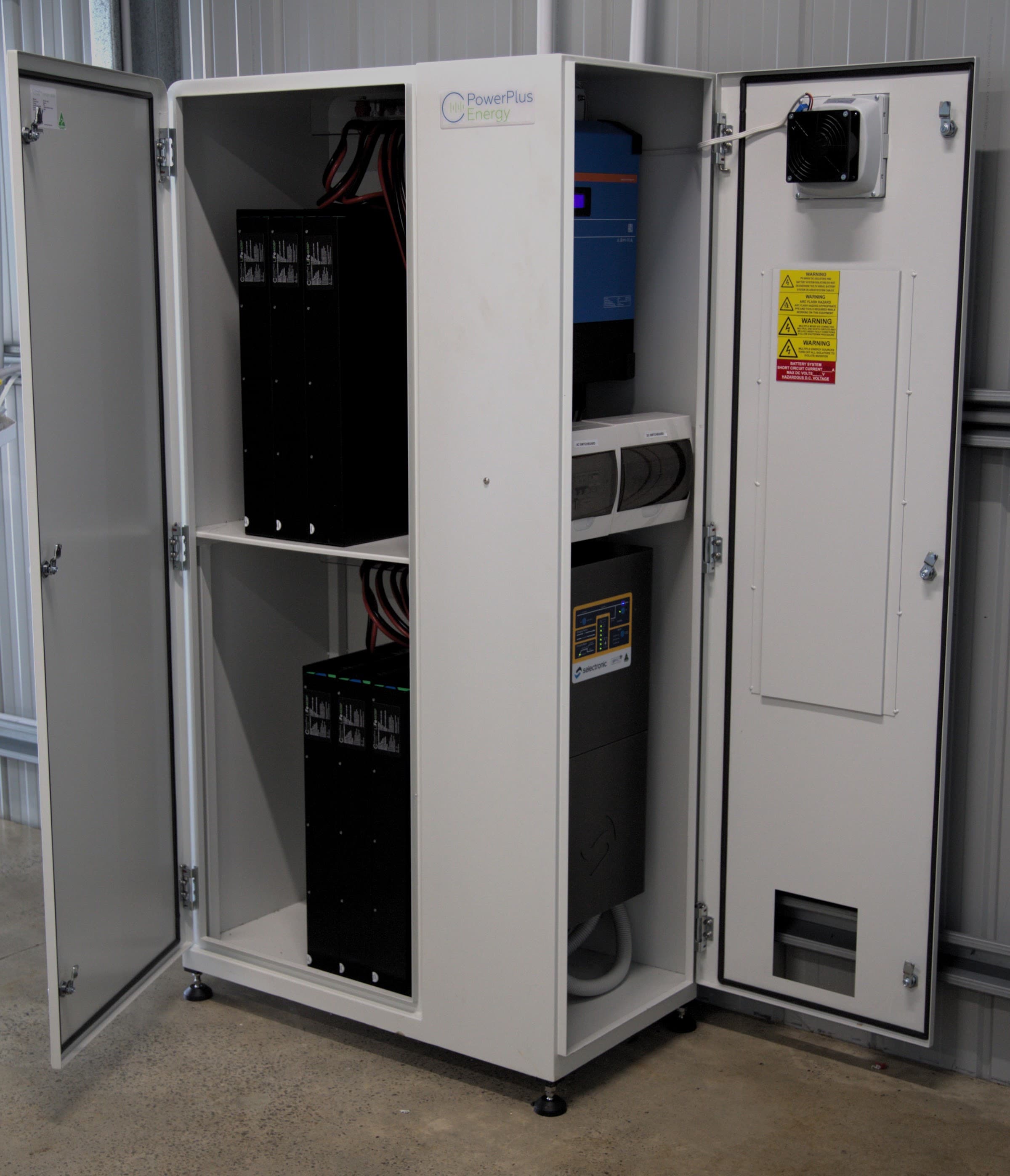
Most of our off grid battery systems are built from PowerPlus Energy rack modules, made by a Victorian battery maker in Scoresby. Each module manages itself, modules can be added or isolated one at a time, and the support desk is in Melbourne. The LiFe4838P is a 3.8 kWh module made in Australia with a 10 year warranty, and the Eco4847P is a 4.7 kWh module with 85 percent Australian content.
The battery sits in a steel cabinet beside a Victron inverter charger, on a 48 volt system. PowerPlus asks that every module reaches a full charge at least once every seven days, so we set the generator to give the bank that weekly full charge through winter.
- Modular: the bank is built from 3.8 or 4.7 kWh modules to the size the house needs
- Serviceable one module at a time, with the rest of the bank still running
- Watched from Trentham through the system's online monitoring
Winter
Where an off grid battery lives through a Victorian winter.
Cold takes some capacity out of any battery, and a lithium battery will not accept charge near freezing. In the Central Highlands that makes the battery's home part of the design: inside a shed or a plant room, in an enclosure, out of the frost and out of the summer sun.
Questions
Asked about this, often.
- How long do off grid batteries last?
- Lithium batteries are rated for thousands of cycles. Sized to one or two nights of autonomy they cycle gently, which is what makes them last, and the warranty terms are set out by each maker. Lead acid banks from older systems typically fail between five and eight years.
- How many batteries do I need to go off grid?
- Enough usable storage for one or two winter nights. A house using 12 kWh on a winter day needs about 24 kWh usable with a generator behind it, which is five to seven modules of the sizes we normally install.
- Can I add more batteries to an off grid system later?
- Usually, yes, with modules of the same model. Older and newer battery models must not be mixed in one bank, so we check what is there before adding to it.
- Can I replace a lead acid bank with lithium?
- Often. The inverter charger and the solar charge controllers need to be set for lithium, and some older ones cannot be. We check the existing equipment on site before recommending what stays and what goes.
Sources
- How much battery does an off grid house need?
- Lithium vs lead acid off grid batteries
- PowerPlus Energy batteries and what the warranty asks
- Do lithium batteries work in a Central Victorian winter?
- GSES, oversized PV array and battery days of autonomy
Written by the Trentham Energy team. Figures without a source are our own sizing model or our own installs.
Tell us about the property.
Where it is, what is on it, and what you need to run. We will tell you honestly whether standalone power stacks up and what it would take.