
Upgrades and repairs
Replacing an old off grid system: what fails first and what to upgrade.
Most off grid systems from the 2000s and 2010s fail in the same order: the lead acid bank first, then the charge controller, then the inverter. The panels and the cabling usually outlive all of them. An upgrade to lithium and Victron keeps what still works and replaces what does not, in stages if that suits the budget.
What fails first
The order things wear out.
Lead acid batteries are the first to go. Flooded and gel banks last between five and eight years in off grid service, less when they are run flat through winter, and they fail gradually: the house gets through fewer nights, the generator runs more, and one bad cell drags the rest down. Charge controllers and inverters from the same era follow, often because they cannot talk to a modern battery or because the fan or the capacitors have had their decade. Panels, racking and cabling, done properly the first time, are usually fine for another twenty years.
- A battery bank that no longer carries a winter night is the usual trigger
- A generator running most mornings in winter is the bank telling you it is finished
- A charge controller without a lithium profile cannot look after a new battery
- An inverter that trips on the kettle or the pump has lost its surge headroom
- Older systems with no monitoring hide all of this until the lights go out
The checklist
What we look at on a site visit.
Before anything is replaced we measure what is there and what the house actually uses. Many of the systems we are asked to repair were undersized on the day they were installed, and a new battery will not fix a system that was never big enough.
- The real daily load, from a logger or the monitoring, not the original design sheet
- Panel output against nameplate, string by string, and the age and type of the racking
- Battery bank voltage under load, cell balance and the charge settings it has been living with
- Inverter make, model, continuous and surge rating against the loads in the house
- Generator condition, run hours, the start battery and the changeover wiring
- Earthing, protection and the switchboard against the current standards
Moving to lithium
The battery first, almost always.
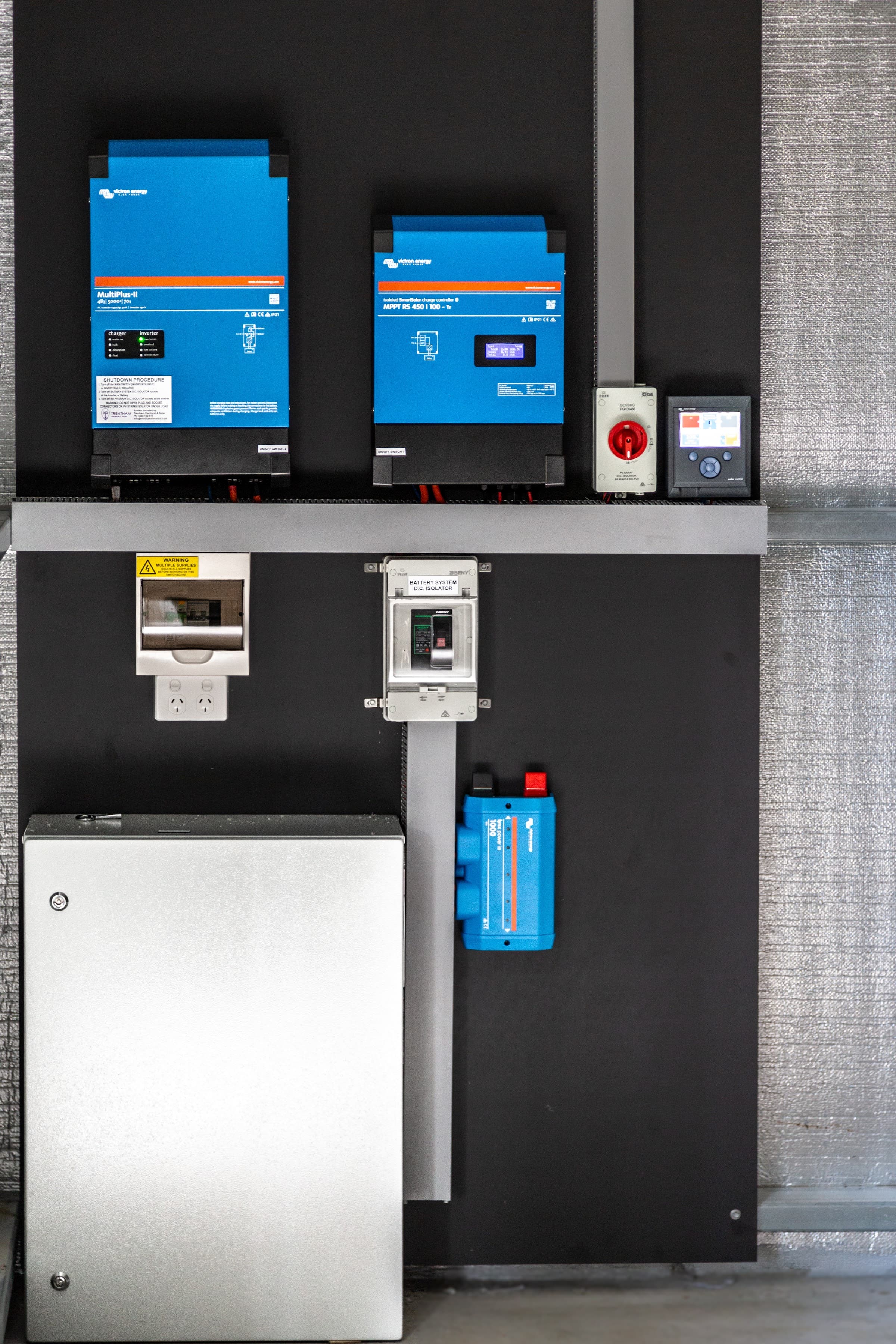
Lithium changes the economics of an upgrade. A lithium bank is rated for thousands of cycles, gives 90 percent of its capacity as usable storage, needs no watering or equalising, and does not mind sitting partly charged through a grey week. It does need a charger and an inverter that follow its charge profile and talk to its management system, which is why the battery upgrade usually brings a Victron inverter charger and charge controller with it.
The existing panels stay if they test well. The existing enclosure often stays. The cabling stays if it was sized right. What goes is the bank, the gear that cannot manage the new bank, and anything the inspection turns up.
In stages
Spread it out without doing it twice.
A Victron system is built to grow, so an upgrade can be staged: the inverter charger and the first lithium bank now, more battery modules next year, more panels on a new charge controller the year after. The board, the cabling and the enclosure are sized for the finished system on day one, so each stage is an addition rather than a rebuild. We write the stages into the design so you know what comes next before you start.
Got an old system?
Tell us what is there, how old it is and what it struggles with. We will tell you what to keep, what to replace, and in what order.
Repairs
Fault finding on the system you have.
Not every call is an upgrade. Batteries charging slowly from solar, a generator that will not auto start, an inverter in alarm, a string that has stopped producing: these are repairs, and most are found with the monitoring and a meter in an hour on site. We work on Victron systems and on most other off grid brands as they come. Where a part is no longer made we will say so, and say what the modern replacement is.
Questions
Asked about this, often.
- Can I put lithium on my existing inverter?
- Sometimes. The inverter charger must be able to follow a lithium charge profile and, ideally, talk to the battery's management system. Many older units cannot, and charging a lithium bank with a lead acid profile shortens its life and can void its warranty. We check the exact model before advising.
- Are my old panels worth keeping?
- Usually yes, if they test near nameplate and the racking is sound. Older panels are smaller per panel than today's, so a roof full of them makes less power than the same roof re-panelled, but working panels are not a cost. We test string by string and keep what earns its place.
- How long does an upgrade take?
- A battery and inverter upgrade on an existing system is typically a couple of days on site once the equipment is on hand, with the house off power for part of one day. Adding panels or a ground mount array adds to that. The ordering before the install takes longer than the install.
Sources
Written by the Trentham Energy team. Figures without a source are our own sizing model or our own installs.
Tell us about the property.
Where it is, what is on it, and what you need to run. We will tell you honestly whether standalone power stacks up and what it would take.