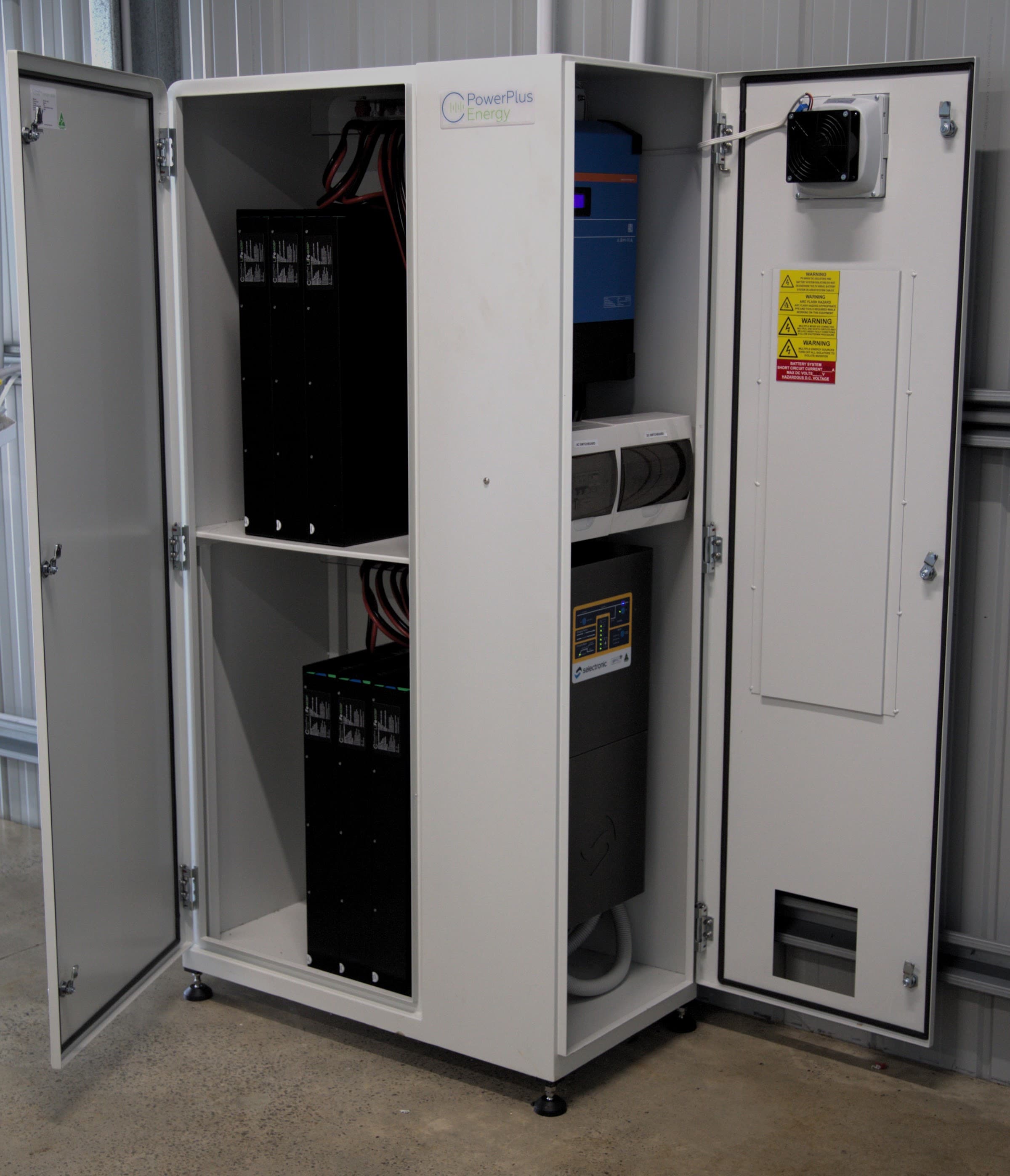
PowerPlus builds LFP batteries in Scoresby. What its warranty asks of an off grid owner, how the models differ and what changed in 2026.
PowerPlus Energy is a Victorian battery maker based in Scoresby, and its modules suit off grid systems because each one manages itself, can be added or switched off one at a time, and is supported from Melbourne. The catch is in the warranty: every module must reach a full charge at least once every seven days, the warranty is measured in energy throughput as well as years, and on two of the three current models the second five years are paid on a sliding scale. None of that is a reason to avoid them. It is a reason to design the system around them. Our PowerPlus brand page lists the models and how they pair with Victron; this article is about living with them.
The three current modules, briefly
PowerPlus sells three batteries for homes and farms in October 2026, all lithium iron phosphate in a 2RU rack format.
- LiFe4838P, 3.8 kWh, made in Australia, 10 year warranty to 80% state of health
- Eco4847P, 4.7 kWh, 85% Australian content, 5 years plus a 5 year pro rata extension when registered, to 70% state of health
- LiFe4851, 5.12 kWh, engineered in Melbourne and made in China, also 5 plus 5
The "Australian made" line on a quote should name the model. It is accurate for the LiFe4838P, close for the Eco4847P and not true for the LiFe4851, and the cells in all three are imported.
The seven day rule, and why it matters in June
Both the LiFe4838P warranty statement and the Eco4847P statement, revised on 18 March 2026, exclude batteries that are not calibrated to 100% at least every seven days. On a grid connected home that happens without anyone noticing. Off grid in a Central Victorian winter it does not happen by itself.
A week of fog over Trentham or Blackwood in June can leave an array making a fraction of its summer output, and a bank that is being used and topped up a little each day may never reach full. The two ways to meet the rule are the same two ways to keep any off grid system healthy:
- size the array for winter, not for the annual average, so a clear day is enough to finish the charge
- program the generator to run a weekly absorption charge if the bank has not reached full in seven days
On a Victron system with an auto start generator, the second can be set once at commissioning, so the rule is met even in the worst week. Our off grid generators guide explains how the auto start logic works.
The warranty counts energy, not only years
Each warranty statement has a table of estimated cycle life and minimum throughput at different depths of discharge. For the LiFe4838P it reads:
- 7,000 to 10,000 cycles at 50% depth, 13.399 MWh of throughput
- 4,000 to 5,000 cycles at 75% depth, 11.4 MWh
- 3,560 to 4,000 cycles at 80% depth, 10.822 MWh
- 2,000 to 2,700 cycles at 100% depth, with no throughput figure given
The Eco4847P table follows the same pattern, 13.385 MWh at 80% depth. Read it two ways. First, a bank cycled shallow lasts far longer than one cycled deep, so a larger bank used gently is the better design. Second, a bank sized too small for the house will use up its warranted throughput before the years run out. Our sizing tool and our sizing guide help you size the bank with that in mind.
What 5 plus 5 pro rata pays
The Eco4847P statement sets out what PowerPlus pays as a share of the replacement cost if a module fails:
- years 1 to 5: 100%
- year 6: 80%
- year 7: 60%
- year 8: 40%
- year 9: 20%
- year 10: 10%
Years 6 to 10 only apply if the battery is registered, at installation or before the fifth anniversary. Without registration the warranty ends at five years.
Two other lines in the statements are worth knowing. PowerPlus may ask for photos of the installation and a history of maintenance before it pays a claim, and a fault must be reported within 30 days of the owner becoming aware of it. On an off grid system monitored through Victron's VRM portal, the maintenance history and the fault date are in the record already, which is one practical reason to keep the system online.
What changed for PowerPlus in 2026
- More factory. In April 2026 PowerPlus won a $2.3 million grant from the Australian Renewable Energy Agency's Battery Breakthrough Initiative towards a $6.7 million upgrade of its Melbourne plant. The plan is to semi automate the pack assembly line and triple module output from 50 MWh to 150 MWh a year over two years. For an off grid owner that means a better chance of a matching module being available when a bank needs to grow.
- A revised warranty statement. The Eco4847P statement was reissued as version 1.1 on 18 March 2026. It now spells out that a refund for a module no longer made is reduced in proportion to the warranty used, and that replacement goods carry only the balance of the original warranty.
- A grid product beside the off grid ones. The Whispr-7, launched in April 2025 with Queensland power electronics maker Redx, pairs a 7 kW single phase hybrid inverter with 13.4 kWh of LFP storage using CATL cells, switches to backup in under 20 milliseconds, and is on the Clean Energy Council approved list. It is a grid connected all in one, a different kind of product from the rack modules off grid systems use.
Where PowerPlus fits, and where it does not
For an off grid home, a farm shed system or a weekender with a Victron inverter charger, PowerPlus rack modules are a strong choice: modular, serviceable one module at a time, no fans to pull dust through them, and a warranty office in Melbourne rather than overseas. Read our Victron article for why the inverter side matters as much.
For a grid connected home that wants a battery and blackout backup, an all in one system such as Sigenergy SigenStor is usually simpler, with one app and one warranty for the inverter and the battery. And because PowerPlus is not on Victron's own tested battery list, we set the charge and cut off voltages from PowerPlus's guide and fit a battery monitor, rather than relying on a closed loop link, except on the LiFe4851, which can talk to the Victron controller over CAN.
If you are planning an off grid system, run your loads through the sizing tool, or send us your address and what needs to run and we will come back with a design that meets the warranty in July as well as January.
Questions
Are PowerPlus batteries made in Australia?
The LiFe4838P is made in Australia at PowerPlus's Scoresby factory. The Eco4847P has 85% Australian content. The LiFe4851 is designed and tested in Melbourne and made in China. The lithium cells in all of them are imported.
What does "calibrated to 100% every 7 days" mean?
The battery must reach a full charge at least once a week, which lets its management system reset its charge reading and balance the cells. The warranty statements exclude batteries that do not. Off grid, a generator set to run a weekly full charge is the reliable way to meet it in winter.
How long is the PowerPlus warranty?
The LiFe4838P has a 10 year warranty to 80% capacity. The Eco4847P and LiFe4851 have five years at full replacement value, then a five year pro rata extension falling from 80% to 10% of the replacement cost, which only applies once the battery is registered.
Can PowerPlus batteries get the federal battery rebate?
The Eco4847P and the Whispr-7 are on the Clean Energy Council's approved list, which is the condition for the Cheaper Home Batteries Program on a grid connected system. An off grid system with no grid connection is a different case, so check with us before you count on it.
Sources
- PowerPlus Energy home page and product list (read October 2026)
- PowerPlus Energy, LiFe4838P warranty statement, V1.2, 23 October 2023 (PDF)
- PowerPlus Energy, Eco4847P warranty statement, V1.1, 18 March 2026 (PDF)
- PowerPlus to triple battery production capability with ARENA grant (pv magazine Australia, 22 April 2026)
- PowerPlus presents hybrid inverter and battery solution (pv magazine Australia, 30 April 2025)
- PPK Group's PowerPlus Energy launches new products aligned with government battery rebate program (TipRanks, 21 July 2025)
Written by the Trentham Energy team.