
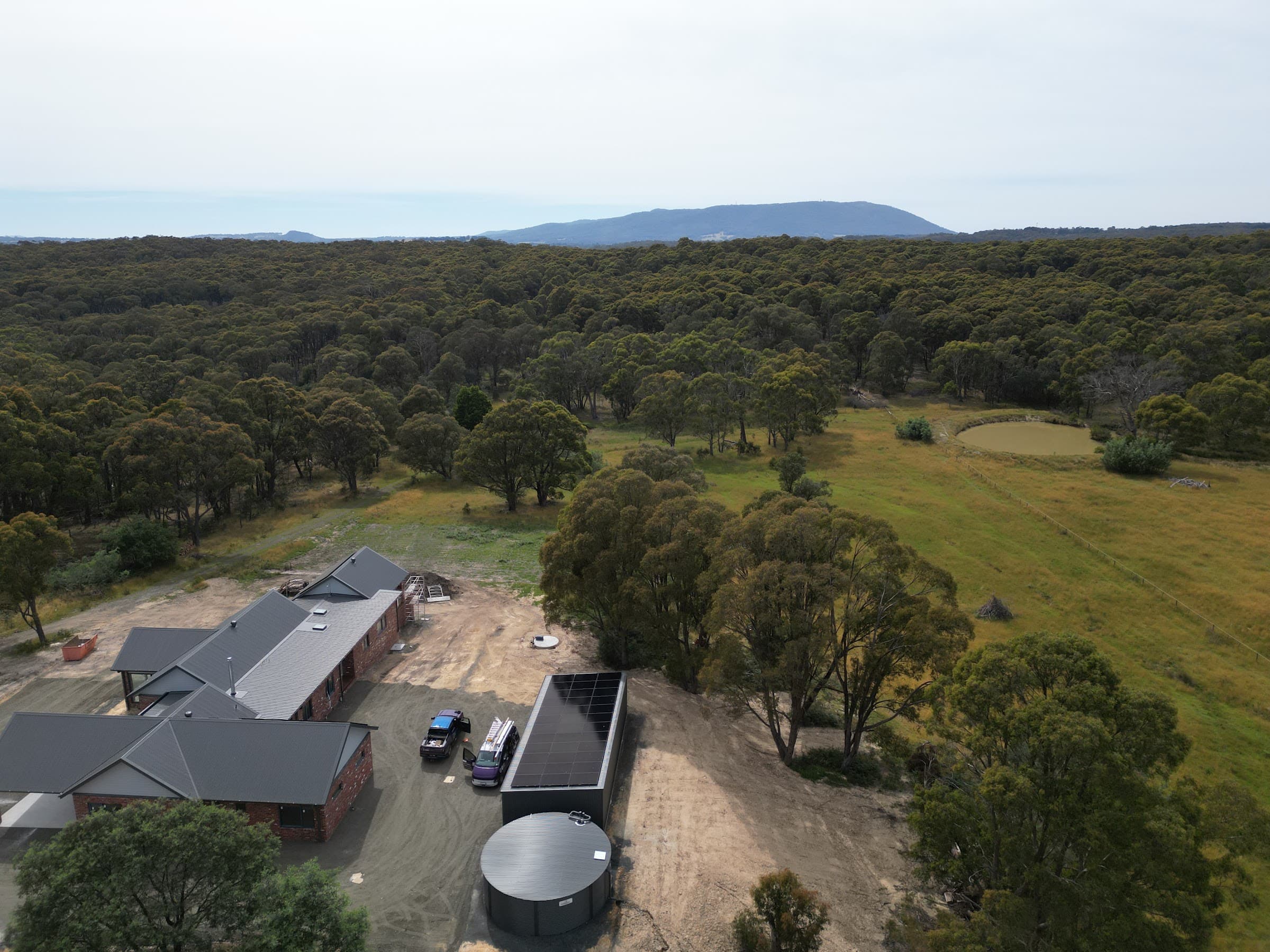
The connection quote
Off grid or connect to the grid: what a Powercor or AusNet quote really means.
If the quote to run power to your block is in the tens of thousands, a standalone system is usually the better buy. You own it, there is no supply charge for the life of the system, and it is sized for the loads you actually have. Here is how to read the quote, what it leaves out, and where the grid still wins.
Reading the quote
What the distributor is charging you for.
A new rural connection in Victoria is priced by the distributor, Powercor across the west and centre of the state, AusNet in the east and north east. The quote covers extending their network to your boundary: poles, conductor, a transformer where the high voltage line has to step down, and the design and traffic work around it. Anything inside your boundary, a private pole, trenching, a pillar and the switchboard, is yours to arrange on top.
Powercor publishes indicative figures for its own network assets: a 22 kV overhead line extension in rural areas at about $200,000 per kilometre, and underground at about $900,000 per kilometre. Those are network figures for larger connections rather than a single house, but they show why a block a kilometre from the nearest line gets a quote that stops the conversation.
- Line extension: how far the nearest suitable line is from your boundary, and whether it is single wire (SWER) or three phase
- A transformer if your block needs its own step down
- Poles, easements and any road or vegetation work
- Your side of the boundary: private pole or underground run, pit, pillar and switchboard
- Then forever: the daily supply charge and the usage, whatever you generate
The comparison
Put the two numbers side by side, honestly.
A connection quote buys you a wire. A standalone system buys you the generation, the storage and the backup, and you still have to run the property either way. So the fair comparison is the connection quote plus your private works plus years of supply charges and bills, against the off grid system plus the fuel the generator burns and a battery replacement a long way down the track.
On most blocks more than a few hundred metres from the line, the standalone system wins on the up front number alone. On blocks with a line at the boundary, the grid usually wins, and a hybrid system with a battery gives you the backup without going off grid.
| Grid connection | Standalone system | |
|---|---|---|
| Up front | The distributor's quote plus your private works | The system, installed, one fixed price |
| Every year after | Supply charge every day plus usage | Generator fuel for the darkest weeks, a service on hours |
| Outages | You lose power when the network does | The network's outages are not yours |
| Bushfire days | Powerlines may be switched off on extreme days | Unaffected, no powerline to your home |
| Big continuous loads | Easy | Design for them, or keep a connection |
| Ownership | The distributor's asset to your boundary | Yours, with a warranty and monitoring |
Where the grid wins
When we tell you to connect.
We design both, so we will say it plainly when the grid is the right call. A line at the boundary and a modest quote. A dairy, a cool room or a workshop that runs big motors all day, every day. A heavily shaded block with nowhere for an array. In those cases a grid connection with a hybrid battery system gives you the outage protection without the generator and the winter maths.
Got a connection quote?
Send it to us with your address. We will size the standalone alternative on your real loads and tell you which one we would choose for our own block.
Questions
Asked about this, often.
- Is there a distributor program that pays for an off grid system?
- Sometimes. Powercor and AusNet can offer a standalone power system they own and run to a small number of existing customers at the end of long rural lines, at no extra cost compared with staying connected. It is their call, not yours, and it is for existing connections. Our standalone power systems page explains who qualifies.
- Can I connect later if I go off grid now?
- Yes. Going off grid does not remove the option of a connection later; the distributor will quote it the same way they would today. In practice almost nobody does, because by then the system has paid for the wire several times over and the outages have stopped mattering.
- What about a SWER line I already have?
- Single wire earth return lines serve many rural properties and are the lines most often switched off on extreme fire days. Plenty of our customers keep the SWER connection for now and add a battery and generator for the days it drops, or replace it entirely with a standalone system when the next bill for the private pole arrives.
Sources
- Powercor, indicative costs of typical connection assets (22 kV rural extension $0.2M per km overhead, $0.9M per km underground)
- Powercor, stand-alone power systems
- AusNet, stand alone power systems
Written by the Trentham Energy team. Figures without a source are our own sizing model or our own installs.
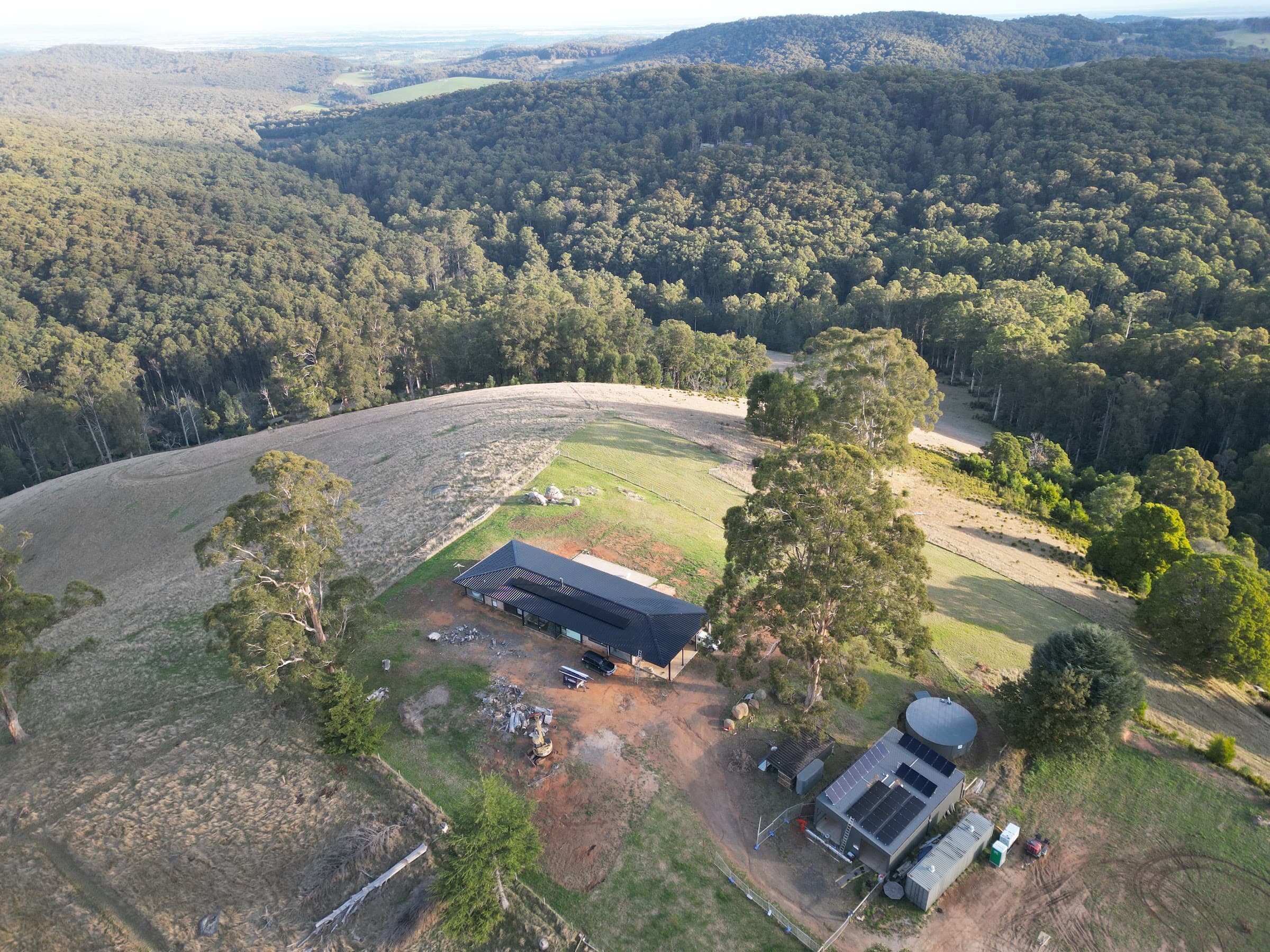
Tell us about the property.
Where it is, what is on it, and what you need to run. We will tell you honestly whether standalone power stacks up and what it would take.