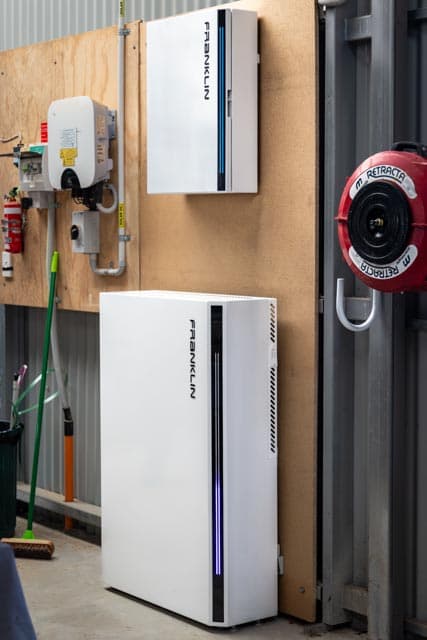
How a FranklinWH aPower battery and aGate controller carry a rural home through outages, work with a standby generator and shed heavy loads to last longer.
A FranklinWH system pairs the aPower battery with the aGate controller, and on a rural property with an unreliable supply it does three useful jobs: it takes the house off the grid automatically when the power fails and runs it from the battery, it brings a standby generator into the picture for long outages, and it switches off heavy loads such as an EV charger or a pool pump so the battery lasts longer. It is AC coupled, so it can sit beside a solar inverter that is already on the roof.
The two parts
- aPower is the battery. The Australian model, the aPower X-02-AU, holds 15 kWh of usable energy in lithium iron phosphate cells, delivers 5 kW continuously and 10 kW for 10 seconds, and is rated at 89 percent round trip efficiency at the beginning of its life. It is a big, all metal unit, 185 kg, rated for indoor or outdoor mounting.
- aGate is the controller. It sits between the grid, the solar, the battery and the house, decides where power goes, and manages the switch to backup. One aGate can manage up to 225 kWh of aPower, and FranklinWH quotes up to 20 kW continuous with four or more aPowers. It supports single, two and three phase configurations.
The warranty is 12 years, or 60 MWh of throughput, according to FranklinWH's Australian datasheet dated 30 April 2026. FranklinWH announced in December 2023 that its system had been listed in the Clean Energy Council's Battery Assurance Program, which means the listed products were independently tested against the program's safety and quality requirements.
Why it suits a weak rural supply
The long single wire earth return lines that feed many farms and bush blocks in Central Victoria are the first to drop out in a storm and the first switched off on extreme fire days. Our article on going off grid on a SWER line covers that history, and the companion piece on SWER line limits covers the capacity ceiling.
On those properties the battery's backup job matters as much as its daily cycling. FranklinWH describes the change from grid to backup as automated and immediate, and its system is described as black start capable, meaning it can bring the house back up from the battery after everything has gone dark.
Two details matter in practice:
- Whole home or partial backup. The aGate can back up the whole home or only selected critical loads. Whole home backup is simpler to live with; partial backup stretches a smaller battery further. The choice is made at design.
- What the battery can carry. At 5 kW continuous per aPower, a single unit runs a house's everyday loads but not an electric oven, a heat pump and a kettle at once. A second aPower doubles both the storage and the power.
Bringing in a generator
For outages longer than a battery can cover, the aGate takes an optional generator module. FranklinWH says the system supports integration with 230 volt, 50 hertz standby generators and calls itself generator agnostic, so it is not tied to one brand. The battery carries the house through the short outages, which are most of them, and the generator is there for the long one.
The battery and generator then work together rather than the generator having to carry every load on its own. The size of generator, its fuel, where it goes and how it starts are worked out for the site, and our generators page covers the general questions.
Load shedding with Smart Circuits
The aGate's optional Smart Circuits module gives two circuits per aGate that can be scheduled or switched on and off from the FranklinWH app. FranklinWH's own system drawing shows the kind of loads they are for: an EV charger, a pool pump, an air conditioner.
During an outage that is the useful part. Shedding a heavy load is the cheapest way to stretch a battery: an EV charger left running can empty a battery that would otherwise carry the house through the night. On a farm the same logic applies to a big pump or a shed circuit that can wait until the grid is back.
Where it fits, and where it does not
FranklinWH is a strong answer for a grid connected rural home that wants serious backup, especially where solar is already installed and the owner wants to keep that inverter. Being AC coupled, the aPower charges from any solar inverter's output, and the aGate supports two solar branch circuits.
For a property going fully off grid we normally design on Victron, for the reasons in why we build off grid on Victron. That said, FranklinWH equipment has been used off grid in a custom configuration, and our earlier article on that off grid FranklinWH project explains how. For a grid connected home focused on tariffs, time of use and export, Sigenergy is often the better fit; see our Sigenergy page.
The honest trade offs: each aPower is heavy and needs a solid mounting position, the round trip efficiency is 89 percent at the beginning of life, so a little energy is lost in every cycle, and continuous power is set by how many aPowers are fitted.
If your property loses power more often than it should, send us a recent bill and your address and we will come back with a right sized design, or get in touch here.
Questions
How big is a FranklinWH battery?
The Australian aPower X-02-AU holds 15 kWh of usable energy and delivers 5 kW continuously, 10 kW for 10 seconds. Up to 225 kWh of aPower can sit behind one aGate.
Does FranklinWH work with a generator?
Yes. The aGate takes an optional generator module and FranklinWH says it supports 230 volt, 50 hertz standby generators. The battery covers short outages and the generator the long ones.
Can FranklinWH run on a two phase property?
FranklinWH's Australian datasheet says the system supports single, two and three phase configurations. The design for a two phase property depends on what is wired to each phase and what needs backing up.
What are FranklinWH Smart Circuits?
An optional aGate module with two circuits per aGate that can be scheduled or switched from the app. They are used to shed heavy loads such as an EV charger or pool pump, which stretches the battery during an outage.
Sources
- FranklinWH, Australian system datasheet, document version V1.3, 30 April 2026
- FranklinWH Australia, Franklin Home Power product page
- FranklinWH, how the FranklinWH system works
- AAP, FranklinWH listed in the Clean Energy Council's Battery Assurance Program (4 December 2023)
Written by the Trentham Energy team.