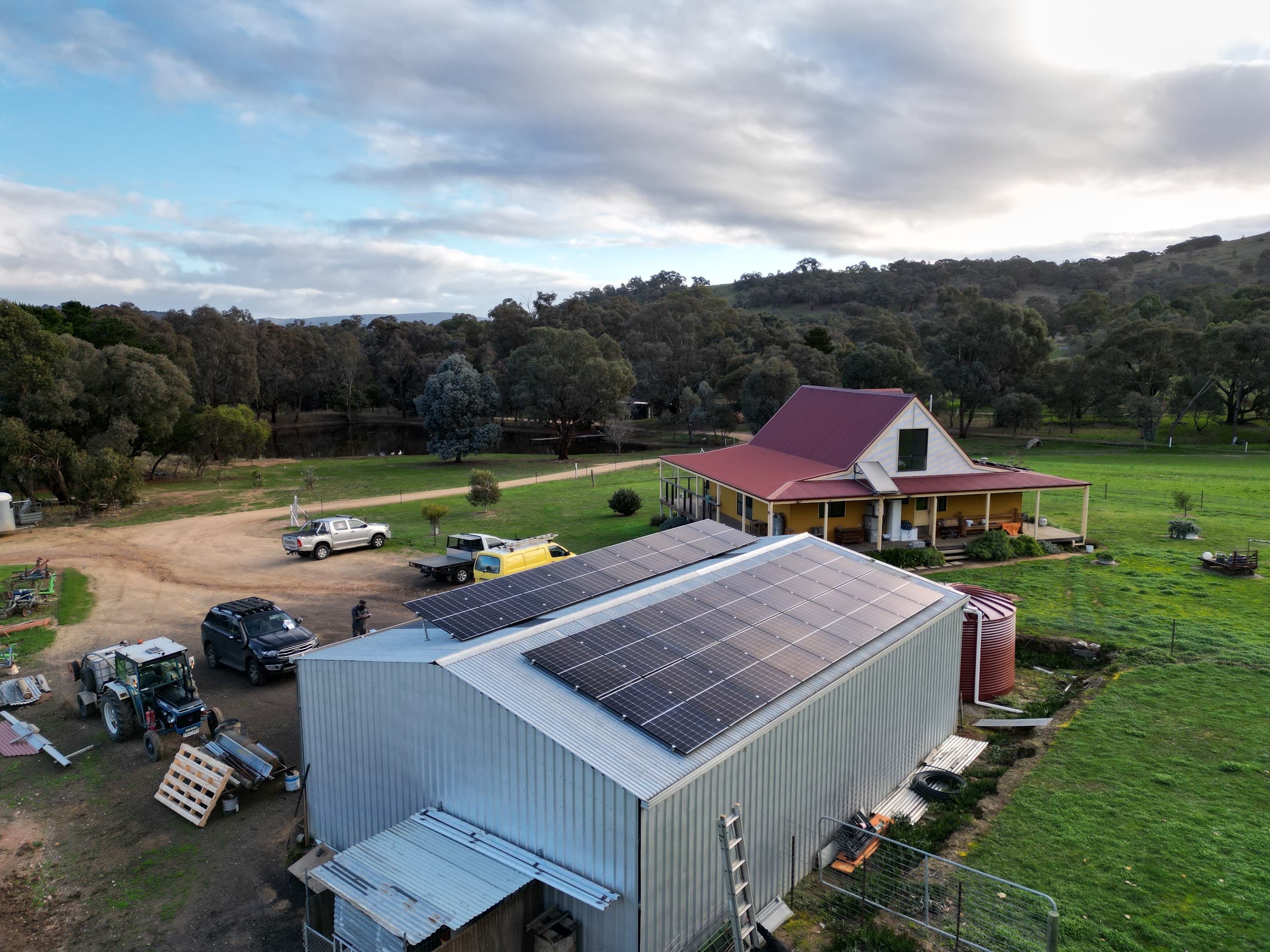
A SWER property draws through a small pole transformer, often 10 or 25 kVA. What that ceiling means, what hits it, and how a battery hybrid lifts it.
A property on a single wire earth return line draws everything through one small transformer on the pole, commonly rated at 5, 10 or 25 kVA. That rating is the ceiling: a 10 kVA transformer gives you about 43 amps at 230 volts, and everything running at once has to fit under it. A battery hybrid system lifts that ceiling without a new line, by covering the peaks from storage so the pole only ever sees the average.
Where the ceiling comes from
A SWER line carries 12.7 kV (from a 22 kV network) or 19.1 kV (from a 33 kV network) on one conductor, with the earth as the return. At each property a small distribution transformer steps it down to 230 volts. The common sizes are 5, 10 and 25 kVA, and a single line can run tens or hundreds of kilometres and feed as many as 80 of them.
The arithmetic is simple. Divide the transformer's rating by 230 volts and you have the current it is built to carry:
- 5 kVA is about 22 amps
- 10 kVA is about 43 amps
- 25 kVA is about 109 amps
Those numbers are why a SWER line was a fine connection for a 1960s farmhouse and is a tight one for an all electric home with a workshop. The typical design assumption for a SWER customer was a maximum demand under 3.5 kVA. Plenty of households today pass that before breakfast.
You can usually read the rating off the plate on the pole transformer, or ask the distributor. Powercor serves most of Central Victoria; AusNet serves the east and north east.
What hits it
It is rarely one appliance. It is the stack of them that lands at the same moment:
- a 32 amp EV charger, which draws about 7.4 kW on its own (32 amps times 230 volts)
- an electric oven and cooktop at dinner time
- a heat pump or reverse cycle system on a frosty morning
- a bore or pressure pump starting, with a starting current several times its running current
- a welder or compressor in the shed
Add those together on a 10 kVA transformer and you are past the rating. A short excursion is tolerated; a long one, every evening, is the kind of load that ends with the protection operating and a wait for a crew. The other symptom people notice first is the lights dimming when the pump kicks in, because a long single wire has a lot of impedance and the voltage sags with every big load.
The same wire limits your solar
The ceiling works in both directions. Voltage drops when you draw hard and rises when you export hard, and a long SWER line is sensitive to both. That is why networks cap exports on SWER more tightly than on a normal line. AusNet's own connection page sets the standard export limit at 5 kW and 3.5 kW for SWER customers. Powercor sets each site's limit through its connection application, so the figure depends on the line.
So a SWER property gets squeezed twice: it cannot draw much in the evening, and it cannot sell much at midday. A battery fixes both at once, because it soaks up the midday surplus that cannot leave and spends it in the evening when the pole cannot keep up.
How a battery hybrid lifts the ceiling
A hybrid system puts an inverter and a battery between the pole and the house. The inverter watches the current coming in and tops it up from the battery whenever the house asks for more than the supply should give. Victron calls the setting an AC input current limit: in its own words, the configured limit is used as the threshold for current at the inverter's AC input, and its peak shaving setting lets the system keep supporting the supply from the battery during peaks. The loads go on the inverter's output so it can see and manage all of them.
In practice that means:
- the pole sees a steady, modest draw, set under its rating
- the battery covers the evening peak, the pump start and the EV charge
- the battery recharges from the panels during the day, and from the grid overnight at a gentle rate if the sun was short
- the export limit stops mattering much, because the surplus goes into the battery instead of up the wire
The inverter's own size sets the new ceiling. A 10 kVA transformer behind an 8 kW inverter backed by a battery gives the house a peak capability of both added together for as long as the battery lasts, which on a well sized system is all evening.
There is a bonus. A SWER line is the first to drop out in a storm and the first switched off on bad fire days. A hybrid that manages the peaks also carries the house through the outage, which is the case we make in going off grid on a SWER line.
The alternatives, and what they cost
There are three other ways around a SWER ceiling, and each has its place.
- A bigger transformer. The distributor can swap the pole transformer for a larger one, if the line itself has the capacity. That is a connection application and a cost to you, and on a long, loaded line the answer may be no.
- A line upgrade. Converting SWER to three phase is a network project. Powercor's 2026 to 2031 proposal, published 25 February 2025, includes upgrading 606 km of SWER to 22 kV three phase across 44 areas, for 1,310 customers in the Wimmera, Goulburn Valley, the South West and the Macedon Ranges. If you are not on that list, it is not coming soon.
- Go standalone. Where the line limits you, is due for replacement, or is not worth its supply charge, a standalone system replaces it. Our grid connection comparison and standalone power systems page lay out when that is the better call.
For most SWER households who want to keep the line, the battery hybrid is the quickest and most certain fix, because it needs nothing from the network beyond the connection you already have.
Sizing it for your place
The battery for a SWER property is sized on the evening, not on the day: how much the house uses from late afternoon until the sun is back, and how big the biggest stack of loads is. The inverter is sized on that stack, with headroom for motor starts. We look at the transformer rating, a recent bill or interval data, and the list of what runs at once.
Send us a recent bill, your address and a photo of the pole transformer plate if you can get one, and we will come back with a right sized design. Get in touch here.
Questions
How do I know if I am on a SWER line?
Look at the pole nearest your house: a SWER line has a single wire on top, and the transformer has one high voltage connection rather than two or three. If you are unsure, Powercor or AusNet can tell you from your address.
Can I just ask for a bigger transformer?
You can ask. It goes through the distributor's connection process, it comes at a cost, and on a long or heavily loaded line the line itself may be the limit. A battery behind the meter avoids the question entirely.
Will a battery let me export more solar on SWER?
No, the export limit stays where the distributor set it. What changes is that you stop needing to export, because the surplus charges the battery and runs the house in the evening.
Does this mean I have to go off grid?
No. A hybrid keeps the grid connection and simply manages it. Off grid is a separate decision, worth making only when the line itself is the problem.
Sources
- Powercor, rural power upgrade to deliver benefits for the bush (25 February 2025)
- AusNet, solar connections up to 30 kW
- Victron Energy, ESS design and installation manual, configuration
- Single wire earth return, overview of SWER transformer ratings and voltages (Wikipedia)
Written by the Trentham Energy team.