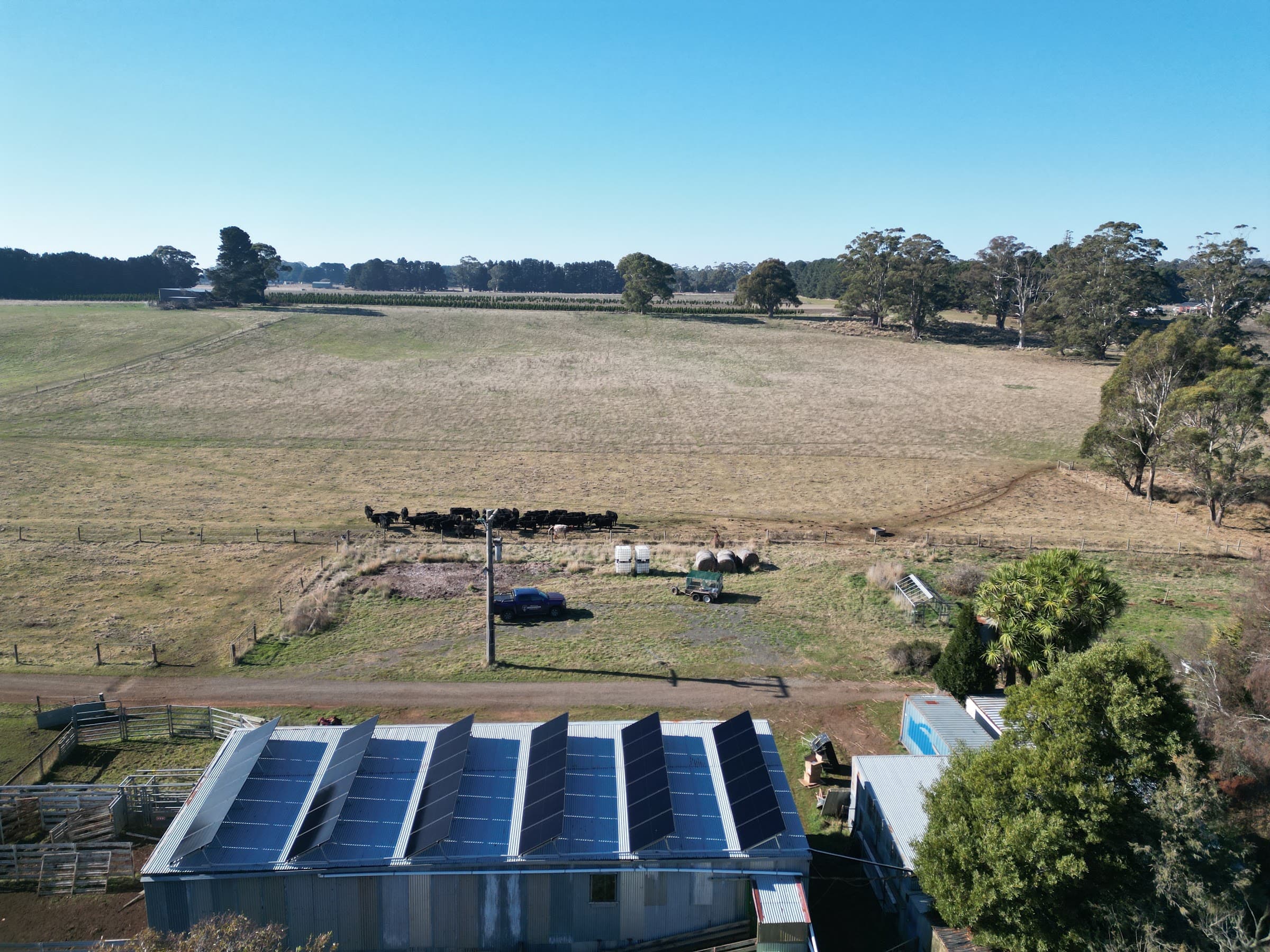
From about $600 where the network is at your boundary to $59,728 for 250 m of rural line and a transformer. What drives it, and when to price off grid.
The cost to connect power to a rural property in Victoria runs from a few hundred dollars to well over $100,000. If the poles and capacity are already at your boundary, Powercor says a typical new connection costs $600 to $4,100. If the network has to come to you, Powercor's own guide prices the first 250 metres of rural high voltage line with a transformer at $59,728 single phase and $69,254 three phase, including GST at April 2024 prices. Distance, trees, three phase and going underground push it higher, which is why a big connection quote is the moment to price an off grid system beside it.
Who do you deal with to connect power in Victoria?
You deal with your electricity distributor, the company that owns the poles and wires, not your retailer. The Australian Energy Regulator lists five in Victoria, each with its own region: CitiPower, Jemena, Powercor, AusNet Services and United Energy, plus a small number of customers served by Essential Energy.
For rural blocks it is almost always Powercor or AusNet. AusNet says its distribution network covers more than 80,000 square kilometres of eastern Victoria. Powercor covers most of central and western Victoria, including our part of the world around Trentham. Your bill names your distributor, and if there is no bill yet, a pole near your block carries the network's tag. In both networks a registered electrical contractor (REC) lodges the application and does the wiring on your side of the point of supply.
How much does it cost to connect power to a house when the network is close?
If supply is already available at the boundary, the connection itself is modest. Powercor's new supply page, read in November 2026, says typical new connection costs range from $600 to $4,100, depending on phasing and metering, with pit costs on top where a pit is needed.
Powercor's indicative cost guide, at April 2024 prices including GST, gives these for the common small jobs:
- Cable and pit off an existing overhead low voltage line, up to 10 m: $6,543
- The same, up to 50 m: $17,772
- Single phase rural substation on an existing pole: $30,016
- Three phase rural substation on an existing pole: $36,261
That substation line matters on farms. A rural block often has a high voltage line out the front but no low voltage line, so even with a pole at the gate you may be paying for a transformer.
How much does it cost to connect power to a rural property with no line nearby?
This is where the money goes. From the same Powercor guide:
- Minor high voltage overhead extension, up to 250 m, single phase and substation: $59,728
- The same, three phase: $69,254
- High voltage extension up to 250 m underground, single phase and substation: $181,806, an option Powercor says is chosen because of vegetation that can't be removed or is dense
Past 250 metres there is no neat household price. The only per kilometre figure we found on Powercor's site is in its table for renewable generator connections, which lists a rural 22 kV overhead extension at about $0.2 million per km and an underground one at about $0.9 million per km, excluding the cost of removing any network constraint. That table is written for generators, not houses, so treat it as a sense of scale only.
Our Powercor connection cost page sets these out in one place.
What drives the cost of a rural connection?
Five things, roughly in order of how much they move the number:
- Distance. Every span of line and every pole costs money, and long runs may need easements over a neighbour's land.
- Trees. Powercor's guide says you may have to get clearing permits and arrange and pay for clearing, stump treatment and removal of debris along the route, including road reserves. None of that is in its prices. Heavy timber can force the line underground.
- Transformer and phases. A new rural substation is a large part of every extension price above. Three phase costs more than single phase.
- Capacity. Powercor's guide notes it typically allocates up to 10 kW (40 amps in total) on these minor projects. Ask for more and the network may need upgrading upstream, which its connection policy charges for above set thresholds.
- Extras outside the guide. Powercor lists preliminary design work, which is non refundable, and Aboriginal Heritage Act compliance, which it says has minimum commencement costs above $10,000. If you connect to a line another customer paid for in the last seven years, you may owe a share of their cost.
How much does it cost to connect three phase power?
On Powercor's April 2024 figures, three phase adds about $9,500 to a 250 metre rural extension ($69,254 against $59,728) and about $6,200 to a new rural substation on an existing pole ($36,261 against $30,016). Converting an existing single phase transformer to three phase is listed at $33,379.
Whether you need three phase at all is worth asking before you pay for it. A house rarely does. A workshop with large motors, a big irrigation pump or a commercial kitchen might. Our piece on when an off grid system needs three phase covers the same question for a stand alone system.
What about contestable works and ASPs?
Some of the work can be done by someone other than the network. In Victoria this is called contestable works: Powercor and AusNet both allow design and construction of an extension to be done by an approved or recognised contractor, with the network keeping the approvals, audits and the final tie in. The finished assets are handed over to the network to own. Powercor's 2026 to 2031 connection policy says that when it offers to modify the network it must call for tenders unless you agree not to, and that on written request it will give you an itemised breakdown of the tenders.
If you have read about Level 1, 2 and 3 Accredited Service Providers (ASPs), that is a New South Wales scheme. The NSW Government says only accredited providers may do contestable work on the networks of Ausgrid, Endeavour Energy and Essential Energy. It does not apply to Powercor or AusNet. In Victoria, ask the network for its list of recognised or approved contractors instead.
What is the customer's own part of the job?
Everything on your side of the point of supply is yours to pay for and must be done by a registered electrical contractor: the consumer mains from the pit or pole to your switchboard, the switchboard itself, any trenching on your land and the Certificate of Electrical Safety. On a long driveway to a house set well back, the private run can be a large bill of its own, so get your electrician to price it alongside the network's figure. Do not dig near existing underground cables or go near overhead lines yourself; that is work for the network and licensed people.
When should you price off grid instead?
When the connection quote climbs into the tens of thousands, it is worth putting a properly sized stand alone system next to it. A grid connection still comes with a supply charge and power bills for life, while an off grid system has its own costs: batteries, a generator for winter, fuel and servicing. Neither is automatically cheaper. Our off grid vs grid connection page shows how to read a connection quote against an off grid design, and our article on what decides the cost of an off grid solar system covers the other side.
Mick McDonald
Technical Director, Trentham Energy
Questions about your own system? Call 1300 3458 00 or send us a message.
Sources
- Customer's selection guide: indicative powerline construction costs, April 2024, Powercor
- Arrange a new electricity supply, Powercor
- Renewable generation project connection, Powercor
- Connection policy 2026 to 2031 revised proposal, Powercor (AER)
- Connection policy from 1 July 2026, AusNet (AER)
- Who is my distributor: Victoria, Australian Energy Regulator
- ASP scheme and contestable works, NSW Government