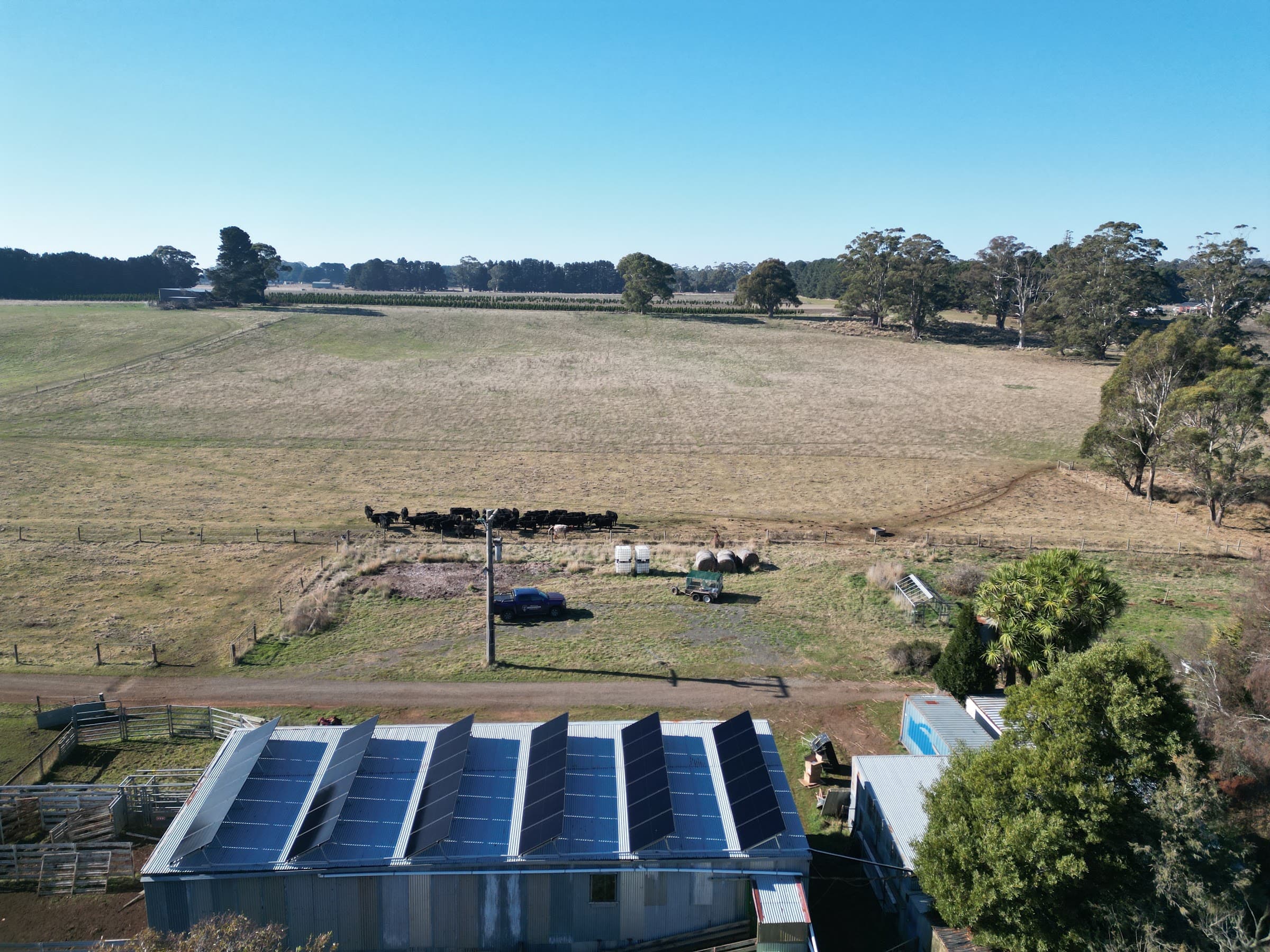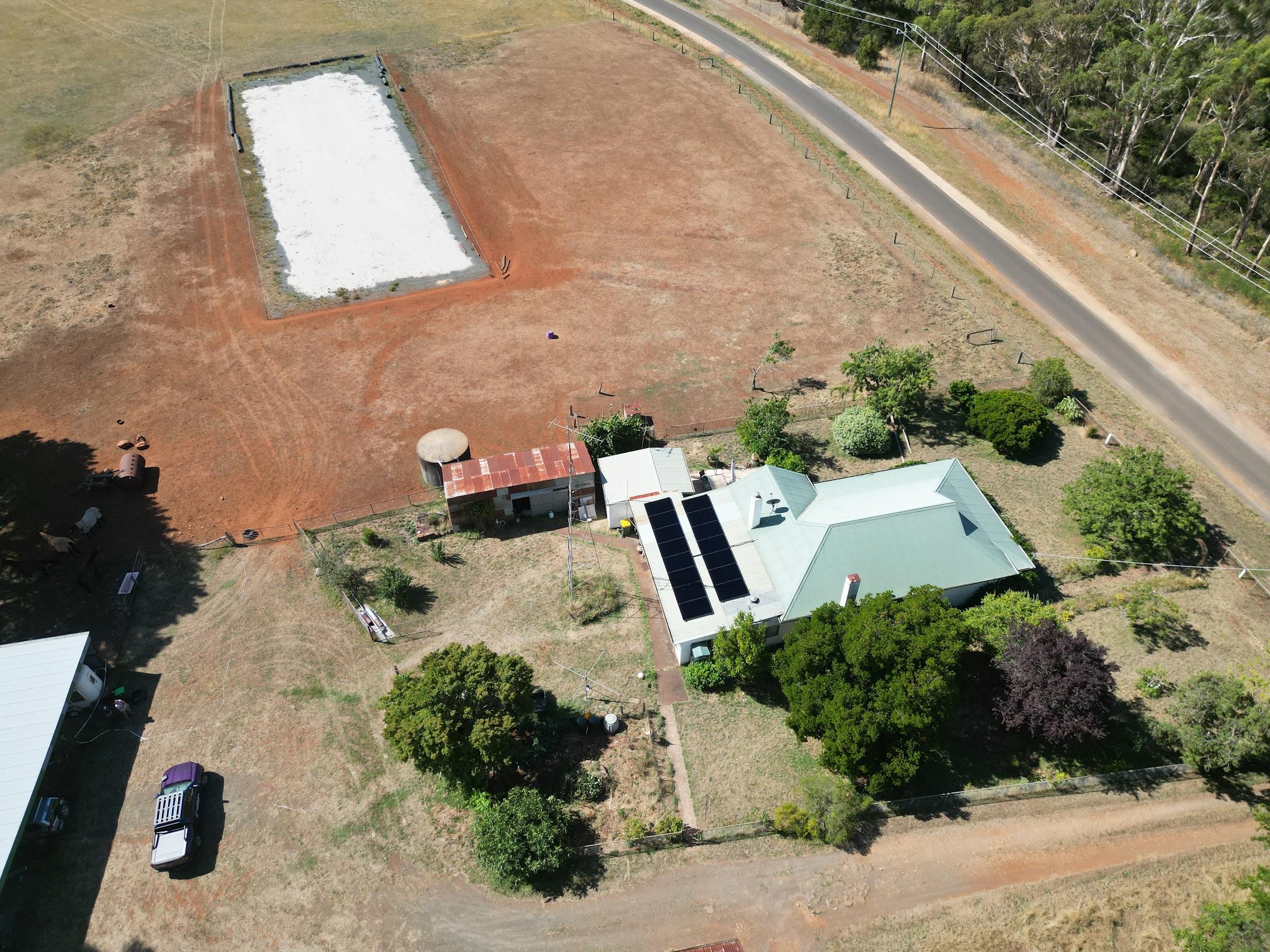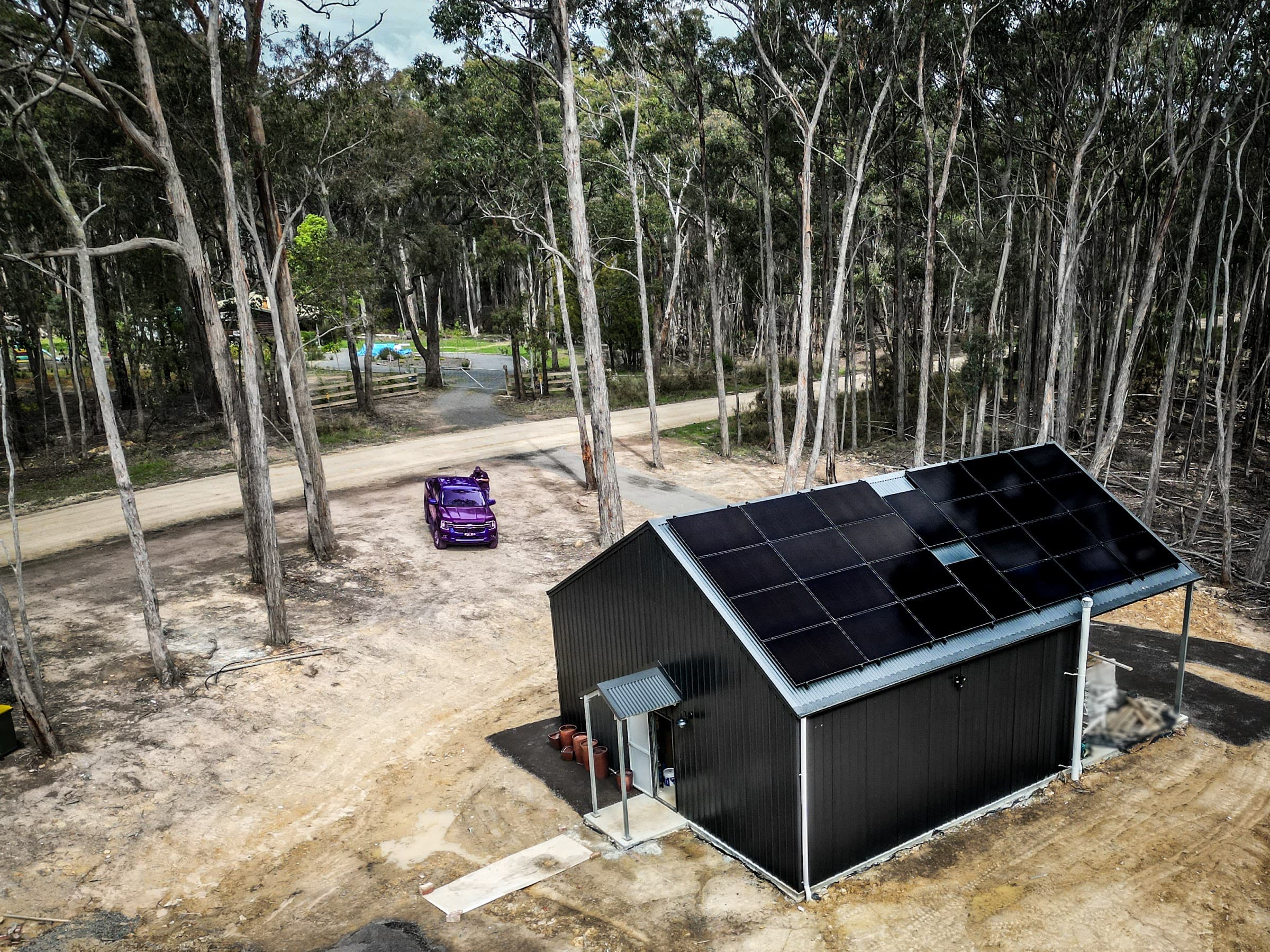
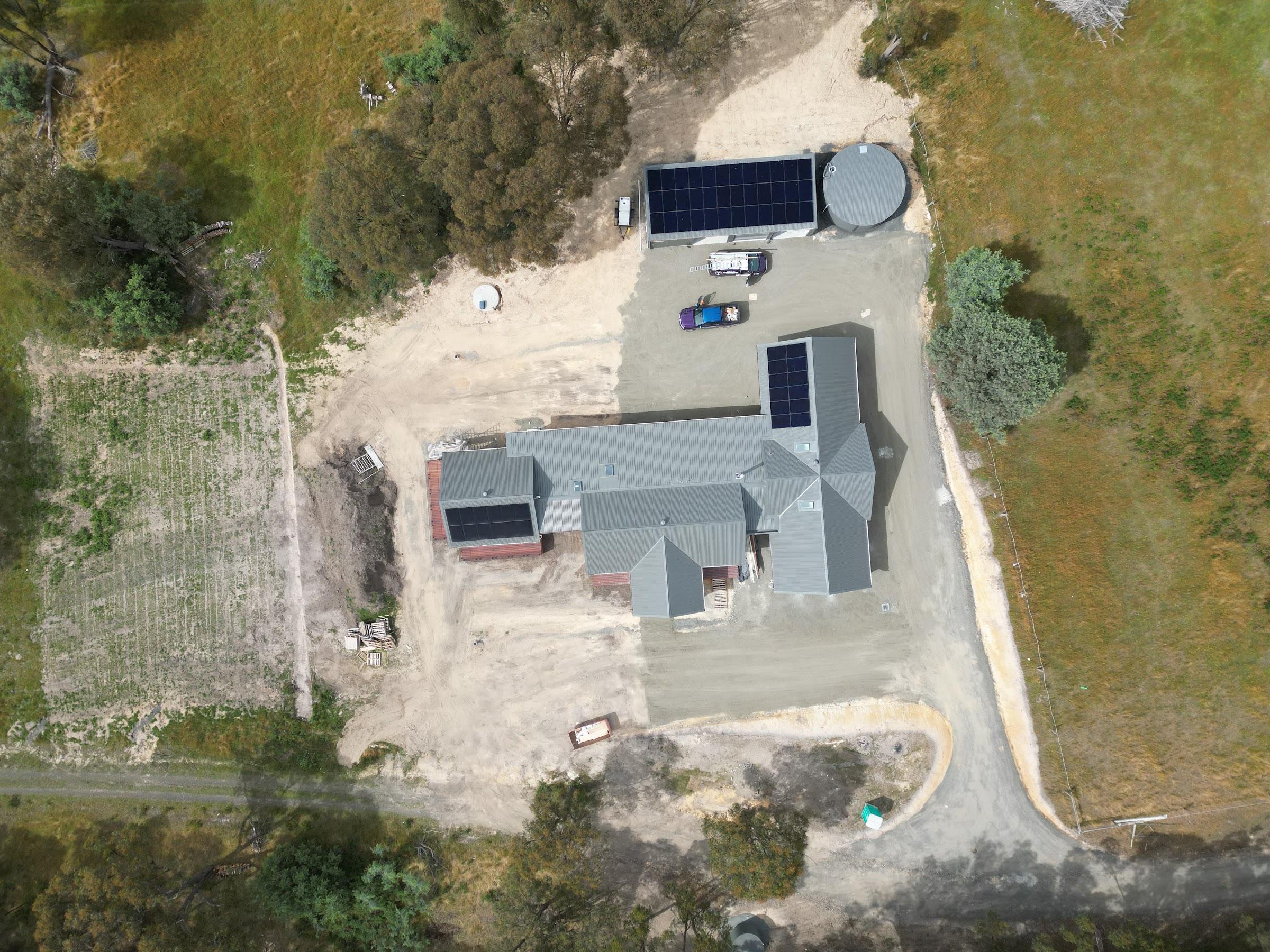
Off grid and on grid solar compared on three things that matter on a rural block: what the connection costs, how often the power goes off, and voltage.
Choosing between an off grid and on grid solar system comes down to three things: what it costs to get power to the house, how often that power goes off, and how clean it is when it arrives. Where the line is already at your boundary, a grid connection is cheap and an on grid system with a battery is usually the better buy. Where the network has to be extended, the connection quote alone can match or beat the cost of an off grid system. Reliability and power quality then depend less on the label and more on how well each side is designed.
What is the difference between an off grid and on grid solar system?
An on grid solar system is connected to the network: the panels feed the house first, the grid fills the gaps, and any surplus is exported. An off grid system has no connection at all, so the panels, a battery and a backup generator have to carry every load, every day of the year.
There is a middle ground. A grid connected system with a battery and a backup circuit keeps the house running through most outages while still drawing on the grid in a long grey spell. We come back to that below, because for many rural homes it is the honest answer.
Off grid vs grid connection cost: which is cheaper to set up?
It depends almost entirely on how far the network is from the house. When the poles and capacity are already at the boundary, Powercor lists typical connection costs of $600 to $4,100. When a high voltage line and a transformer have to be built, Powercor's own guide prices the first 250 metres at $59,728 single phase and $69,254 three phase, and $181,806 underground, at April 2024 prices including GST. Tree clearing and preliminary design are on top.
We have set out those figures, and what pushes them higher, in our article on what it costs to connect power to a rural property. The point for this comparison is simple: below a few thousand dollars, connecting is hard to beat; once the quote reaches tens of thousands, it is worth pricing an off grid system beside it on the same loads.
The two sides also cost differently after the build. A connected home pays a daily supply charge and buys power in the gaps for as long as it is connected. An off grid home pays for generator fuel in the dark weeks, servicing, and eventually a battery replacement. The fair comparison is the connection quote plus your private works plus the years of supply charges, against the off grid system plus fuel, servicing and that battery.
Is off grid more reliable than the grid?
A well designed off grid system can be more reliable than a long rural line, but it is not automatic. The grid's weak points are kilometres of line through trees and paddocks that you cannot fix yourself. An off grid system's weak points are on your own property: the inverter, the battery, the generator and its fuel.
The networks publish what they expect. Powercor's reliability targets for 2026 to 27, set with the Australian Energy Regulator, are an average of 240.92 minutes of unplanned outage a year across 2.09 interruptions for customers on rural long feeders, against 104.14 minutes on rural short feeders and 57.18 minutes on urban feeders. AusNet's targets for the same year are 310 unplanned minutes and 2.08 interruptions on long rural feeders, plus 8.66 momentary interruptions, the flickers that reset clocks and modems.
Those are averages for normal operation. The regulator's reliability reporting leaves out interruptions outside a network's reasonable control, such as natural disasters, so the long storm outages come on top. Our companion article on power outages in Victoria covers those, and what you are paid when they happen.
What can go wrong with an off grid system?
The same honesty applies the other way. An off grid system has a few single points of failure, and good design covers each one.
- The inverter charger. If it fails, the house has no AC power. Two units in parallel, or a spare path through the generator, reduce that risk.
- The battery. Its management system will shut it down to protect the cells if something is wrong. A battery sized for winter and kept within its limits rarely gets there.
- The generator. It is the backup for the backup. It needs auto start, fuel on hand and servicing on hours, or a run of cloudy days will find it wanting.
- Monitoring. Problems you can see early are problems that rarely leave you in the dark. We build on Victron with GX monitoring and the VRM portal, and we monitor the systems we install remotely from Trentham.
What an owner can check safely: the battery level and alarms in the monitoring app, the generator's oil and fuel with it stopped and auto start off, and that vents and enclosures are clear. Anything inside the switchboard, the inverter or the battery enclosure is work for a licensed electrician.
Which gives better power quality, off grid or on grid?
On a long rural line, an off grid inverter usually delivers steadier voltage than the network does. Victoria's Electricity Distribution Code of Practice sets the nominal supply at 230 V and allows steady state variation at the meter of plus 13% to minus 10%, with network wide compliance judged against the Australian Standard window of 216 V to 253 V for all but 1% of the time. Victron's datasheet for the MultiPlus-II gives an inverter output of 230 V plus or minus 2% and 50 Hz plus or minus 0.1%.
Voltage matters in two directions. The Australian Energy Regulator notes that undervoltage can stop some appliances working properly, and that above 253 V a compliant solar inverter starts cutting its output, which is why some rural on grid systems lose generation on sunny afternoons. An off grid system has no network voltage to fight, so neither problem applies.
The caveat is size. An inverter has a fixed surge limit, and a big motor starting at the wrong moment can trip it where the grid would just supply it. That is a design question, answered by sizing the inverter to the real loads.
What are the in between options?
You do not have to pick an extreme.
- Grid connected with battery backup. You keep the connection and its supply charge, but a battery and a backup circuit carry the fridge, pump, lights and internet through most outages, and a generator inlet covers a long one. Our guide to battery backup for blackouts and storm season explains how that works.
- A stand alone power system run by the network. Powercor and AusNet can supply some existing customers on ageing rural lines with a system they own and run, but they choose the sites. Powercor's program for 2026 to 2031 is a pilot of up to about six sites, which we cover in our article on Powercor's stand alone power pilot.
- Keep the line and go off grid in stages. Some owners run an off grid capable system with the connection still in place through one winter before deciding whether to have the line removed.
Mick McDonald
Technical Director, Trentham Energy
Questions about your own system? Call 1300 3458 00 or send us a message.
Sources
- Arrange a new electricity supply, Powercor
- Customer's selection guide: indicative powerline construction costs, April 2024, Powercor
- Network reliability targets, Powercor (read 22 November 2026)
- Supply reliability targets FY27, AusNet (read 22 November 2026)
- Network performance report 2026, Australian Energy Regulator
- Electricity Distribution Code of Practice, Version 3, Essential Services Commission
- MultiPlus-II inverter charger datasheet, Victron Energy