Most EVs use 13 to 22 kWh per 100 km. How much solar that takes in a Central Victorian winter, how solar only charging works, and the off grid traps.
An electric car uses about 13 to 22 kWh of energy for every 100 km, so a 50 km day needs roughly 7 to 12 kWh at the plug. On a farm with a decent solar array that is easy in summer and tight in June, and a solar only charging mode lets the car soak up the surplus without pulling from the grid. Off grid it can work too, but the inverter, the battery and the generator all set limits that a grid connected house never sees.
How much energy an EV actually uses
Real world figures from the EV Database, measured in watt hours per kilometre, give a fair spread:
- Tesla Model 3 RWD: 130 to 133 Wh per km
- Tesla Model Y RWD: 158 Wh per km
- MG4: 164 to 171 Wh per km
- Hyundai Ioniq 5: 174 to 180 Wh per km
- BYD Atto 3 Evo: 185 to 192 Wh per km
- Kia EV9: 209 to 221 Wh per km
Multiply by your daily distance and add about 10% for charging losses, the same allowance our EV charging page uses. A Model Y doing 50 km a day needs 7.9 kWh into the battery, or about 8.7 kWh from the solar or the grid.
What a 7 kW charger draws, and why it matters
A single phase wall charger at 32 amps draws about 7.3 kW, the figure Victron gives for its own charger in single phase mode. Three phase chargers go to 11 kW or 22 kW. The car decides how much of that it takes: its on board charger sets the limit whatever is on the wall, which our EV charging page explains in full.
On a grid connected farm, 7.3 kW is just another big load the switchboard has to carry. Off grid, it is more than many inverters can supply continuously, which is the first thing to design around.
Solar only charging modes
A smart charger can watch what the solar is making and charge the car only from the surplus. Three examples:
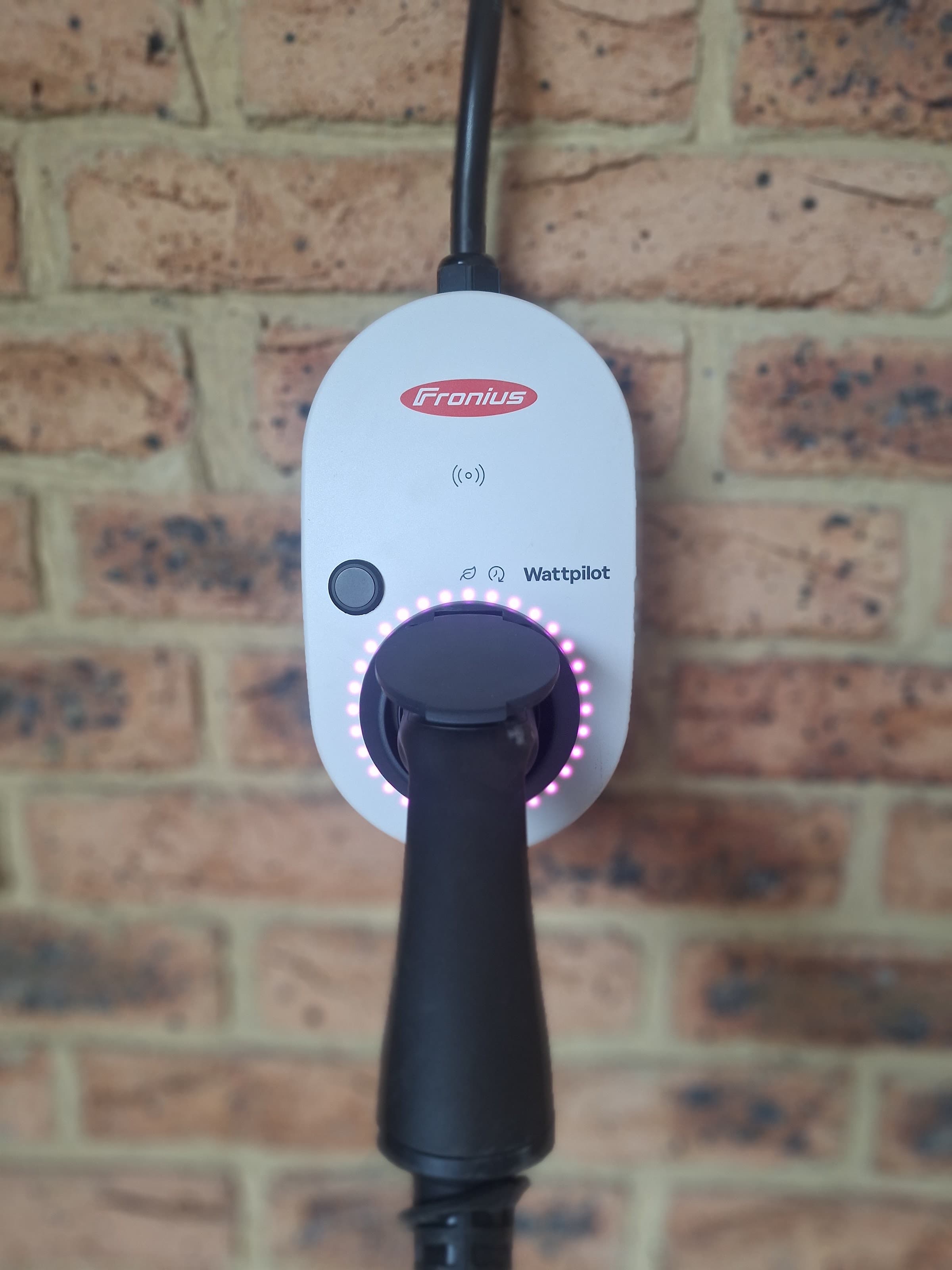
- Fronius Wattpilot, Eco mode. It starts charging once the surplus reaches 1.38 kW, then adjusts in 230 watt steps on one phase up to 4.14 kW. On a three phase supply it switches to three phase charging above that, in 690 watt steps, using up to 22 kW of surplus. It needs a compatible Fronius inverter and a Fronius Smart Meter on the same network. A Next Trip mode lets you enter when you are leaving and how far you are going, and it charges for that trip.
- Sigenergy. The Sigen EV AC charger has a 100% solar mode, and the Sigen DC module charges the car straight from the SigenStor's DC side. Details are on the Sigenergy page.
- Victron EV Charging Station. In automatic mode it works out the surplus as solar production minus the house loads, and starts only when the house battery is above a state of charge you set. In manual mode you set the current from 6 to 32 amps. Automatic mode needs a Victron GX device.
Why the threshold matters: AC charging starts at 6 amps, the bottom of the Victron charger's range, which is about 1.4 kW on one phase and is why the Wattpilot waits for 1.38 kW. A thin winter morning that makes 1 kW of surplus will not move the car at all in a strict solar only mode.
How much solar the car needs in a Central Victorian winter
The European Commission's PVGIS model for Trentham gives a 1 kW north facing array at a 37 degree tilt about 2.6 kWh a day in June and 5.0 kWh a day in January, or 1,459 kWh over a year.
For the Model Y doing 50 km a day, that means:
- June: 8.7 kWh divided by 2.58 kWh per kW is about 3.4 kW of panels, just for the car
- January: 8.7 divided by 5.03 is about 1.7 kW
Those are average days. A grey week in July makes much less, and on a farm the house, the pumps and the sheds want the same morning sun. If the car has to run on solar through winter, size the array for June and for the car on top of everything else.
Off grid: the traps
Charging an EV from an off grid system is possible, and the risks are all about asking the system for more than it was built for.
- The inverter. A Victron MultiPlus-II 48/5000 is rated for 4,000 W continuous at 25 degrees, and 3,700 W at 40 degrees. A car pulling 7.3 kW on one phase is beyond it. Either set the charger to a lower current or let the automatic mode follow the surplus.
- The battery. Overnight charging empties the house battery into the car, and the house then starts the next day flat. Set the charger to start only above a sensible battery level, and charge in the middle of the day.
- The generator. If a solar shortfall means the generator runs to fill the car, every kilometre costs fuel. Our generators page covers how the generator fits into an off grid design.
- Winter. An off grid system sized for the house in June has little spare for a car. The sizing tool lets you add the car's daily kWh as a load and see what it does to the array and the battery.
Every off grid system we build is monitored from Trentham through Victron's VRM portal, which shows when the car is charging and what it is doing to the battery.
On grid farms: time it to the cheap hours
If you are on the grid, the car is the easiest load there is to move. Powercor's Victorian Default Offer from 1 July 2026 charges 17.26 cents per kWh including GST in the 11 am to 4 pm solar soak window, against 41.67 cents in the 4 pm to 9 pm peak. Some retail plans now include free daytime windows. Our free energy plan finder ranks every Victorian plan against your own usage, car included.
For the running cost of a working ute against diesel, see diesel ute vs electric ute running costs.
If you want the car on the farm's solar, send us a recent bill and your address and we will come back with a right sized design.
Questions
How many solar panels do I need to charge an electric car?
For a car doing 50 km a day in Central Victoria, about 3.4 kW of panels covers it on an average June day and about 1.7 kW in January, on top of what the house uses. A shorter daily run needs proportionally less.
Can I charge an EV from an off grid system?
Yes, if the system is sized for it. The charger has to stay within the inverter's continuous rating, the car should charge from the midday surplus rather than the battery, and the array needs room for the car in winter.
Does solar only charging work on a cloudy day?
Only if the surplus stays above the charger's starting point, about 1.4 kW on one phase. Below that a strict solar only mode waits. Most chargers let you top up from the grid or the battery if you need the car the next morning.
Should I charge my EV from my home battery?
Usually not. The battery is better used for the house's evening load, with the car charged from the midday surplus or a cheap grid window. Off grid, draining the house battery into the car overnight is the quickest way to start the generator.
Sources
- EV Database, energy consumption of full electric vehicles (read October 2026)
- Fronius Australia, charging electric cars with PV surplus
- Victron Energy, EV Charging Station NS manual, description and features
- Victron Energy, MultiPlus-II inverter charger datasheet (PDF)
- European Commission JRC, PVGIS calculation for Trentham, 1 kW at 37 degrees facing north
- Essential Services Commission, Victorian Default Offer 2026 to 27
Written by the Trentham Energy team.