Sigenergy says SigenStor can run off grid through its gateway, with a generator port. What the datasheets show, what they omit, and when we use Victron.
Yes, Sigenergy says its SigenStor can run off grid, but only with a Sigen Energy Gateway in the system, and the gateway is also where a generator connects. Sigenergy's datasheets list "on and off grid compatibility", "multi source black start" and a generator port with two wire start. What they don't publish is much detail on how the system behaves as the only source of power for a home day after day, which is why we build fully off grid homes on Victron and use Sigenergy where there is a grid to lean on.
Does SigenStor support off grid operation?
On paper, yes. The datasheet for the single phase Sigen Energy Controllers, 3.0 to 12.0 kW, lists "on and off grid compatibility" among its features, and Sigenergy's Australian SigenStor page, read in November 2026, says SigenStor can run "off grid with 2x peak power output".
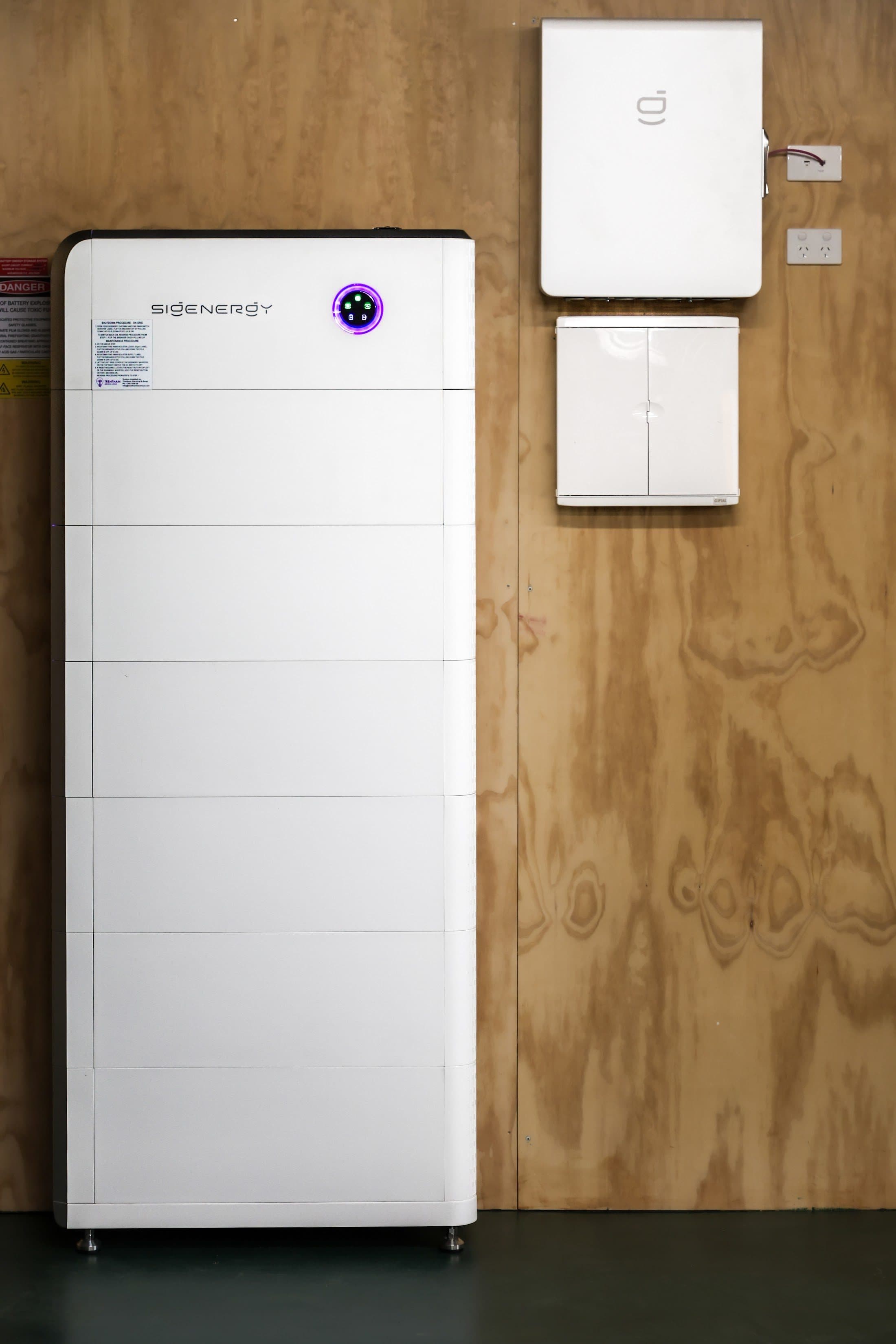
The catch is the gateway. Without one, a SigenStor is a hybrid inverter and battery that shifts solar into the evening and stops when the grid does. The backup and off grid behaviour Sigenergy describes depends on a Sigen Energy Gateway sitting between the inverter, the switchboard and the grid or generator. SolarQuotes' review puts it plainly: the system will run off grid "as long as you've sized it appropriately and have installed their Gateway".
What does the Sigenergy off grid gateway do?
The gateway is a switching and metering box. When the grid drops out it isolates the house from the grid and lets the energy controller supply the home, and it has a separate port for a generator or a large controllable load.
From Sigenergy's Australian gateway datasheet, read in November 2026:
- Home SP AU: single phase, 12 kW nominal through the grid, backup and generator (Smart Port) connections, 54.6 A
- Home TP AU: three phase, 30 kW nominal, 45.6 A per phase
- Switchover: 0 ms "disruption time" on the load side, with a footnote that this holds only when the gateway is used with a Sigen Energy Controller and Sigen battery, and only when the controller's rating is higher than the total backup load
- Generator: "Generator 2-wire start: Supported" on the Smart Port
Sigenergy's Australian gateway page also lists a single phase HomePro SP-F AU at 22 kW with 100 A grid and backup circuits, and a C60 AU at 60 kW, each with a matching generator rating.
That 0 ms figure is what most owners care about for blackouts. It is a backup claim, though. Off grid, there is no grid to switch away from; the question becomes whether the inverter, battery and generator can carry the house through a Central Victorian winter on their own.
Can you connect a generator to a Sigenergy off grid system?
Yes. The gateway's Smart Port is rated for a generator, and it supports a two wire start signal, the simple contact that auto start generators use. Sigenergy's Australian SigenStor page describes the grid port as ready for an automatic transfer switch and a generator connection.
What Sigenergy doesn't publish in the documents we could open is the detail an off grid designer needs: the maximum charging rate from a generator into the battery, how the system handles a generator whose frequency wanders under load, and how it limits the draw so a small generator isn't overloaded. Victron publishes all of that for its inverter chargers, which is a large part of why we use it. On a three phase gateway, a reseller summary of Sigenergy's guidance says only a three phase generator can be used, so check that before you buy one.
SolarQuotes' feature review was frank about the idea, calling generator integration for off grid "adorably optimistic", given how troublesome generators are in off grid installs. That is one reviewer's view, written in March 2024, but it matches ours: the generator is the hardest part of an off grid system to get right.
What about black start and surge?
Sigenergy lists "multi source black start" as a feature, which reads as the system being able to start itself without the grid, from more than one source. We could not find a published description of how it works or what it needs, so treat it as a claim to ask your installer about.
Surge is where the numbers are worth reading. The single phase controller datasheet we read gives a backup peak output for 10 seconds of 4.5 kW on the 3.0 kW model, 9 kW on the 6.0 kW, and 15 kW on both the 10.0 and 12.0 kW models. So the 12 kW controller can give 25% above its rating for ten seconds. The newer "2x peak power" claim on Sigenergy's website gives no duration and no model, and the SigenStor Neo we wrote about in our Neo article quotes 200% for up to 10 seconds. Check the datasheet for the exact controller on your quote.
For comparison, Victron's datasheet gives the MultiPlus-II 48/5000 a continuous 4,000 W at 25°C and a 9,000 W peak. Bore pumps, fridges, compressors and welders are what decide whether an off grid inverter feels big enough, and that starting margin is a large part of it.
When does Sigenergy suit, and when does Victron?
Sigenergy suits homes where the grid is still there:
- Whole home backup. A grid connected house that wants the lights, fridge and pump to stay on through a storm, with a 0 ms switchover.
- A weak grid. A property on a long or limited line, such as a SWER line, where a battery covers the gaps. Our SWER article explains the limits.
- Grid connected with a generator as a last resort. A farm that keeps the grid but wants a generator for a long outage.
Victron suits homes with no grid at all:
- The generator is part of daily life in winter. Victron's inverter chargers have a known charge rate, an adjustable input current limit and PowerAssist, which tops up from the battery when the house briefly wants more than the generator can give.
- Big motor loads. A 5 kVA MultiPlus-II's peak is more than double its continuous rating, and units can be run in parallel or in three phase.
- Repairs a long way from town. Separate inverter, charge controllers and monitoring mean one part can be swapped without the rest.
We set out the full reasoning in why we build off grid on Victron, and our generators page covers how we connect backup generators.
What should you ask before buying Sigenergy for off grid?
- Which gateway model is on the quote, and is it the one rated for your generator?
- What is the 10 second peak output of the exact energy controller, and will it start your largest motor?
- What is the maximum battery charging rate from the generator?
- How many days of autonomy is the battery sized for in June?
- Who monitors it, and can they change settings remotely?
Gateways, switchboards and generator wiring are work for a licensed electrician. An owner can safely read the app, keep the units' vents clear and check the generator's oil and fuel with auto start switched off. Batteries can deliver dangerous current even when the house is dark.
Mick McDonald
Technical Director, Trentham Energy
Questions about your own system? Call 1300 3458 00 or send us a message.
Sources
- SigenStor product page, Sigenergy Australia
- Sigen Gateway product page, Sigenergy Australia
- Sigen Energy Gateway Home SP AU and TP AU datasheet, Sigenergy (via SOL Distribution)
- Sigen Energy Controller 3.0 to 12.0 kW single phase datasheet, Sigenergy (via SolarQuotes)
- Sigenergy review, SolarQuotes
- Sigenergy battery: if it lives up to the claims, SolarQuotes (4 March 2024)
- MultiPlus-II inverter charger datasheet, Victron Energy
- Sigenergy gateways explained, AC Solar Warehouse (19 February 2025)