Yes. An inverter split system runs well off grid and summer cooling is easy. Winter heating is the hard part, so size the battery and generator for it.
Yes. A modern inverter split system runs well on an off grid solar system, and for most of the year it is one of the easiest big loads to support. Summer cooling is the simple part, because the heat arrives when the sun is out and the panels are making more than you need. Winter heating is the hard part: short days, frosty mornings and long nights mean the energy has to come out of the battery or the generator, so the system has to be sized for heating, not cooling.
Can off grid solar run an air conditioner?
It can, as long as the inverter, battery and solar array are sized for it and the air conditioner is a modern inverter unit.
As an example, Mitsubishi Heavy Industries' specification page for the SRK35ZSX-WF wall split, from its European range, lists a nominal cooling capacity of 3.5 kW for a power draw of 0.74 kW, and a nominal heating capacity of 4.3 kW for 0.90 kW. The same page lists a maximum heating output of 6.8 kW and a maximum running current of 9 A. Off grid, that last figure matters more: 9 A at 230 V is roughly 2 kW, the most the unit should pull flat out on a cold morning. Australian models have their own specifications, so check the exact unit you buy.
Why does an inverter split system suit off grid?
Because its compressor speeds up and slows down to match the load instead of switching hard on and off. That means a gentle start rather than a big surge, and a much lower draw once the room is at temperature.
Older fixed speed units draw either their full power or nothing, so every start is a jolt for the inverter.
Reverse cycle heating is also far more efficient than any heater that turns electricity straight into heat. The Energy Rating program explains that a reverse cycle unit moves some three to five units of heat into the room for every unit of electricity, while a standard bar, radiant or convection heater gives back about one.
Is cooling in summer easy off grid?
Yes, it is the easiest big load you will run. Hot afternoons line up with the strongest sun, and an off grid array sized for winter makes far more than the house needs in summer, so cooling mostly runs on surplus that would otherwise be wasted.
That 3.5 kW split running for six hours through a hot afternoon at its nominal 0.74 kW uses about 4.4 kWh, most of it straight from the panels. The best habit is to cool the house while the sun is up: start the air conditioner late morning, let the building cool down, and let the battery go into the evening full.
Can off grid solar heat a house in a Central Victorian winter?
It can heat a well insulated room or two, but winter heating is where off grid systems are stretched. Heating is needed most in the evening, overnight and on frosty mornings, which is exactly when the panels make nothing, and in June the panels make only a fraction of their summer output. We cover that in detail in what off grid panels really make in a Central Victorian winter.
The air conditioner also works harder in the cold. The Energy Rating program's guidance on the Zoned Energy Rating Label notes that, for a given input of electricity, heating output is lower at 2°C outside than at 7°C, and that frost starts forming on the outdoor coil once the air drops below about 5.5°C. The unit then has to run defrost cycles, and some units stop heating completely while they defrost. That is why the label shows a heating capacity at 2°C, and that is the number to compare if you live somewhere frosty.
Here is a simple illustration with the inputs shown. Say you heat a living area from 5 pm to 11 pm and again from 6 am to 9 am, nine hours in total, and the unit averages about 1 kW of electricity across that time once you allow for the cold and defrosting. That is about 9 kWh a day, nearly all of it from the battery. On a run of grey June days, when the array may not even cover the rest of the house, that 9 kWh has to come from the generator.
What size inverter and battery do you need for air conditioning?
Size the inverter for the air conditioner's maximum draw plus everything else that could run at the same time, and size the battery and generator for winter heating nights, not summer days.
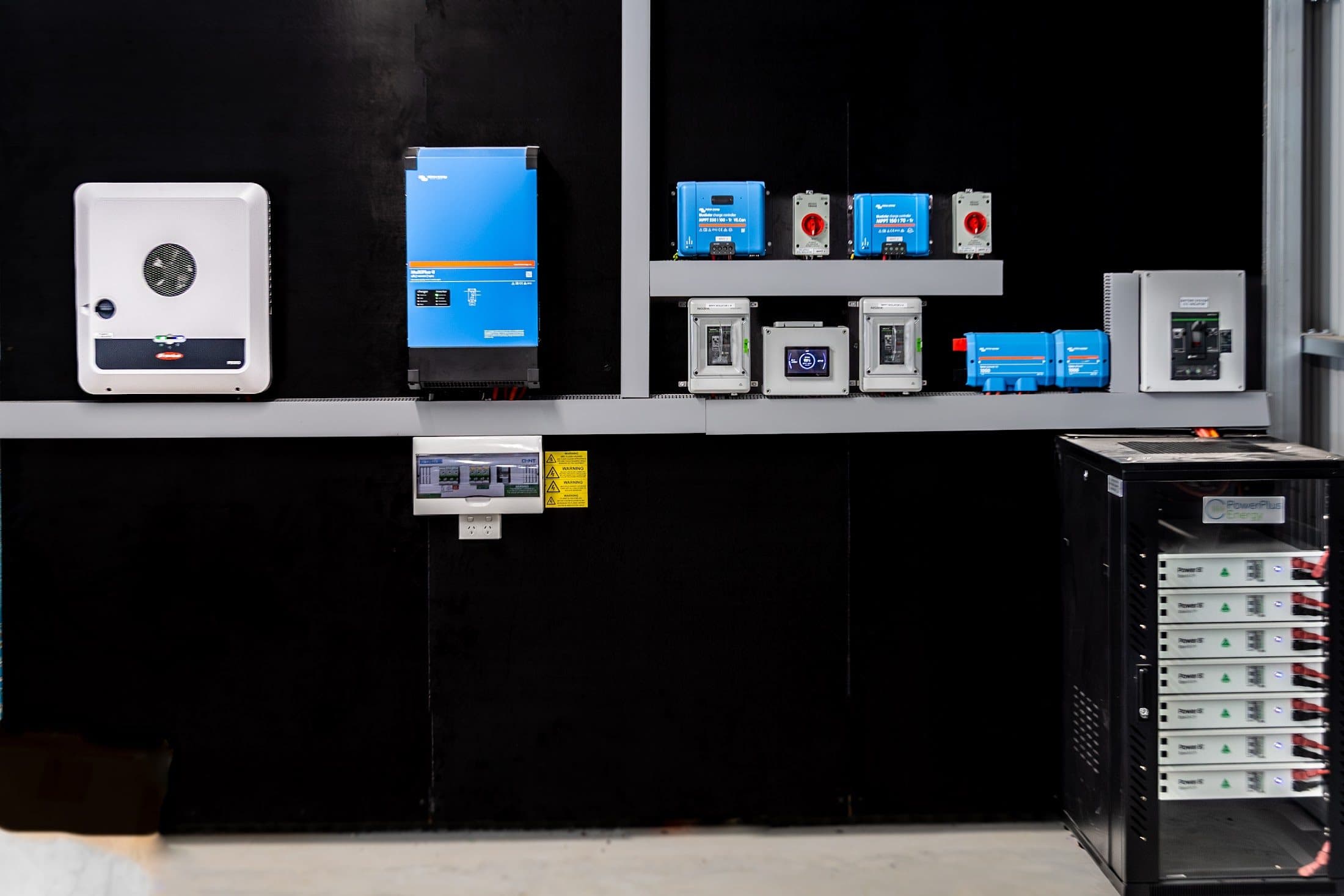
Take the inverter first. Victron's technical specifications list the MultiPlus-II 48/5000 at 4,000 W continuous at 25°C, dropping to 3,700 W at 40°C, with a 9,000 W peak for short bursts. The 48/8000 gives 6,400 W at 25°C and 5,500 W at 40°C. Two splits working hard on a cold morning at around 2 kW each, plus a kettle and a toaster, can push past what a 5 kVA inverter will carry continuously. Inverters also lose capacity when hot, so on a 40°C day an inverter in an unventilated shed has less to give. For more, see what you can run on a 3, 5 or 8 kW off grid inverter.
Then the battery. It must cover evening and overnight heating on top of the normal house load, with a buffer left by morning. The solar array then has to refill it in June, not just in January. Finally the generator, which is the honest answer to a week of cloud. On our Victron systems an auto start generator comes on when the battery gets low and charges it back up, and in a heating winter it will run more than it does in summer. See off grid generators.
What should you avoid?
Most problems come from the wrong equipment or wrong expectations, not the idea itself.
- Fixed speed or very old units. They hit the inverter with a hard start and run at full power. Replace them before you build a system around them.
- Ducted whole house systems by default. They are larger units heating the whole volume of the house through ducts, and the winter energy adds up quickly. Wall splits in the rooms you actually use are far easier to support.
- Oversized units. A bigger unit has a higher maximum draw. Size it to the room.
- Resistive heaters as a backup. A 2.4 kW bar, radiant or fan heater gives a third or less of the heat per kilowatt hour that a reverse cycle unit does.
- Heating with no plan for cloudy weeks. If there is no generator, or the generator is too small, winter heating will flatten the battery.
- Ignoring the building. Insulation, draught sealing and good curtains cut the heating load more cheaply than extra batteries.
Useful features help. Daikin's Cora range has an Econo mode that limits the unit's power consumption, and operation timers let you schedule it, so you can heat harder in the afternoon while the sun is up.
What can you check yourself, and what needs a licensed tradie?
An owner can safely clean the indoor filters, keep leaves and long grass away from the outdoor unit, use the timers and modes, and watch battery state of charge and solar production on the monitoring. If the air conditioner trips the inverter, note the time and what else was running, and tell your installer.
Do not open the inverter, the battery enclosure or the switchboard, and do not move or rewire the air conditioner's circuit. Adding a circuit, changing inverter settings or connecting a generator needs a licensed electrician, and any work on the refrigerant side needs a technician with a refrigerant handling licence. Refuel a generator only with the engine stopped and cool, and keep fuel away from the battery and inverter.
Mick McDonald
Technical Director, Trentham Energy
Questions about your own system? Call 1300 3458 00 or send us a message.
Sources