In June a north facing kilowatt of panels near Trentham makes about 2 kWh a day at roof pitch and 2.8 at a steep tilt. The monthly figures explained.
On an average June day, one kilowatt of north facing panels near Trentham makes about 2 kWh at a typical 15 degree roof pitch, against about 5.5 kWh in January. Stand the same panels up at 60 degrees and June rises to about 2.8 kWh while summer falls away. That June trough is the whole design problem off grid, and tilt, array size and the generator are the three levers that solve it.
The figures here come from the European Commission's PVGIS tool, run for Trentham (37.39 degrees south, 144.32 degrees east) with 14 percent system losses and the ERA5 weather record for 2005 to 2023. They are estimates from a weather model, not a guarantee, but they are the same kind of estimate every solar designer starts from.
The monthly numbers
Here is what one kilowatt of panels facing due north makes per day, month by month, at a 15 degree roof pitch:
- January 5.46, February 5.04, March 4.25, April 3.20
- May 2.38, June 1.97, July 2.14, August 2.78
- September 3.79, October 4.57, November 4.96, December 5.43
June makes about 36 percent of January. July is barely better, and May and August are not far off. For a grid connected home that does not matter much: the summer surplus is exported and the year adds up to about 1,400 kWh per kilowatt. Off grid there is nowhere to send July's shortfall from, and nowhere to borrow it from in July.
Why June is so low
Three things stack up in the middle of winter.
- The sun is low. At solar noon on the June solstice the sun sits about 29 degrees above the horizon at Trentham's latitude, against about 76 degrees in late December. Low sun travels through more atmosphere and hits a shallow roof at a glancing angle.
- The days are short. Fewer hours above the horizon, and the first and last of them make very little.
- It is cloudier. Winter brings the fronts, and a run of grey days is a normal part of June and July in the hills.
The year to year spread is smaller than people expect. PVGIS puts a typical June at 59 kWh per kilowatt for the month at 15 degrees, with a year to year standard deviation of about 5 kWh, so a poor June is roughly 8 percent below average. The month itself is predictable. What varies is the order the days come in: a grey week in the middle of June is what empties a battery, not a slightly dull month.
Tilt: the cheapest winter kilowatt hours
A steeper panel faces the low winter sun more squarely. The same kilowatt facing north, at three angles:
- 15 degrees (a common roof pitch): June 1.97 kWh a day, January 5.46, year 1,396 kWh
- 37 degrees (about the latitude): June 2.57, January 4.96, year 1,451 kWh
- 60 degrees (a steep ground mount): June 2.82, January 3.88, year 1,330 kWh
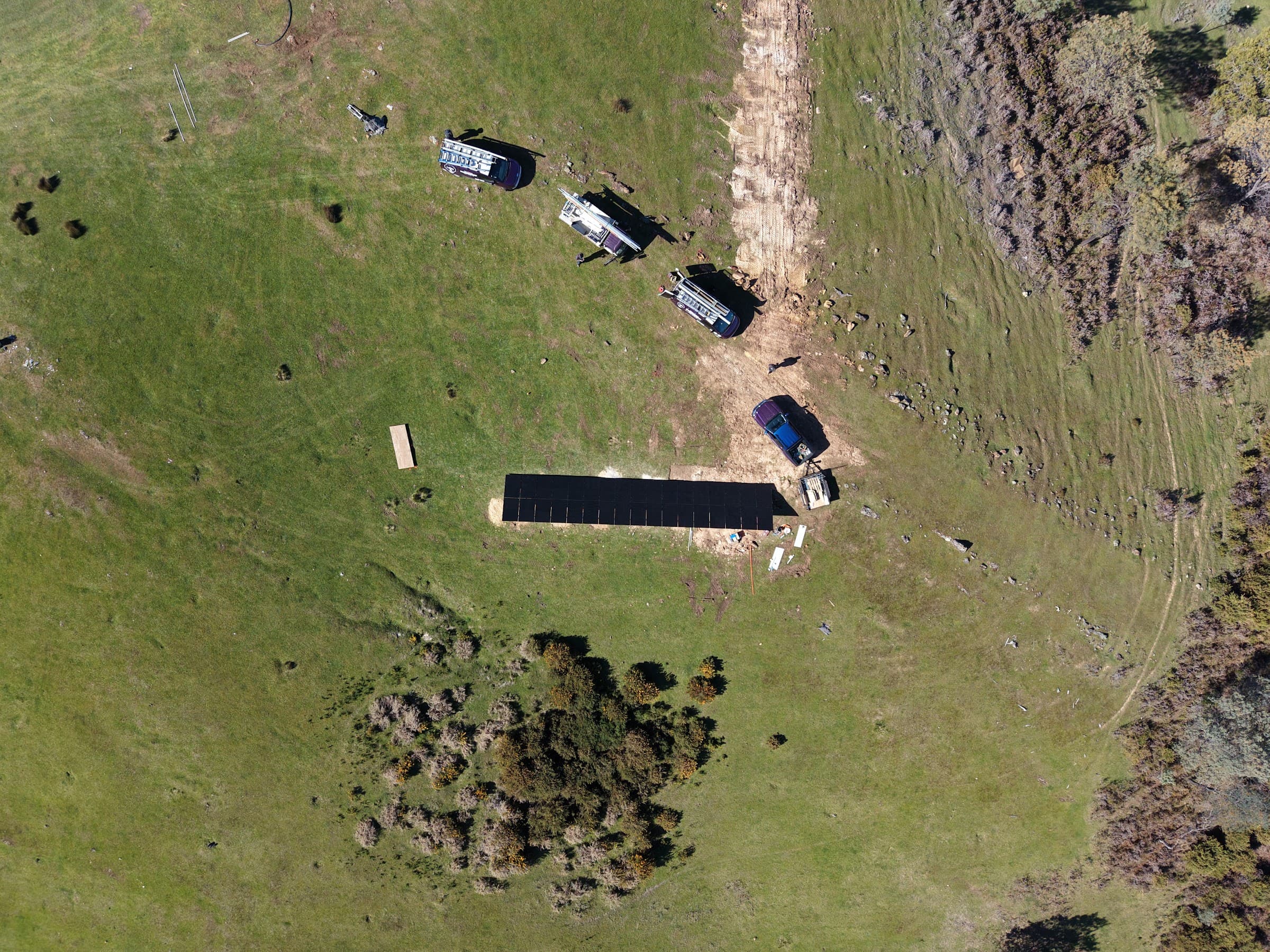
Going from 15 to 60 degrees lifts June by about 43 percent and gives up about 5 percent of the year. Off grid, that is a trade worth making, because the summer kilowatt hours were going to be wasted anyway once the battery is full. It is also why so many off grid systems sit on a steep ground frame in a clear paddock rather than on the roof: the frame sets the angle for winter, and the paddock usually has less shade than a roof under the gums.
How much array per kilowatt hour of daily load
Divide the June figure into one and you get the kilowatts of panels needed for each kilowatt hour the house uses on an average June day:
- at 15 degrees, about 0.51 kW of panels per daily kWh
- at 60 degrees, about 0.35 kW of panels per daily kWh
So a house using 10 kWh a day in winter needs about 5 kW on a shallow roof, or about 3.5 kW on a steep frame, just to break even on an average June day. That is before battery round trip losses and before any margin for the grey weeks, both of which push the real number up. Our article on sizing an off grid system for Central Victoria works through the margins and a full example, and the sizing tool does the sum for your own loads.
The practical point: on an off grid block, extra panels are the cheap way to buy winter. Batteries carry you through the night; panels decide whether the battery is full again by the next evening.
Where the generator comes in
No sensible amount of solar removes the grey week. The generator is there for those stretches, and the hours it runs come down to arithmetic: the energy the battery is short, divided by the rate the inverter charger can put it back.
A Victron MultiPlus-II 48/8000 charges at up to 110 amps on its datasheet. At a battery voltage around 52 volts that is roughly 5.7 kW into the bank. If a grey stretch leaves the battery 20 kWh short of where you want it, the generator needs about three and a half hours to put it back, a little longer in practice because charging slows as the battery fills. The generator should be big enough to run the house and charge at the same time, which our generators page covers along with auto start and quiet hours.
A well designed system runs the generator a handful of times across May, June and July. One that runs it most mornings is short of panels or short of battery, and the monitoring will show which.
What to take from this
- Design for June, not the year.
- Tilt the array for winter if you have the room for a ground mount.
- Treat panels as cheap winter insurance and the battery as the night.
- Size the generator for the grey week and let it sit idle the rest of the year.
If you want this worked through for your block, with the shading and the slope you actually have, send us a recent bill or a list of what you run and your address, and we will come back with a right sized design. You can start on the off grid hub.
Questions
How much solar does an off grid house need in winter in Victoria?
Work from the winter daily load. Near Trentham, each kWh used on an average June day needs about half a kilowatt of north facing panels at roof pitch, or about a third of a kilowatt at a steep tilt, plus a margin for battery losses and cloudy runs.
What is the best tilt for off grid panels in Central Victoria?
For winter, steeper than the roof: PVGIS shows a 60 degree frame making about 43 percent more in June than a 15 degree roof, for about 5 percent less across the year. A frame near the latitude, about 37 degrees, sits in between and still adds about 30 percent to June.
Are the PVGIS numbers exact?
No. They come from a weather model averaged over 2005 to 2023, and a site with shade, a hill to the north or fog in the valley will do worse. They are a sound starting point; a site visit and a year of monitoring tell you the rest.
Is July any better than June?
Only a little. PVGIS has July at 2.14 kWh per kilowatt per day at roof pitch against June's 1.97, and May at 2.38. Treat the three months as one long winter when you size an off grid system.
Sources
- PVGIS 5.3, monthly output for Trentham at 15 degrees, north facing (European Commission JRC)
- PVGIS 5.3, monthly output for Trentham at 37 degrees
- PVGIS 5.3, monthly output for Trentham at 60 degrees
- PVEducation, elevation angle of the sun
- Victron Energy, MultiPlus-II 230 V datasheet
Written by the Trentham Energy team.