How to read a Victron MultiPlus-II model name, 12, 24 and 48 volt models, the 3000 W question, PowerAssist, parallel, three phase and the Quattro.
A Victron MultiPlus-II model name is four numbers: battery voltage, continuous output in VA, the most it can charge the battery in amps, and the most AC it can pass through from a generator or the grid in amps. So a MultiPlus-II 48/5000/70-50 runs off a 48 volt battery, puts out 5,000 VA continuously, charges at up to 70 A and passes through up to 50 A. For a full time off grid house the 48 volt models are the ones to look at; the 12 and 24 volt models suit caravans, cabins and small sheds.
We build off grid on Victron, and our article on why we build off grid on Victron covers the reasons. This one is about choosing the size.
What does the Victron MultiPlus-II model number mean?
Each part of the name maps to a line on Victron's specification table. Victron doesn't spell the naming out on that page, but the figures match every model:
- 48: the battery voltage, 12, 24 or 48 volts
- 5000: continuous output in VA at 25°C
- 70: the maximum battery charge current in amps
- 50: the AC transfer switch rating in amps, how much generator or grid power can pass straight through to the house
The watt figure is lower than the VA figure. On Victron's specification table, read in November 2026, the 48/5000 is 4,000 W continuous at 25°C with a 9,000 W peak. Our piece on what you can run on a 3, 5 or 8 kW off grid inverter works through the appliance side, so here we stick to the hardware.
Which Victron MultiPlus-II sizes are there?
The 230 volt range on Victron's table, read in November 2026:
- 12/3000/120-32, 24/3000/70-32 and 48/3000/35-32: 3,000 VA, 2,400 W continuous, 5,500 W peak, 32 A transfer switch
- 12/5000/220-50, 24/5000/120-50 and 48/5000/70-50: 5,000 VA, 4,000 W continuous, 9,000 W peak, 50 A transfer switch
- 48/8000/110-100: 8,000 VA, 6,400 W continuous, 15,000 W peak, 100 A transfer switch
- 48/10000/140-100: 10,000 VA, 8,000 W continuous, 18,000 W peak
- 48/15000/200-100: 15,000 VA, 12,000 W continuous, 27,000 W peak
Notice the charge current falls as the battery voltage rises: the 12 volt 3 kVA model charges at 120 A, the 48 volt one at 35 A. That isn't a weaker charger. The same power at four times the voltage needs about a quarter of the current. Victron's product page also lists GX versions, which build the monitoring device into the inverter, and 120 volt models for other markets.
Is a Victron 3000 W inverter big enough?
For a house you live in, usually not on its own. The 3,000 VA MultiPlus-II gives 2,400 W continuous at 25°C and less when hot. A kettle alone can use most of that.
It suits a weekender, a cabin, a shed, or a caravan. For those jobs the 12 or 24 volt versions can make sense because the battery is smaller and simpler. For a home, the 48/5000 is the usual starting point and the 8 kVA and up models are for houses with ovens, dryers or a lot of air conditioning.
One trap with the search "Victron inverter 3000W": Victron also sells Phoenix inverters, which are inverters only. They make 230 volt AC from a battery but don't charge the battery from a generator. For off grid you want an inverter charger, the MultiPlus-II or the Quattro, so the generator can refill the bank.
Why 48 volts for a house?
Because current, cable size and losses all fall as voltage rises. A 4,000 W load draws about 83 A from a 48 volt battery and roughly four times that from a 12 volt one. At 12 volts the DC cables become very heavy, the fuses very large and the losses noticeable.
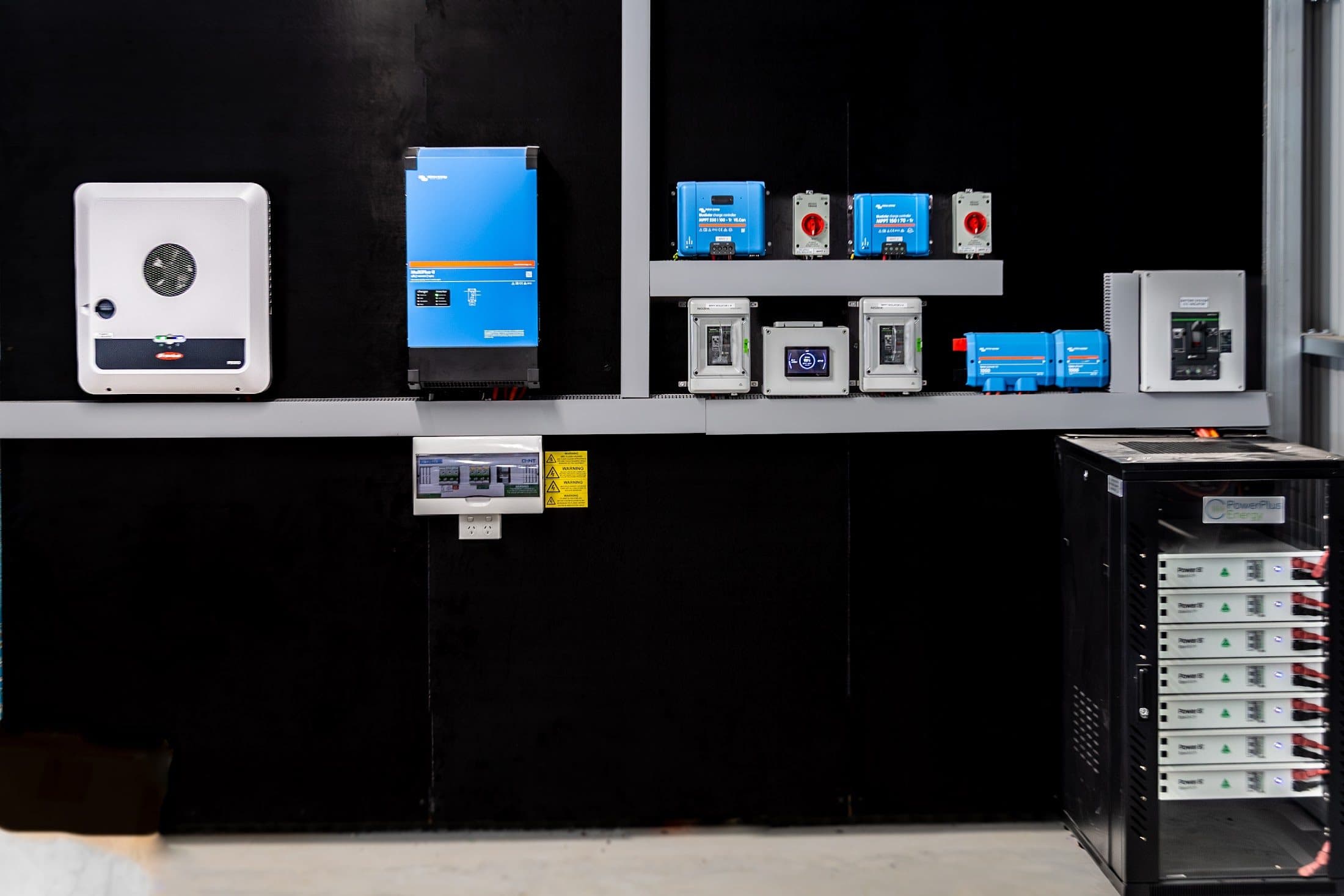
Most home batteries made for solar, including the PowerPlus Energy modules we install, are 48 volt class batteries. That makes the 48 volt MultiPlus-II the natural match for a house.
What is PowerAssist, and why does it matter off grid?
PowerAssist lets the inverter add battery power on top of a generator so the generator isn't overloaded. Victron describes two levels: first it cuts back battery charging, then it boosts the generator's output with energy from the battery.
That means a modest generator can run a house during a charging run, because the inverter covers the moments when the kettle, oven and pump all switch on. It is one reason we size the generator to the charger rather than to the whole house.
Can you run MultiPlus-II units in parallel or three phase?
Yes. Victron's product page says the MultiPlus-II supports parallel and three phase systems. Two or three units in parallel give a single phase house more power; three units, one per phase, make a three phase supply.
There's a catch on the bigger models. Victron's specification table notes that the 8, 10 and 15 kVA units can be used in three phase but run in parallel only with an external AC transfer switch. That shapes the switchboard design, so it is worth deciding early whether a house will grow from one big unit to two. Our article on when an off grid system needs three phase covers that decision.
MultiPlus-II or Quattro: what's the difference?
The Quattro has two AC inputs where the MultiPlus-II has one. Victron says the Quattro can be connected to two independent AC sources, for example shore power and a generator (on a farm, the grid and a generator), and switches automatically to whichever is live.
Victron says up to six Quattros can run in parallel, and it lists the Quattro from 3,000 to 15,000 VA. The 48/5000/70-100/100 Quattro, for example, is 5,000 VA, 4,000 W continuous, 10,000 W peak and charges at 70 A, so the inverter side is very close to a MultiPlus-II 48/5000. You choose a Quattro when you need the second input, such as a property with two generators, or a site that keeps a grid connection beside a generator. If there is only ever one generator, a MultiPlus-II does the job.
How does it connect to monitoring and the generator?
Through a GX device, such as the Cerbo GX, or a MultiPlus-II with GX built in. Victron says that with a GX device you can monitor and control the inverter locally or remotely through the free VRM portal and app, including auto starting a backup generator.
That is how we run the systems we install: GX monitoring, VRM, and an auto start generator, watched remotely from Trentham.
Safety: an owner can read the screen, check the app and keep the inverter's vents clear. Changes to settings, the DC side, the AC wiring or the generator connection need a licensed electrician. A 48 volt battery bank can deliver a dangerous fault current.
Mick McDonald
Technical Director, Trentham Energy
Questions about your own system? Call 1300 3458 00 or send us a message.
Sources