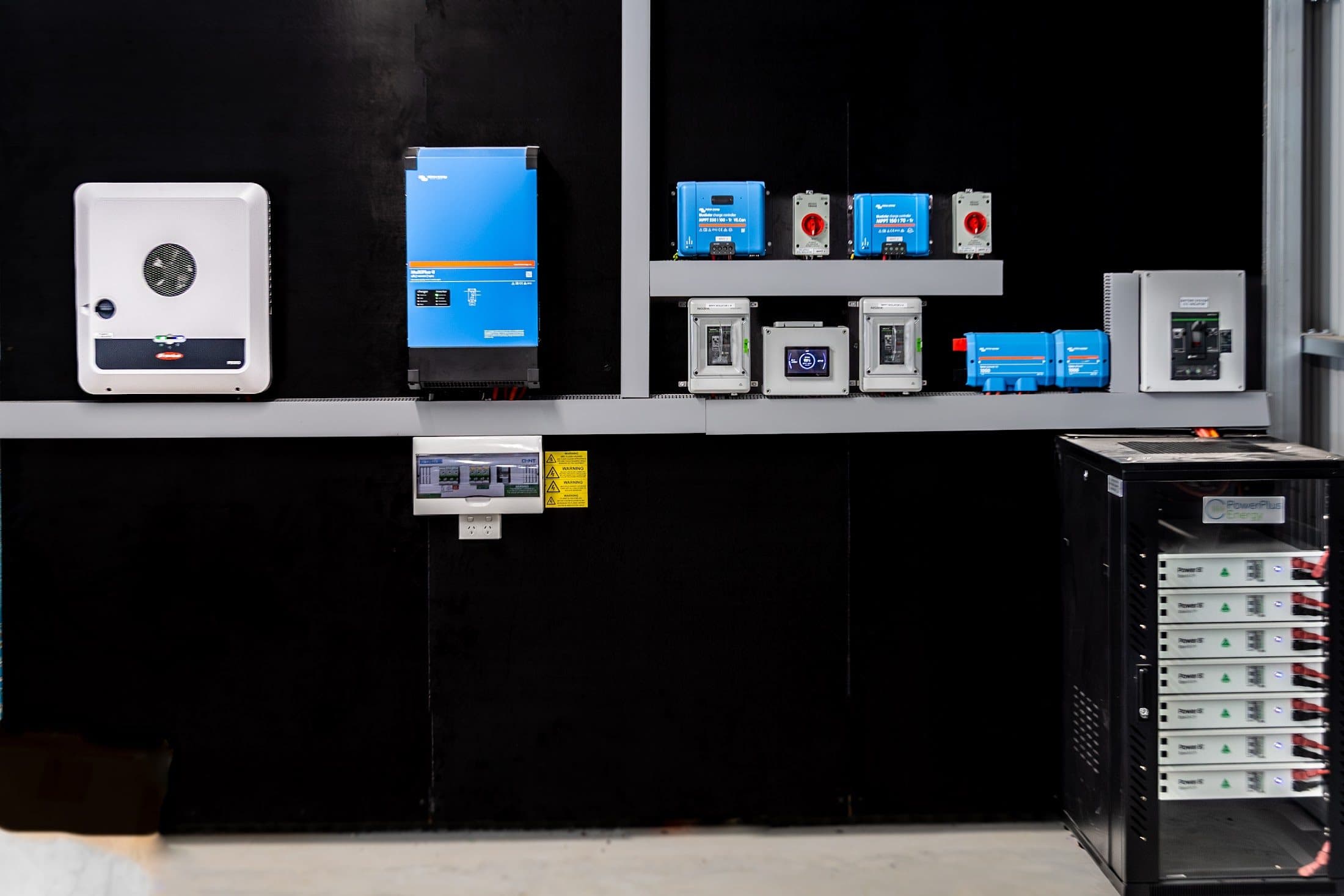
A 3 kVA inverter runs a fridge, pump and lights plus one kettle at a time; 5 kVA suits most homes; 8 kVA handles ovens and air conditioning.
A 3 kVA off grid inverter comfortably runs lights, a fridge, a TV, computers, a pressure pump and a washing machine, plus one big heating appliance such as a kettle at a time. A 5 kVA unit lets a normal household use the kettle while the pump, fridge and washing machine are running. An 8 kVA unit can run an electric oven, a dryer or a couple of split systems alongside everyday loads. What trips an inverter is usually a motor starting, or several big loads switching on at once.
What do 3, 5 and 8 kVA actually mean?
They are the continuous rating in volt amps, and the usable figure in watts is lower. On Victron's own MultiPlus-II specification page, checked in November 2026, the 48 volt models are rated like this:
- MultiPlus-II 48/3000: 3,000 VA, which is 2,400 W continuous at 25°C, 2,200 W at 40°C, and 5,500 W peak.
- MultiPlus-II 48/5000: 5,000 VA, which is 4,000 W continuous at 25°C, 3,700 W at 40°C, and 9,000 W peak.
- MultiPlus-II 48/8000: 8,000 VA, which is 6,400 W continuous at 25°C, 5,500 W at 40°C, and 15,000 W peak.
At 25°C the watt figure is 80 per cent of the VA figure, and output falls as the inverter gets hot. An inverter in a tin shed on a 40°C January afternoon has less to give, just when the air conditioner and pump are working hardest.
What is the difference between continuous and surge rating?
Continuous rating is what the inverter can hold for hours. Surge, or peak, rating is what it can deliver for a moment while something starts. Victron says its inverter chargers can deliver peak power of roughly double their continuous rating for short periods, and also warns that start up behaviour still has to be considered when sizing.
Treat surge as a starting allowance, not spare capacity. Ask a 3 kVA unit for 5,000 W for more than a moment and it shuts down on overload. The surge figure only tells you whether a motor can get going without the inverter dropping out.
Why do motors and compressors cause most of the trouble?
Because an electric motor started straight across the supply draws several times its running current until it gets up to speed. Textbook figures for induction motors started direct on line are five to seven times full load current, and Danfoss puts a direct on line compressor start at five to six times nominal current.
Take a common house pressure pump. Davey's HM60-08T is listed with a 0.72 kW output rating. If it draws about 1 kVA from the supply when running, our assumption rather than a Davey figure, a start at five to seven times running current asks for something like 5 to 7 kVA for a moment. That sits at or beyond the 5,500 W peak of a 3 kVA inverter, before the fridge happens to kick in at the same time. That is why a pump on a small inverter trips it seemingly at random: it depends on what else starts in the same second.
Plenty of newer gear starts gently. Inverter type split systems and heat pumps use variable speed compressors, and Danfoss describes their soft start as giving near zero inrush current. Pumps on variable speed drives ramp up gently in the same way. Old fridges, chest freezers, bore pumps, air compressors and bench grinders are the usual offenders.
How much power do common appliances draw?
The rating plate gives the real number. As a rough guide (most of these ranges come from an American appliance guide, so check your own plates):
- Kettle: 1,850 to 2,400 W, with most Australian kettles at 2,200 to 2,400 W.
- Microwave: 600 to 1,200 W.
- Fridge: 100 to 800 W while the compressor runs, much less averaged over a day, plus a start up surge.
- Washing machine: 400 to 1,400 W, higher if it heats its own water.
- Dishwasher: 1,200 to 2,400 W, mostly while its element heats or dries.
- Air conditioner: 500 to 3,500 W depending on size.
- Electric oven: 2,000 to 5,000 W.
- Clothes dryer: 1,800 to 5,000 W.
- Plug in heater: 750 to 1,500 W or more.
Elements are the big continuous loads, motors the big starting loads. LED lights, chargers and the modem barely register.
What can each size run at the same time?
Add up everything realistically on together and compare it with the continuous rating at the inverter's working temperature.
3 kVA (about 2,400 W)
Enough for a weekender, a cabin or a very careful household. Lights, fridge, TV, laptops and the pressure pump are fine together. A kettle at 2,400 W uses the whole inverter on its own, so the kettle, toaster and microwave take turns. A pump starting while the kettle is on is a likely trip.
5 kVA (about 4,000 W)
The usual size for a family house that does not cook or heat mainly with electricity. The kettle can go on while the fridge, pump, lights and washing machine are running. A modest inverter split system in the evening is realistic. The kettle plus a dishwasher heating plus a microwave is where it runs out.
8 kVA (about 6,400 W)
Suits an all electric house, a heat pump hot water system, a couple of split systems, or a workshop with bigger tools. It will run an oven and the kettle over the everyday loads, but not every heating appliance at once, and at 40°C it drops to 5,500 W.
Welders and three phase motors are a different design job, covered in powering a shed or workshop off grid. Victron units can also run in parallel or as three phase, though Victron notes the MultiPlus-II 8000 and larger models need an external AC transfer switch to run in parallel.
Is inverter size the same question as battery size?
No. Inverter size is power, measured in kW: how much you can run at once. Battery size is energy, measured in kWh: how long you can keep running. A big battery on a 3 kVA inverter runs the fridge for days but still trips when the kettle and pump coincide. A big inverter on a small battery runs everything at once, briefly.
They are linked in one place: the battery must be able to supply the current the inverter asks for. On a 48 volt system, 4,000 W of output is roughly 80 to 90 A from the battery once losses are counted, and a 9,000 W surge is around 180 to 200 A. If the battery's management system limits discharge below that, it will cut out before the inverter does. Victron says the battery must be able to deliver the inverter's continuous and surge current, and points to the pairings in its datasheets and manuals. Our article on how much battery an off grid house needs covers the energy side.
Does a bigger inverter cost you anything apart from the price?
Yes, a little standby energy. The 48 volt MultiPlus-II 3000 draws 11 W with no load, while the 8000 draws 29 W. Over a day that is about 0.26 kWh against 0.7 kWh, which matters in a Central Victorian June when the panels are making little.
The generator side changes with size too. With the generator running, the 3000 passes through up to 32 A, the 5000 up to 50 A and the 8000 up to 100 A, and PowerAssist lets the inverter top up a smaller generator from the battery during a peak. Our generator page goes into matching the two.
What can an owner safely check, and what needs an electrician?
You can safely read the overload and warning history on the GX display or VRM portal, read rating plates, and change habits, such as not boiling the kettle while the pump fills a tank. If you refuel a generator, switch its auto start off first.
Leave the inside of the inverter, the battery enclosure, the DC cabling and the switchboard to a licensed electrician: a 48 volt battery bank can deliver hundreds of amps into a fault. Changing inverter settings, adding circuits, fitting soft starters or adding an inverter are licensed work.
Mick McDonald
Technical Director, Trentham Energy
Questions about your own system? Call 1300 3458 00 or send us a message.
Sources
- Victron Energy: MultiPlus-II 230V technical specifications
- Victron Energy: Help me choose the right inverter/charger
- Danfoss: Inverter technology for AC, heating and ventilation
- Electrical Easy: Starting methods of three phase induction motors
- Cool Tech Pumps: Davey HM60-08T home pressure system
- Enphase: How many watts do common home appliances use?
- Highflow Energy: How many watts does a kettle use