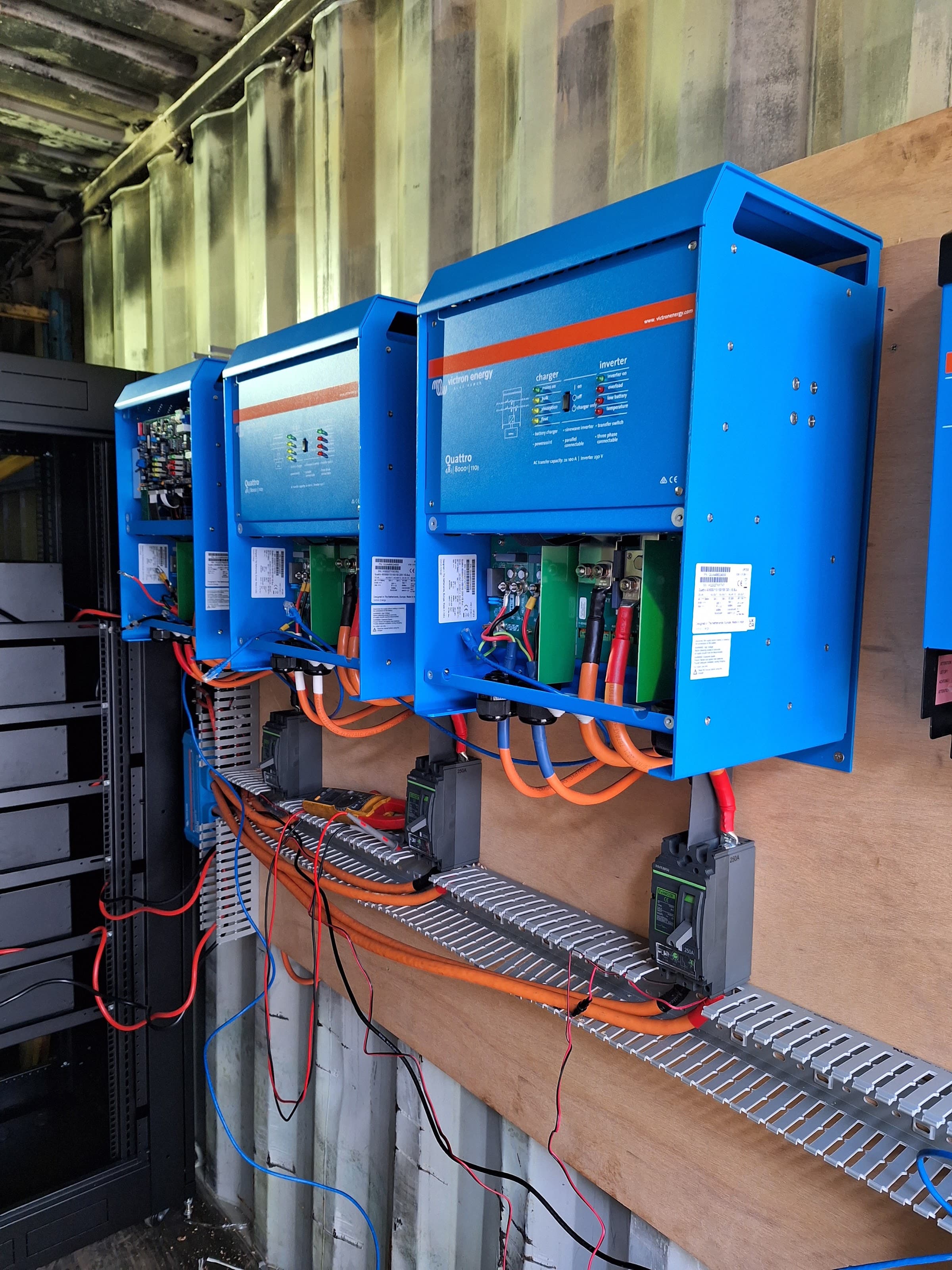
Choose an off grid inverter by continuous kW, surge, a 48 V battery, how the solar connects, generator input and phase. A worked example with real figures.
An off grid inverter is the heart of an off grid power system: it makes the 230 volt power the house runs on from a battery, and it charges that battery from the solar and a generator. Choose one by the continuous power your house uses at once, the surge its motors need to start, a 48 volt battery, how the solar panels connect, a generator input with auto start, and whether you need one phase or three.
What does an off grid inverter charger do that a grid tied inverter cannot?
It makes its own grid. A grid tied solar inverter follows the network and, by law, switches itself off within a fraction of a second when grid power is lost, so it cannot run a house on its own. An off grid inverter charger builds the 230 volt supply from the battery, charges the battery from a generator, and passes generator power straight through to the house while it does.
That is also the answer to the common search "off grid inverter vs hybrid inverter". A hybrid inverter is a grid connected inverter with a battery port; some keep a few circuits running in a blackout. An off grid inverter charger is built to be the only supply, every day, with a generator as its backup.
Australian standards treat the two differently. AS/NZS 4509.1 sets the safety and installation rules for stand alone power systems, the standards term for off grid. On the Clean Energy Council's inverter list, an inverter that connects to the grid must meet AS/NZS 4777.2, while a stand alone inverter with no grid connected port is judged against safety standards such as IEC 62109.
What size off grid inverter do I need?
Big enough to carry everything that runs at the same time, continuously, and to start your largest motor while the rest are running. Inverters quote two numbers:
- Continuous rating: what the inverter holds for hours. Victron's MultiPlus-II 48/5000 is 5,000 VA, which is 4,000 W at 25°C and 3,700 W at 40°C.
- Peak or surge rating: what it gives for a moment while a motor starts. The 48/5000 peaks at 9,000 W; the 48/8000 gives 6,400 W continuous, 5,500 W at 40°C, and 15,000 W peak.
Surge matters because a motor started straight across the supply draws five to seven times its full load current until it gets up to speed. Heating elements are the big continuous loads: most Australian kettles are rated 1,850 to 2,400 W.
Run a house inverter from a 48 volt battery. A 4,000 W load draws about 83 A from a 48 volt battery and four times that at 12 volts, which means huge cables and fuses. The Victron MultiPlus-II sizes explained article goes through every model, and what you can run on a 3, 5 or 8 kW off grid inverter covers the appliance side.
Worked example: sizing an off grid inverter for a family house
Take a family house whose rating plates read:
- Kettle: 2,400 W
- Fridge: 300 W while the compressor runs (fridges run 100 to 800 W, averaging less as they cycle)
- Lights, TV, modem and chargers: 300 W together
- Washing machine: 500 W
- Pressure pump: taken as 1,000 W running, our assumption for a pump like Davey's HM60-08T, which has a 0.72 kW output motor
Continuous load at the busy moment. Kettle, fridge, lights and pump together are 2,400 + 300 + 300 + 1,000 = 4,000 W. That is the whole 25°C rating of a 48/5000 and more than its 3,700 W at 40°C.
Surge. At five to seven times its running draw, the pump asks for 5,000 to 7,000 W as it starts. With the fridge, lights and washing machine on (1,100 W), the peak is 6,100 to 8,100 W, inside the 48/5000's 9,000 W. Add the kettle and it becomes 8,500 to 10,500 W, and at the top of that range the inverter trips.
The choice. A 48/5000 works if the household lives with the kettle and pump not overlapping, or the pump is changed for a soft starting one. A 48/8000, with 6,400 W continuous and 15,000 W peak, carries all of it without anyone thinking about it, at the cost of a higher idle draw: Victron lists 29 W with no load for the 8000.
AC coupled or DC coupled solar: which suits an off grid inverter?
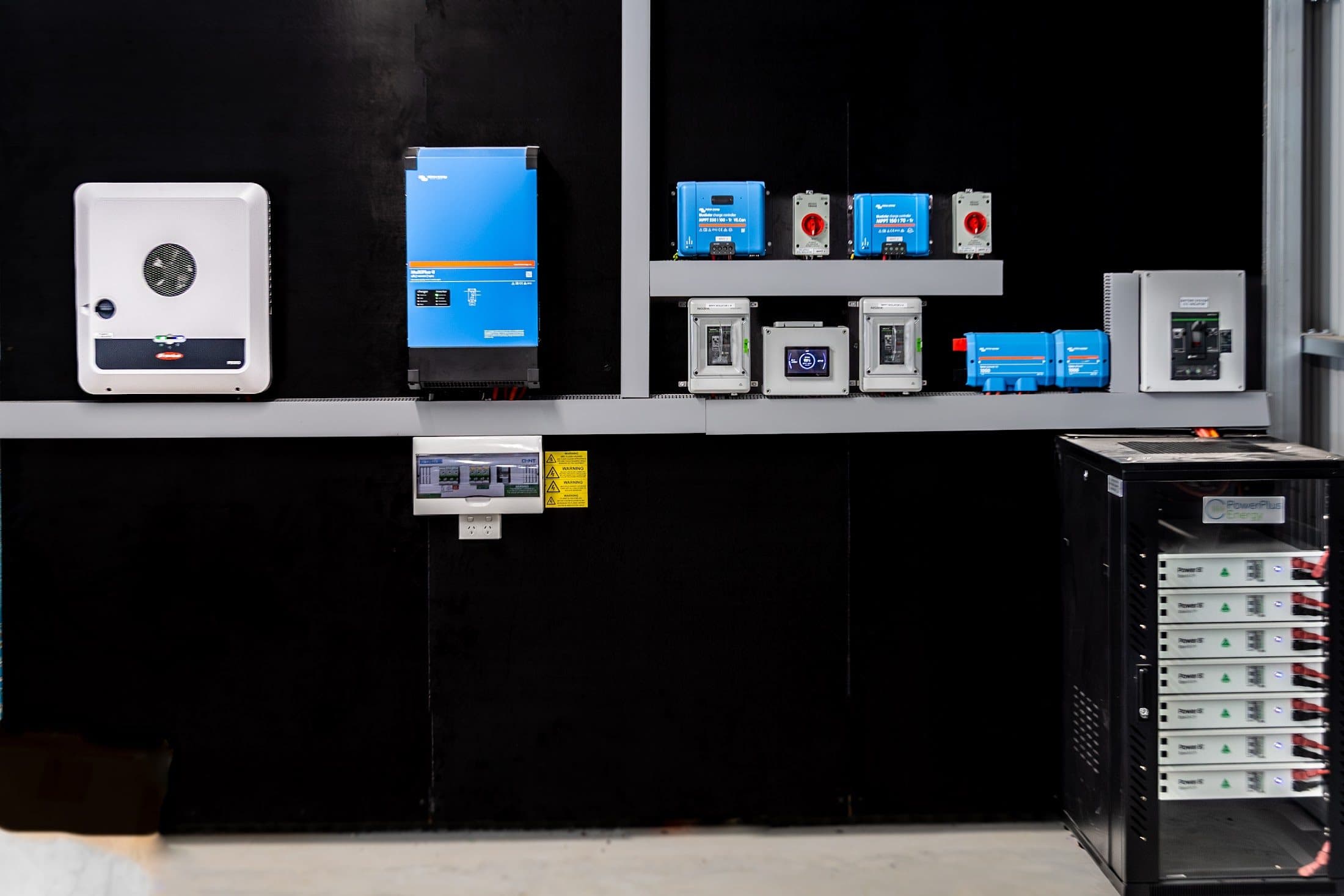
DC coupled, or at least mostly DC coupled. With DC coupling the panels feed the battery through a solar charge controller, such as Victron's SmartSolar MPPT, and Victron says no Factor 1.0 limit applies to that solar.
With AC coupling a normal grid type solar inverter sits on the output of the inverter charger, which throttles it by shifting the AC frequency when the battery is full. Victron's rules are that the AC coupled solar must not exceed the inverter charger's VA rating, so 5,000 W on a 5,000 VA unit, and that lithium storage needs about 4.8 kWh for every 1.5 kW of AC coupled panels. Victron's guide also says DC coupling is needed for off grid systems, because AC coupling alone can end in a deadlock once the battery is flat.
Off grid inverter with generator input: auto start and three phase
Every full time off grid house needs a generator input, because winter will empty the battery sooner or later. The inverter charger's transfer switch passes generator power to the house while its charger fills the battery: on the MultiPlus-II that is 50 A pass through and 70 A of charging on the 48/5000, and 100 A and 110 A on the 48/8000.
Auto start is what makes it livable. Victron's Cerbo GX lists auto start and stop of a generator, quiet periods when it will not start, and remote control through the VRM portal. Our article on what size generator an off grid house needs covers matching the two.
Most houses run on single phase. Where a property has three phase pumps or machinery, Victron's MultiPlus-II supports three phase and parallel operation, one unit per phase. Its specification table notes the 8, 10 and 15 kVA models can only run in parallel with an external AC transfer switch, so decide early.
Which off grid inverters do Australians compare?
The names most Australians weigh up for a house are Victron Energy and Selectronic.
- Victron Energy (Netherlands): the MultiPlus-II inverter chargers, the Quattro, which accepts two AC inputs, SmartSolar MPPT charge controllers, and the Cerbo GX with the VRM portal for monitoring.
- Selectronic (Australia): the SP PRO Series 2i, which Selectronic says is Australian designed and manufactured, from 3 kW to 20 kW continuous per model at 48 or 120 volts, up to 240 kW over three phases with its Powerchain system, with AC or DC coupling, integrated generator control and remote monitoring.
Whatever the badge, ask for the continuous rating at 40°C, the peak rating, the generator transfer and charge current, how solar connects, the Clean Energy Council listing and how the installer will watch it remotely.
Questions
Can I use a hybrid inverter off grid?
Only if it is designed and listed to run with no grid connection at all. A hybrid inverter's backup output is built for blackouts, not for being the only supply every day with a generator charging the battery. Check the maker's documentation for off grid operation before buying one for that job.
What battery voltage should an off grid inverter be?
48 volts for a house. Lower voltages are for small loads with short cables, such as a caravan or a shed.
Can an off grid inverter charge from a generator?
Yes, that is what the charger half of an inverter charger does. With auto start, the generator runs when the battery gets low and the system stops it again when charging is done.
Mick McDonald
Technical Director, Trentham Energy
Questions about your own system? Call 1300 3458 00 or send us a message.
Sources
- MultiPlus-II 230V technical specifications, Victron Energy (read 25 November 2026)
- AC coupling and the Factor 1.0 rule, Victron Energy
- Quattro inverter charger, Victron Energy
- Cerbo GX, Victron Energy
- SP PRO Series 2i multi mode inverters, Selectronic
- Inverter categories and required standards, Clean Energy Council (2024)
- AS/NZS 4509.1:2009 Stand alone power systems, Part 1: Safety and installation, Building Performance NZ codehub
- Solar inverter anti islanding protection, SolarQuotes
- Starting methods of three phase induction motors, Electrical Easy
- How many watts do common home appliances use, Enphase
- How many watts does a kettle use, Highflow Energy
- Davey HM60-08T home pressure system, Cool Tech Pumps