At $2.84 a litre, a farm generator makes power for about 66 cents to $1.28 per kWh after tax credits. How that compares with the grid, solar and a battery.
On 31 October 2026 a diesel generator on a GST registered farm makes electricity for roughly 66 cents to $1.28 per kWh in fuel alone, depending on how hard it is working. Grid power on Powercor's default small business tariff is 27.36 cents including GST. Solar energy works out at around 2 to 3 cents per kWh over its life, and storing it in a battery adds about 20 to 28 cents per kWh. The arithmetic and every input are below, so you can redo it with your own numbers.
Input 1: what a litre of diesel costs you
- Pump price: $2.839 a litre at the Shell in Sebastopol on 31 October 2026, from Service Victoria's Servo Saver data. The same station averaged $2.772 from 3 August to 31 October.
- GST: a GST registered business claims back one eleventh, leaving $2.581.
- Fuel tax credit: the ATO rate for diesel used for business purposes off public roads, which includes generators, is 53.7 cents a litre for fuel acquired from 3 August 2026. For fuel acquired from 1 July to 2 August 2026 it was 36.6 cents.
- Net cost to the business: $2.581 minus $0.537 is about $2.04 a litre.
A household or hobby farm that cannot claim GST or the credit pays the full $2.84.
Input 2: litres per kWh
How much fuel a generator burns for each kWh depends on its load. Cummins publishes the fuel table for its C22 D5, a 20 kVA set rated 16 kW prime:
- full load, 16 kW at 5.2 litres an hour: 0.33 litres per kWh
- three quarter load, 12 kW at 4.1 litres an hour: 0.34 litres per kWh
- half load, 8 kW at 3.2 litres an hour: 0.40 litres per kWh
- quarter load, 4 kW at 2.5 litres an hour: 0.63 litres per kWh
That is the most important number in the whole comparison. A generator working near its rating sits around a third of a litre per kWh. A big set idling along at a quarter of its rating burns nearly twice as much fuel for the same energy.
The diesel result
Multiply the net price per litre by the litres per kWh:
- full load: $2.04 times 0.33 is about 66 cents per kWh
- three quarter load: about 70 cents
- half load: about 82 cents
- quarter load: about $1.28
For a buyer who pays the full $2.84, the same four figures are about 92 cents, 97 cents, $1.14 and $1.77 per kWh.
These are fuel only. Oil and filter changes, servicing, overhauls, the trip to refill the tank and the generator itself are on top.
The grid result
The Essential Services Commission's Victorian Default Offer for 1 July 2026 to 30 June 2027 is the reference price for Powercor's network. All figures include GST:
- small business flat tariff (under 40 MWh a year): 27.36 cents per kWh plus $1.6978 a day supply
- small business time of use: 36.29 cents from 9 am to 9 pm on weekdays, 19.21 cents at all other times, same supply charge
- household flat tariff: 28.22 cents per kWh plus $1.3805 a day
Excluding GST, the business flat rate is about 24.9 cents. Market offers can be lower or higher; our energy plan finder ranks them against your own usage.
Even the dearest time of use rate, about 33 cents excluding GST, is half the best case diesel figure.
The solar result
Solar has almost no running cost, so its cost per kWh is the system price spread over what it makes.
- Price: Solar Choice's index for 1 October 2026 puts a 10 kW residential system in Melbourne at $8,920 including GST after the STC discount. Its August 2026 commercial table puts 30 kW in Melbourne at $26,150, or $23,773 excluding GST.
- Output: the European Commission's PVGIS model gives about 1,460 kWh per installed kW per year for a north facing array at Trentham tilted 30 degrees.
- Over 25 years: 10 kW makes about 365,000 kWh, so $8,920 works out at about 2.4 cents per kWh. 30 kW makes about 1,095,000 kWh, so $23,773 is about 2.2 cents per kWh excluding GST.
Those figures leave out maintenance, an inverter replacement during the life, panel ageing and finance, and a farm ground mount or long cable run costs more than a city roof. Even doubled, solar energy is a fraction of grid or diesel. The catch is timing: solar is only worth that much when you use it as it is made.
The battery result
Stored energy costs more than solar energy because the battery wears with use. Solar Choice's August 2026 figures, including GST and the federal battery rebate, divide installed price by the warranted energy throughput:
- 16 to 20 kWh batteries: about 28 cents per warranted kWh
- 20 to 30 kWh: about 23 cents
- 30 to 40 kWh: about 21 cents
- 40 to 50 kWh: about 20 cents
These are household prices with the rebate applied. Add the solar that charged it and solar plus battery energy is roughly 22 to 30 cents per kWh across a warranted life. That is about the grid's flat rate, well under diesel, and it is energy you have at night and in an outage.
What this means on a farm
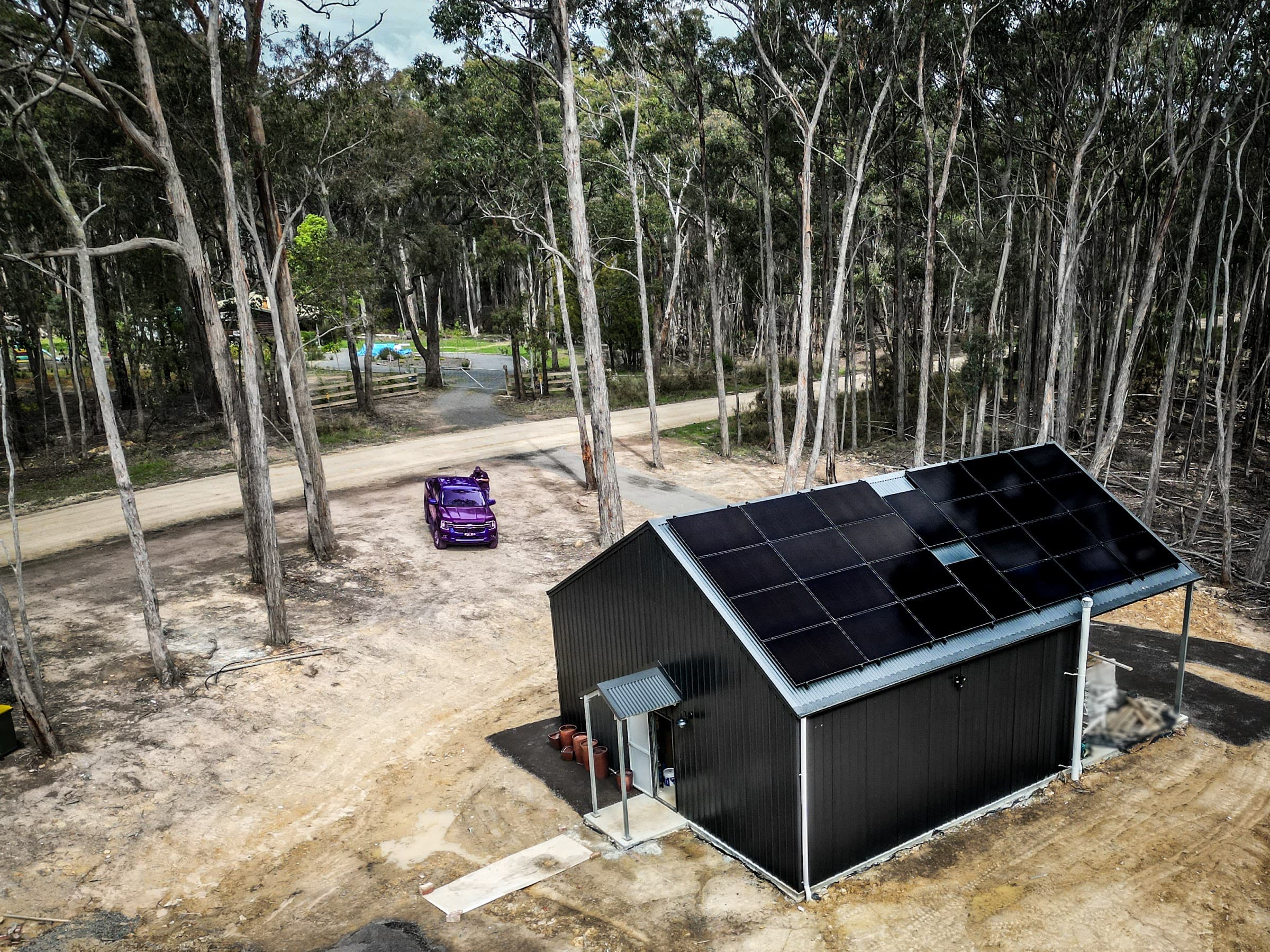
- Grid connected sites: use solar for daytime loads first; it is the cheapest energy you will ever buy. Add a battery where you have evening load, peak tariffs or outages to cover.
- Off grid sites: design so the generator runs rarely and runs hard. A generator that charges the battery bank at near full load uses a third of a litre per kWh; one left running a small load all night uses twice that. Our generators page explains how we size and automate them.
- Diesel pumps and engines: the same light load trap applies. See moving a farm pump off diesel.
Questions
How much diesel does a generator use per kWh?
From Cummins' published table for its 16 kW prime C22 D5, about 0.33 litres per kWh at full load, 0.34 at three quarter load, 0.40 at half and 0.63 at quarter load. Other sets differ, so check the maker's fuel table for yours.
What is the fuel tax credit for farm diesel in 2026?
The ATO rate for liquid fuels used for business purposes other than in heavy vehicles on public roads is 53.7 cents a litre for fuel acquired from 3 August 2026, and 36.6 cents for fuel acquired from 1 July to 2 August 2026.
Is it cheaper to run a generator or connect to the grid?
On running cost, the grid is cheaper per kWh. The real question on a farm is the cost of the connection, which on a long rural run can be large. Our grid connection versus off grid page compares the two.
If you send us your bills, your fuel use and your address, we will come back with a right sized design, or start with the sizing tool.
Sources
- ATO, fuel tax credit rates for business, 1 July 2026 to 30 June 2027
- Shell Sebastopol diesel price, Servo Saver data via fuel prices EU (read 31 October 2026)
- Cummins C22 D5 generator set data sheet DS340-CPGK
- Essential Services Commission, Victorian Default Offer 2026 to 27
- Solar Choice, solar panel costs price index (October 2026)
- Solar Choice, battery prices (August 2026)
- PVGIS, European Commission Joint Research Centre (Trentham, 30 degrees, north)
Written by the Trentham Energy team.