A heat pump heats an average home's water for about $85 to $225 a year in power. Gas costs at least $326 before supply charges. The sums and rebates.
A heat pump hot water system heats an average household's water for roughly $85 to $225 a year in electricity on Powercor's 2026 to 27 default rates, depending on how cold it gets and when it runs. The same heat from a gas storage tank costs at least $326 a year on a Central Victorian standing offer, before the gas supply charge, and an electric storage tank costs about $410 to $670. Solar Victoria's rebate of up to $1,000, or $1,400 for a locally made unit, still applies on 31 October 2026, and from 1 March 2027 a gas hot water system that dies must be replaced with an electric one anyway.
How much heat a household actually uses
The inputs come from a 2023 report for the NSW Government on hot water baselines. It found that at 45 litres a day per person, the average household uses about 23.4 MJ of hot water energy a day in hot water zone 4, close to the small load in the Australian standard. That is 6.5 kWh of heat a day, or about 2,372 kWh a year.
Every system below has to deliver that same heat. What changes is how much energy it buys to do it, and what that energy costs.
The running cost, with the inputs
- Electricity: Powercor's Victorian Default Offer from 1 July 2026, including GST: 28.22 cents per kWh flat, 17.26 cents in the 11 am to 4 pm solar soak window, and 17.26 cents on controlled load.
- Gas: EnergyAustralia's standing offer from 1 July 2026 for the AusNet West zone (Ballarat, Kyneton, Castlemaine, Daylesford postcodes), including GST: 4.2559 cents per MJ for the first 100 MJ a day from 1 June to 30 September, and 3.5959 cents the rest of the year, plus 159.06 cents a day supply. Market offers are often cheaper.
- Heat pump efficiency: the iStore 270L datasheet gives a coefficient of performance (COP) of 4.8 at 20 degrees ambient, heating to 60 degrees. That means 4.8 units of heat for each unit of electricity. On a cold Central Victorian winter morning the real figure is lower, so we also show a COP of 3.
What that gives you, per year:
- Heat pump at COP 4.8: 494 kWh. In the solar soak window that is about $85; on the flat rate about $139.
- Heat pump at COP 3: 791 kWh. About $137 in the solar soak window, about $223 on the flat rate.
- Heat pump on your own solar: 494 kWh that you would otherwise export. With some retailers paying up to 8 cents for exports, that is worth about $40 a year.
- Electric storage tank: a resistive element turns one unit of electricity into one unit of heat, so at least 2,372 kWh. About $410 on controlled load, about $670 on the flat rate.
- Gas storage tank: 8,541 MJ of heat a year at the seasonal rates above is at least $326, even if the tank lost nothing. Real tanks lose heat, so the true figure is higher. If hot water is your last gas appliance, the supply charge adds about $581 a year on that tariff.
Electric storage and the heat pump figures also leave out standing losses from the tank, which apply to every storage system.
The rebates on 31 October 2026
- Solar Victoria hot water rebate: 50% of the price after other discounts, up to $1,000 for an eligible heat pump or solar hot water system, or up to $1,400 for an eligible locally made product (the locally made incentive started on 1 July 2025). You must own and live in the home, the combined taxable income of all owners must be under $150,000 a year, the property must be valued under $3 million, and the system being replaced must be at least three years old. The page was last updated on 27 October 2026.
- Small scale technology certificates (STCs): the federal scheme gives an eligible heat pump a number of certificates based on its hot water zone and model, which comes off the price.
- Victorian Energy Upgrades (VEU): an approved provider can give a VEU hot water discount on top.
Solar Victoria puts the combined reduction from all three at up to $1,630 for most systems and up to $1,960 for a locally made one. Rebates change each 1 July, so check the figures on the day you sign.
The rule that starts on 1 March 2027
From 1 March 2027, when a gas hot water system in an existing Victorian home reaches the end of its life and cannot be repaired or safely maintained, it must be replaced with an electric system such as a heat pump. Bottled LPG can still be used for hot water in regional homes. Our article on getting off gas in Central Victoria covers the rest of the rules. If your gas tank is old, planning the change now beats a cold shower and a rushed choice later.
Heat pumps in a frost zone
A heat pump pulls heat out of the air, so cold air makes it work harder. Two of the units we install show the limits plainly:
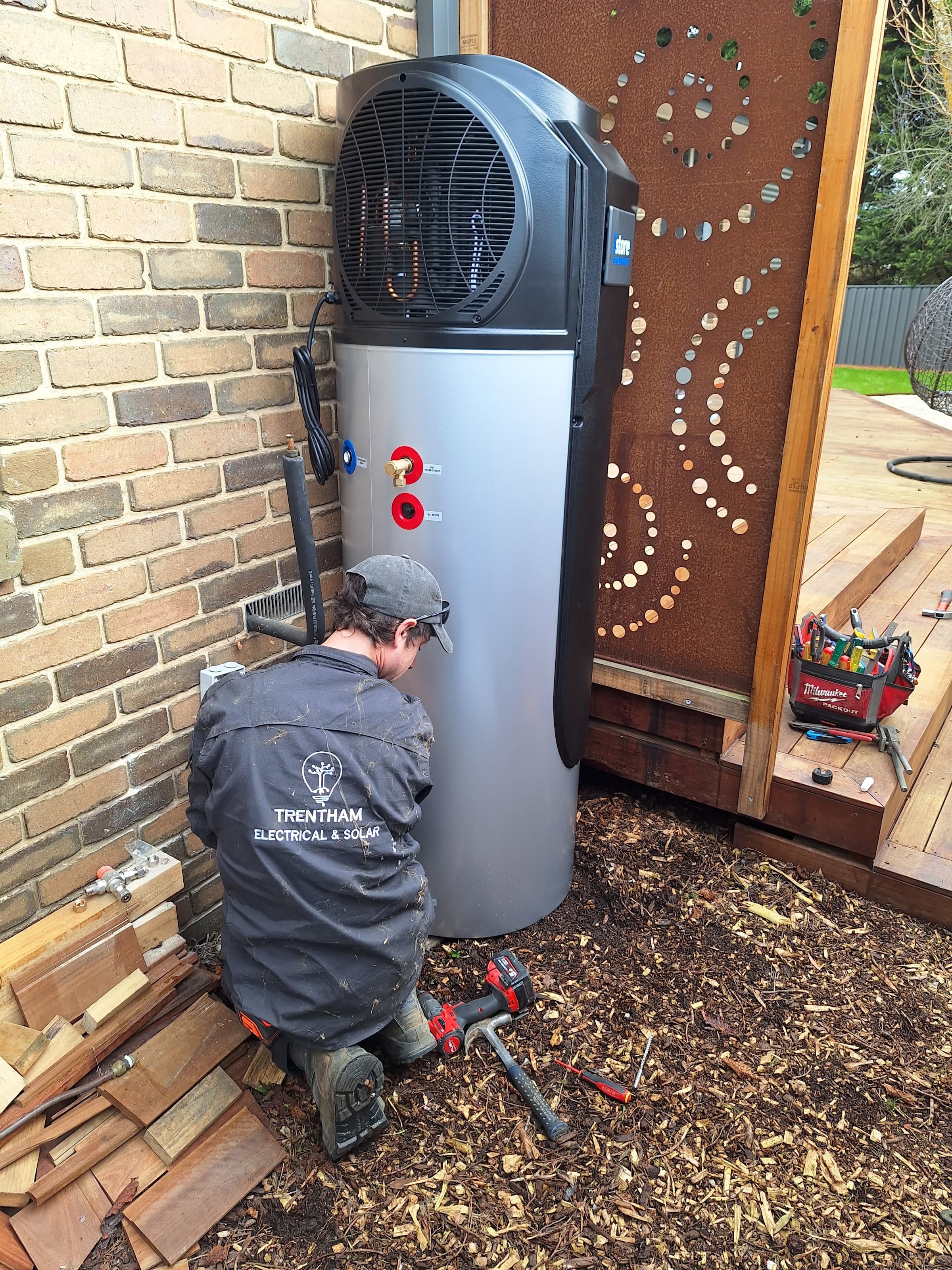
- iStore 270L: operating range of minus 5 to 43 degrees, R290 refrigerant, a PCB controlled anti frost cycle, inbuilt timers, and 47 dB(A) at one metre.
- Thermastore Heatwave 270: a sister brand of Evoheat, 270 litres, R290, a listed range of minus 5 to 43 degrees and a 1 kW backup element. SolarQuotes notes some owners need a manual boost in very cold conditions or high demand.
Winter mornings around Trentham, Glenlyon and Ballan are often frosty. The answer is to run the heat pump in the middle of the day, when the air is warmest and solar is on the roof. That is also when Powercor's solar soak rate applies. Place the unit away from bedroom windows, because a compressor running at 47 dB(A) is noticeable at night.
A 270 litre tank suits an average family; SolarQuotes suggests larger tanks for six people. Our hot water page has more on the systems we install.
Which is right for you
- Gas storage near the end of its life: a heat pump is the obvious replacement, and from 1 March 2027 it is close to the only one.
- Electric storage on off peak: a heat pump uses roughly a third to a fifth of the electricity for the same hot water.
- Solar on the roof: a heat pump on a midday timer is the cheapest hot water there is.
Send us a photo of your current hot water system, a recent bill and your address, and we will come back with a right sized heat pump and the rebates you qualify for.
Questions
How much does a heat pump hot water system cost to run per year?
For an average household using 23.4 MJ of hot water energy a day, about $85 to $225 a year on Powercor's 2026 to 27 default rates, depending on the season's real efficiency and whether it runs in the solar soak window or on the flat rate.
Do heat pumps work in frosty Central Victorian winters?
Yes, within their operating range, which is minus 5 to 43 degrees for the iStore 270L. Efficiency drops in the cold, so run it in the middle of the day on a timer, and pick a unit with a backup element if the site gets hard frosts.
Can I get the Solar Victoria hot water rebate in 2026?
If you own and live in the home, the owners' combined taxable income is under $150,000, the property is valued under $3 million and the old system is at least three years old. The rebate is up to $1,000, or $1,400 for a locally made unit, as of 27 October 2026.
Do I have to replace my gas hot water with a heat pump?
From 1 March 2027, yes, once the gas system reaches the end of its life and cannot be repaired. A working gas system can keep running and can be repaired.
Sources
- Solar Victoria, hot water rebate (last updated 27 October 2026)
- iStore 270L R290 product specification data sheet (October 2024, PDF)
- SolarQuotes, Thermastore heat pump review
- EnergyConsult for the NSW Government, residential and small business hot water baselines (December 2023, PDF)
- Essential Services Commission, Victorian Default Offer 2026 to 27
- EnergyAustralia, Victorian gas standing offer rates from 1 July 2026 (PDF)
- AusNet, new rules for gas and electric homes in Victoria
- Energy Matters, Victoria solar feed in tariff 2026 to 27 (10 July 2026)
Written by the Trentham Energy team.