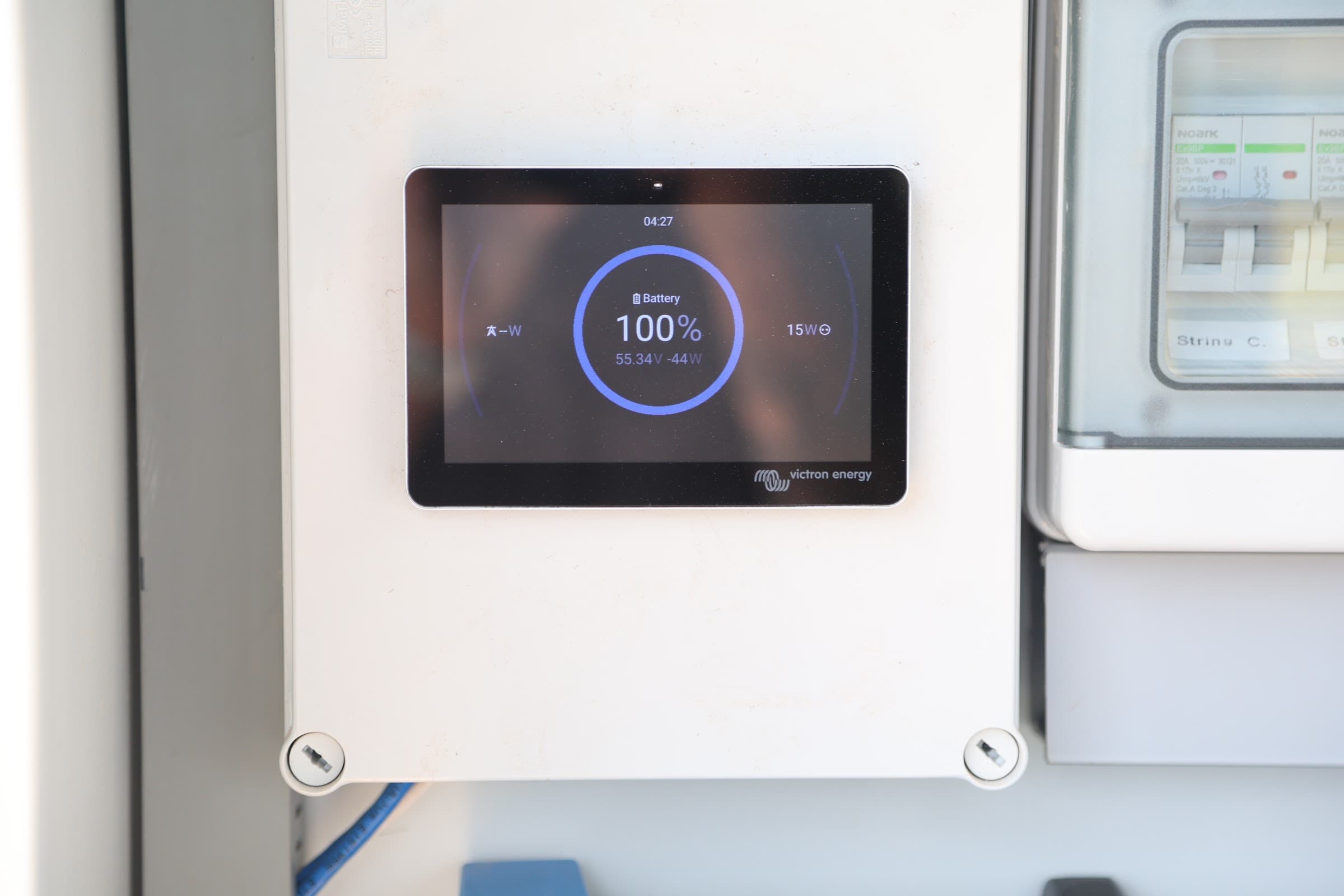
A year of Victron VRM data shows the battery's seasonal cycle, when the generator runs, which months bite and the faults that appear before you notice.
A year of remote monitoring tells you four things a single site visit never can: how the battery's daily cycle shifts with the seasons, when and why the generator runs, which months are tight for your system, and which parts are starting to misbehave before anything actually stops. On a Victron system all of that comes through the VRM portal, the same view the owner has on their phone and the one we use to support systems from Trentham.
What VRM keeps, and for how long
Victron's VRM portal stores two kinds of data. The dashboard figures for solar yield and consumption, in kilowatt hours, are kept for a minimum of five years. The detailed data in the Advanced tab, the voltages, currents and device readings behind the graphs, is kept for at least six months, with battery state of charge treated as an exception in Victron's own answer.
That split shapes how a year is read. The kilowatt hours tell the seasonal story over many years. The fine detail is for chasing a specific event, so when something odd happens it is worth looking while the data is fresh.
The battery's year
A well sized off grid battery has a recognisable rhythm, and the rhythm changes with the months.
- Summer. The battery is full by mid morning and the panels spend the afternoon with nowhere to put their energy. The overnight low is shallow.
- Autumn and spring. The battery still fills most days, but later, and a run of cloud shows as two or three nights where it does not quite get back to full.
- Winter. The daily swing is deeper, full is reached late in the day or not at all, and the low point after a grey spell is where the generator start rule earns its place.
That shape follows the sun. PVGIS puts the output of a north facing kilowatt near Trentham at about 5.5 kWh a day in January and about 2 kWh a day in June at roof pitch. Our article on off grid solar in a Central Victorian winter has the month by month figures. A system that stays comfortable through June and July on the graph is sized right; one that sits low for weeks is telling you something.
Generator hours: the number that matters most
The generator's run hours are the clearest single measure of how a system is coping. On a system designed for the site, the hours cluster in May, June, July and August and are close to zero the rest of the year.
What to look for over a year:
- When it ran. Hours outside winter usually mean the battery is being asked for more than it was sized for, or a part of the array has stopped.
- How long each run lasted. Short, frequent runs often point at a start rule set too high. Long runs can mean a weak charger setting or a generator too small to charge and run the house together.
- Whether it actually started. VRM's automatic alarms include a generator not detected at the AC input, which catches the generator that was asked to start and did not.
- The trend year on year. A rising count with the same weather usually means the household load has crept up, a new freezer, a second fridge, an electric heater, rather than the system failing.
Load creep shows up in the kilowatt hours
The consumption figures VRM keeps for five years make load creep visible. Families grow, a shed gets a compressor, someone starts working from home. None of it feels big on the day, but a year on year comparison of winter consumption shows it plainly. That is usually the moment to add a few panels or a battery module before the next winter, not after it.
Faults that show up before you notice
Victron's automatic alarm monitoring watches a list of parameters on every connected product and sends an alert when one enters an alarm state, then a recovery notice when it clears. The list covers the things that go wrong off grid:
- inverter charger errors, overload, high temperature and low battery
- battery high and low voltage, low state of charge, high current, cell imbalance and internal errors
- solar charger faults and voltage alarms
- the generator not detected at the AC input
Two others are worth knowing. Communication monitoring raises an alarm when a site stops sending data, which on a remote block is often the first sign of a power or internet problem. And user configurable alarms can be set on any value in the VRM database, with a delay so a short spike does not wake anyone up. Alerts can go by email, by push notification to the VRM app, or to a web browser.
Some faults never raise an alarm but show in the graphs. A string of panels that stops producing shows as one charge controller's yield falling away from its neighbours. A battery that holds less than it used to shows as a deeper drop for the same evening load. A fan that is failing shows as a temperature that climbs higher each summer afternoon.
What can be done from Trentham
Monitoring is only half the value; the other half is acting on it without a drive. Through VRM, an installer can update firmware remotely, and with Remote VEConfigure can download an inverter charger's configuration, change it and upload it again, which covers things like charge settings and generator rules. Victron notes that some changes, such as Assistant settings, can briefly switch the inverter charger off, so they are done at a time agreed with the owner, and with the owner's permission. That is a large part of why we build off grid on Victron.
If you already have a Victron system and want a second pair of eyes on its year, or you want to know what monitoring would look like on a system you are planning, get in touch. Our upgrades and repairs page covers what usually comes next.
Questions
How long does Victron VRM keep my data?
Victron says solar yield and consumption figures on the dashboard are kept for at least five years, and the detailed Advanced data for at least six months, with battery state of charge treated as an exception.
Will VRM tell me if my generator fails to start?
Yes. Its automatic alarm monitoring includes a generator not detected at the AC input, and alerts can go to email, the VRM app or a browser.
Can my installer change settings without coming out?
On a Victron system with a GX device connected to the internet and VRM, an installer can update firmware and change inverter charger settings remotely through Remote VEConfigure, with some limits on older firmware.
What is the first sign an off grid system is undersized?
Generator hours outside winter, and a battery that sits low for weeks at a time in June and July. Both are plain to see in a year of data.
Sources
- Victron Energy, VRM portal manual, contents
- Victron Energy, VRM portal manual, alarms and monitoring
- Victron Energy, VRM portal manual, frequently asked questions
- Victron Energy, VRM portal manual, Remote VEConfigure
- PVGIS 5.3, monthly output for Trentham at 15 degrees, north facing (European Commission JRC)
Written by the Trentham Energy team.