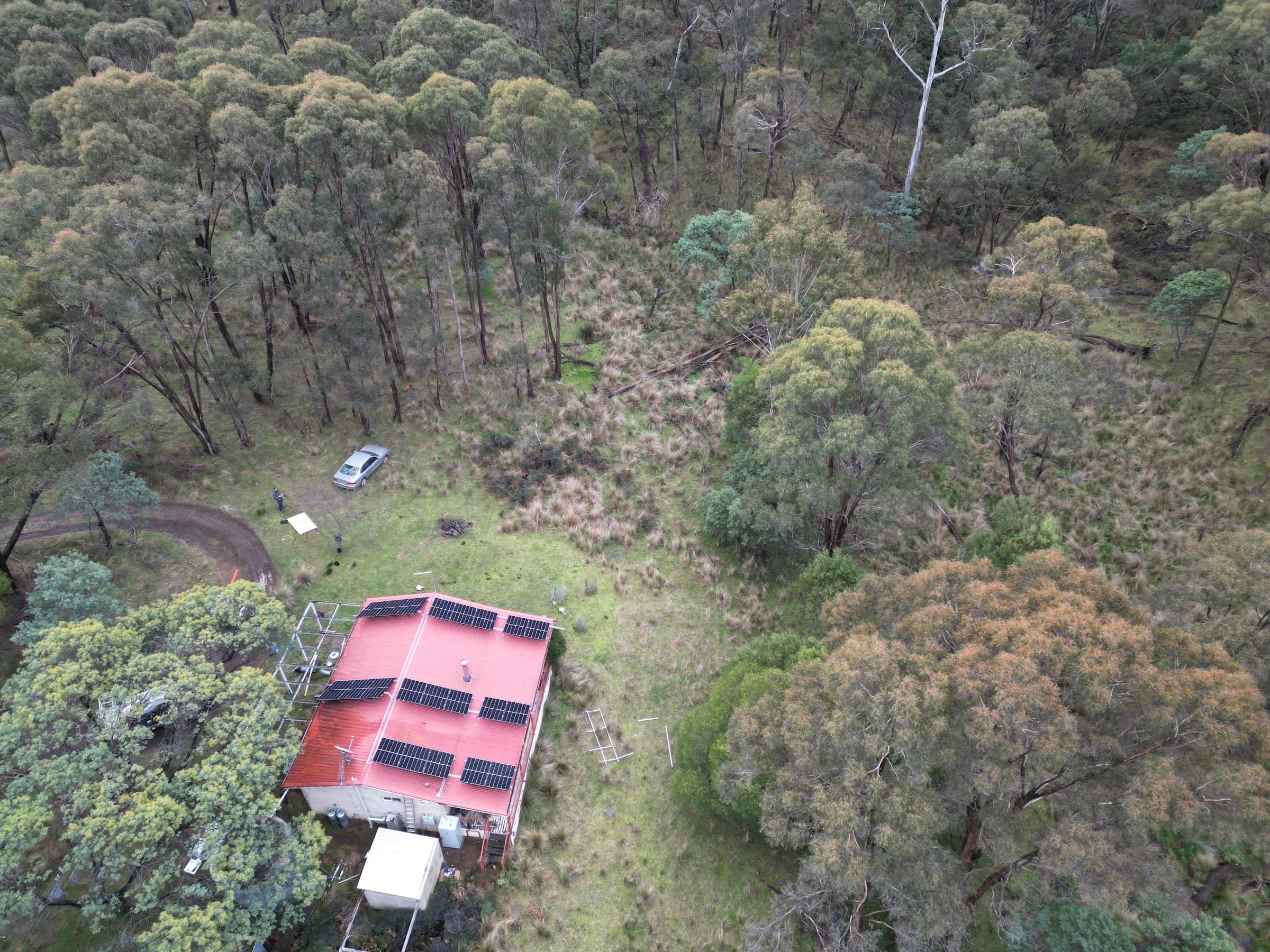
Five kWh a day runs a fridge, lights, a pump and a few devices. What that looks like on a small off grid system, and the pitfalls of the cheap kits.
A weekender or a bush block cabin usually needs around 5 kWh a day: a fridge, LED lights, a water pump, a TV and the phones and laptops. That is a small off grid system, a few kilowatts of panels, a modest lithium battery and a small inverter charger, and it can be built properly for a fraction of what a full family home needs. The trap is the other end of the market, where an all in one kit looks like the same thing for much less and fails the first winter.
What 5 kWh a day actually runs
Here is a typical weekender, worked through with the inputs shown so you can swap in your own:
- a fridge labelled 365 kWh a year: about 1.0 kWh a day
- a small chest freezer labelled 250 kWh a year: about 0.7 kWh a day
- ten LED lights at 8 W each for five hours: 0.4 kWh
- a 600 W pressure pump running 30 minutes in total: 0.3 kWh
- a 100 W television for four hours: 0.4 kWh
- internet, a laptop and phone chargers, about 50 W for ten hours: 0.5 kWh
- a 2,000 W kettle for 15 minutes across the day: 0.5 kWh
That comes to about 3.8 kWh. Add the inverter's own draw and a margin for the days you have guests and you are close to 5 kWh. The energy figure on an appliance label is an estimate of its use over a year in kilowatt hours, so dividing by 365 gives the daily figure.
What is not on the list matters as much. Electric heating, an electric oven, electric hot water and air conditioning each use more than the whole list above. A small system works because those jobs go to wood, gas or a solar hot water service. If the plan is to run them on electricity, the system is no longer small.
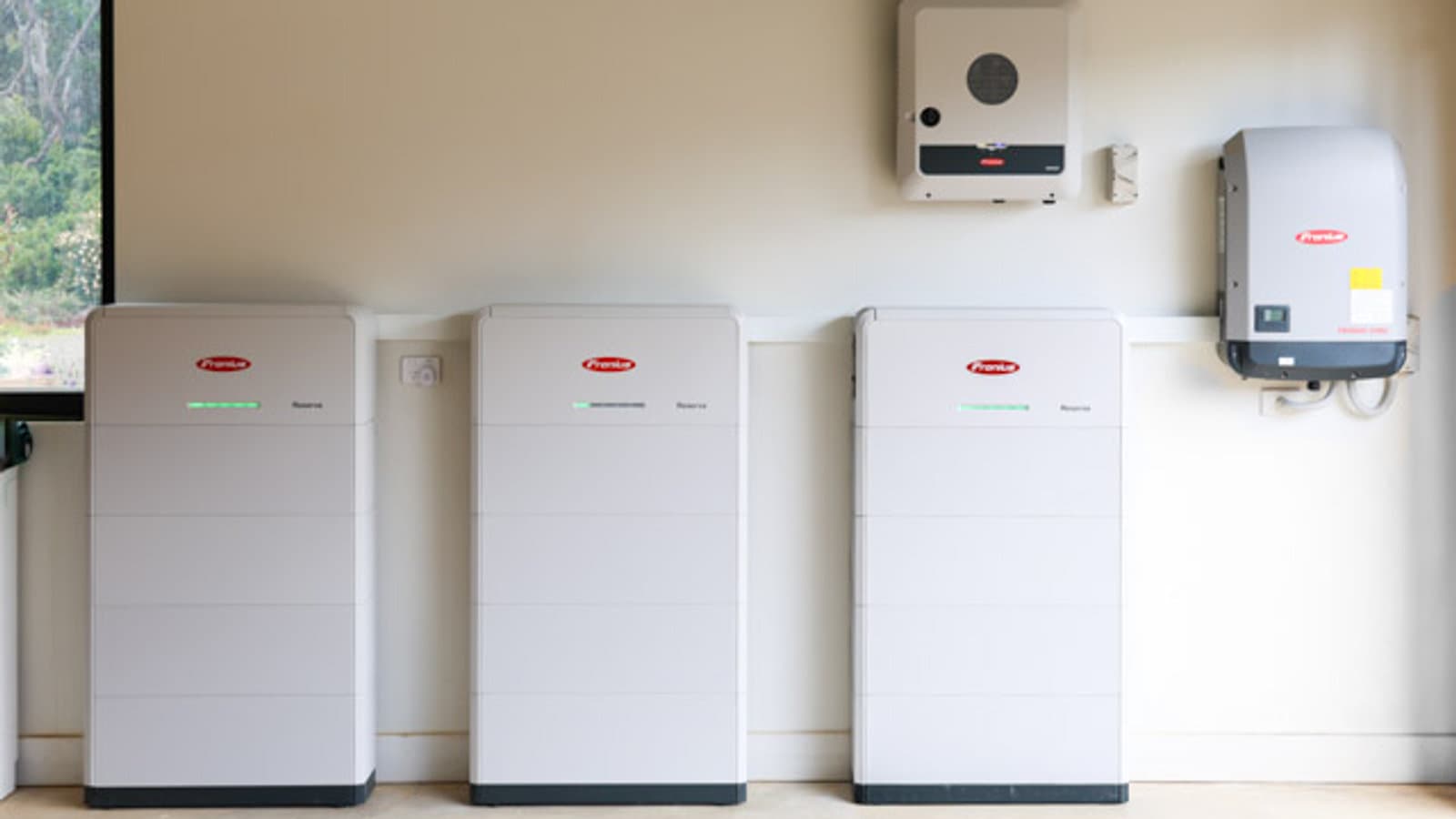
The parts of a small system
A small off grid system has the same parts as a big one, just smaller.
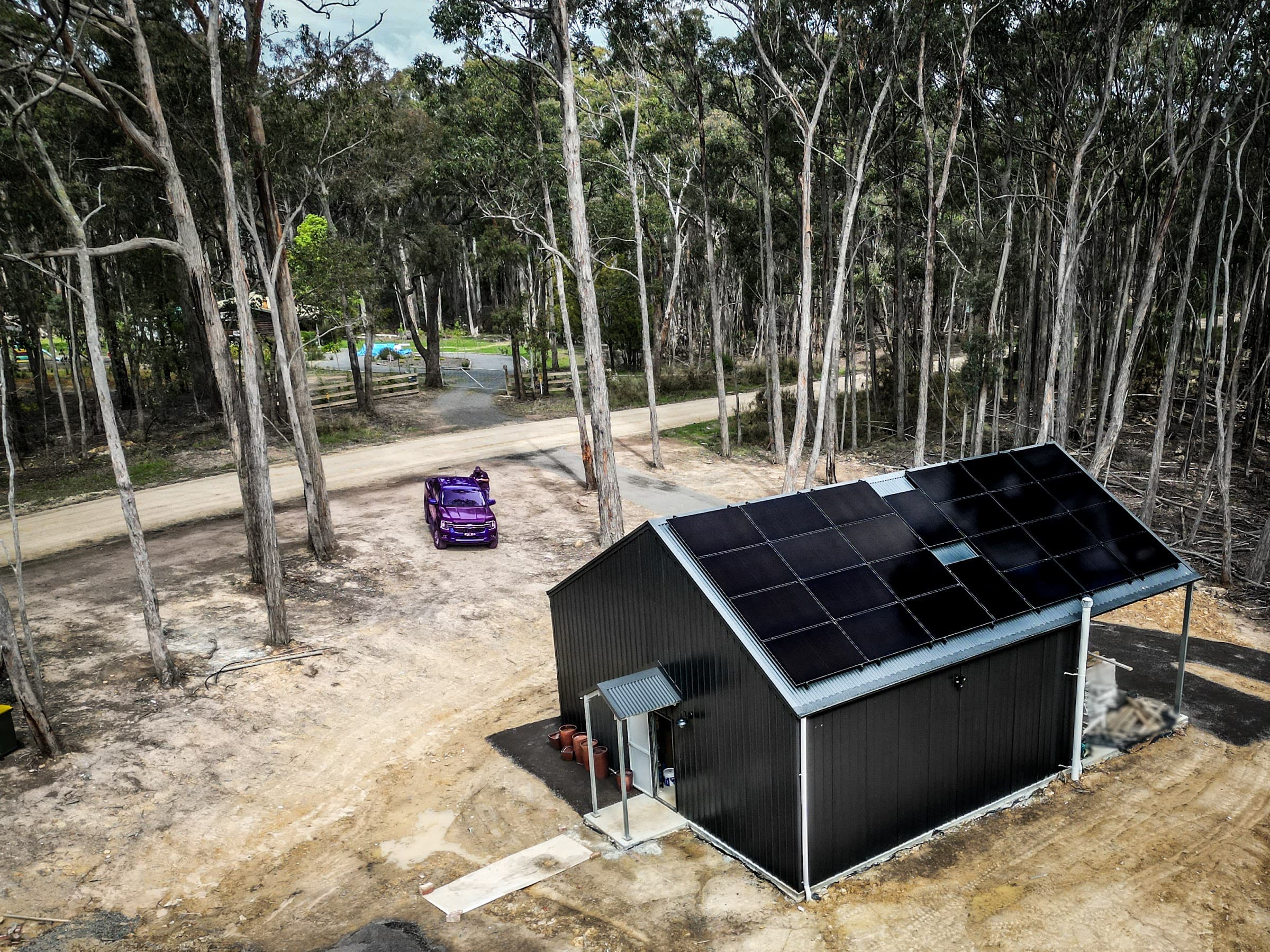
- Panels, sized for June. Near Trentham a north facing kilowatt makes about 2 kWh on an average June day at roof pitch and about 2.8 kWh on a steep frame, according to PVGIS. Our article on off grid solar in a Central Victorian winter has the monthly figures. For 5 kWh a day the bare break even is about 1.8 kW on a steep frame or 2.5 kW at roof pitch; once battery losses and grey days are allowed for, plan on roughly 2.5 kW on a frame to 3.5 kW or more on a roof.
- A lithium battery big enough for the night and a grey day or two.
- An inverter charger. A Victron MultiPlus-II 48/3000 is rated at 2,400 W continuous with a 5,500 W peak, enough for the kettle or the pump start, and its datasheet puts its idle draw at 11 W, or 7 W in its power saving mode.
- A solar charge controller to charge the battery from the panels.
- A way to charge in a long grey spell, which for a weekender can be a small generator connected to the inverter charger's input.
Why a weekender is easier than a home
A place that is used two or three days a week has an advantage: the panels refill the battery while nobody is there. A battery drained over a Saturday night and Sunday is usually full again by the next Friday, even in June. That lets a weekender run a smaller array against its weekend use than a full time home could.
The things that keep running while you are away still need covering: the fridge if you leave it on, the freezer, the internet, the inverter's own idle draw, and anything security related. The 11 W idle draw of a small inverter is about 0.26 kWh a day, which is small, but a cheap inverter with a high idle draw can flatten a small battery over a quiet week of grey weather.
Portable or fixed?
Portable power stations, the suitcase sized battery and inverter units with a socket on the front, have their place. They are good for a campsite, a building site, or a cabin used a few nights a year with a fridge and some lights.
They are a poor fit for a place you want to treat as a home:
- the battery is usually small for a June week
- the inverter is sized for appliances, not for a pump start
- they are not built to be wired into the cabin's switchboard, so everything runs off extension leads
- there is no automatic generator start for a long grey spell
A fixed system is wired in by an electrician, runs the cabin's own power points and lights, and grows if the place does. That is the line between camping and living.
The trouble with cheap all in one kits
The online kits that bundle panels, a battery and an inverter for a low price tend to go wrong in the same ways.
- Sized for summer. The panel count looks fine against the average year and leaves you short in June.
- High idle draw. An inverter that uses a lot just being switched on eats the battery while the cabin is empty.
- No remote view. When something stops, you find out when you arrive on a Friday night to a warm fridge.
- Installation. Anything that connects to the cabin's 230 volt wiring has to be installed by a licensed electrician. In June 2023 a fire at a property in Mafeking in the Grampians destroyed a living room and bedroom; the owner had installed his own solar and battery system, and Energy Safe Victoria used the case to remind owners to use a licensed electrician.
- Warranty with nobody local. When a part fails, the question is who comes out, and with an online kit the answer is usually nobody.
Cheap is fine for a camping battery. For a cabin you rely on, it costs more the first time it lets you down.
Building it to grow
A small system built on separate parts can grow with the place. A second string of panels goes on another charge controller, more battery modules join the bank, a second inverter charger runs in parallel. If there is a chance the weekender becomes a home, we size the cabling, the switchboard and the enclosure for the finished system on day one, so each stage is an addition rather than a rebuild. That is the reasoning in why we build off grid on Victron.
The sizing tool gives a first answer in five minutes. When you have it, send us the result and your address and we will come back with a right sized design, or get in touch.
Questions
How much solar do I need for an off grid cabin?
Start from the daily use in winter. For about 5 kWh a day near Trentham, PVGIS figures point to roughly 2.5 kW of north facing panels on a steep frame, or 3.5 kW or more at roof pitch, once losses and cloudy days are allowed for.
Can I run a weekender on a portable power station?
For a few nights a year with a fridge and lights, yes. For a cabin you use most weekends, with a pump and power points, a fixed system wired in by an electrician is the better answer.
Can I install an off grid kit myself?
Not the parts that connect to 230 volt wiring. That work must be done by a licensed electrician, and Energy Safe Victoria has pointed to a house fire in the Grampians where the owner had installed his own solar and battery system.
What should a weekender not run on solar?
Electric space heating, electric hot water, an electric oven and air conditioning each use more than the rest of a small cabin put together. Run them on wood, gas or solar hot water, or size the system as a full home.
Sources
- PVGIS 5.3, monthly output for Trentham at 15 degrees, north facing (European Commission JRC)
- Victron Energy, MultiPlus-II 230 V datasheet
- Ausgrid, energy star ratings and what the kWh figure means
- Electrical Connection, Energy Safe warns property owners following DIY solar fire (4 July 2023)
Written by the Trentham Energy team.