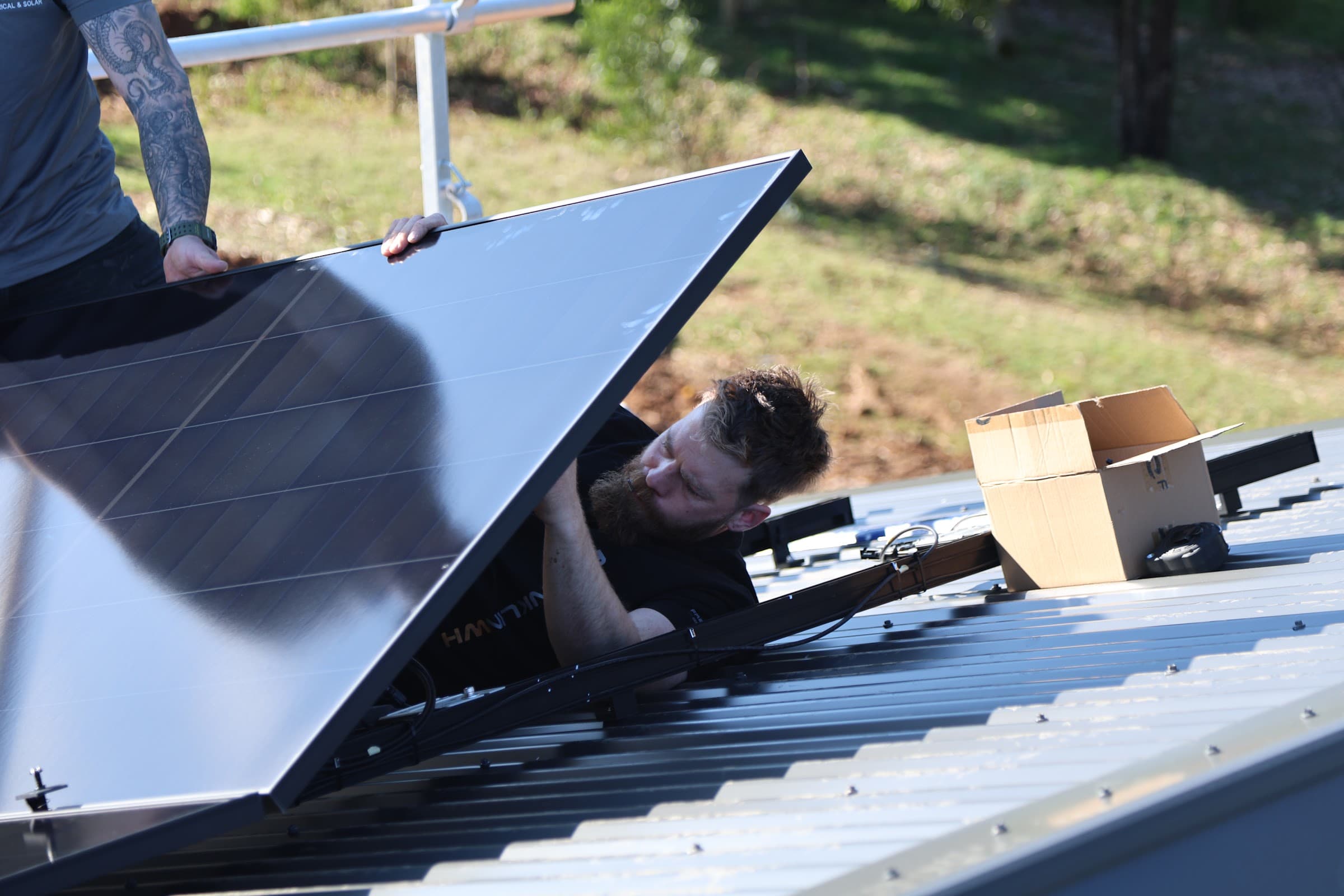
AIKO back contact panels earn their keep on hot days and under small shadows, not a whole shaded row. What the tests show and what changed in 2026.
AIKO's Neostar panels do three things better than a standard panel: they make more power from the same roof area, they lose less output on a hot day, and they ride through a small shadow with less loss. They do not make a shaded roof unshaded. Once a whole row of cells is covered, an AIKO panel behaves like any other panel, and the independent tests say so plainly. This article is about what the panels actually do on a roof, what changed in 2026, and when we would still steer a customer towards a cheaper panel. Our AIKO brand page explains how the back contact cell works; we will not repeat that here.
What the datasheet promises
The panel we fit most on homes is the Neostar 3S54, the all black 54 cell module in the standard residential size of 1762 by 1134 mm. AIKO's February 2025 datasheet rates the range at 460 to 490 W, with module efficiency from 23.0% to 24.5%, a temperature coefficient of power of minus 0.26% per degree, three bypass diodes, a 25 year product warranty and a 30 year performance warranty that allows no more than 1% loss in the first year and 0.35% a year after that, finishing at 88.85% in year 30. The module weighs 20.6 kg and is rated for 5400 Pa of snow load on the front.
Two lines on that datasheet matter in our area and rarely get read. The hail rating on the mono glass model is the standard 25 mm stone at 23 metres a second, and the fire rating is IEC Class C. If you are building in a high bushfire attack level zone, ask about the dual glass models: AIKO's Gen 3 dual glass panels launched in Australia in March 2026 carry IEC Fire Class A certification.
What the panels do on a hot day
Every panel makes less power as it heats, and a north facing roof in Kyneton or Castlemaine in January runs well above 60 degrees at the cell. The temperature coefficient tells you how fast output falls. AIKO's minus 0.26% per degree compares with about minus 0.28% on a good value TOPCon panel such as the TW Solar modules sold here. The difference is real but it is not large: across a 35 degree rise above the 25 degree test condition, the AIKO panel gives up about 9% of its rated power and the TOPCon panel about 10%. Over a summer it adds up to a few extra kilowatt hours a week on a typical house array, not a different system.
What the panels do in shade, honestly
This is where the marketing and the measurements part company, so here are the measurements.
An installer in Brisbane put nine AIKO panels beside nine Canadian Solar 465 W panels on the same warehouse roof and shaded them identically late in the afternoon. Under a small shadow the size of a phone or a wallet, the Canadian Solar panel lost about 150 W and the AIKO panel about 50 W. Once about a third of either panel was covered, both panels' bypass diodes engaged and the two lost power the same way. The installer's verdict in March 2025 was that the shade advantage was marginal at best.
AIKO published its own response in June 2025. It argues, fairly, that covering half a panel with plywood triggers the bypass diodes in every technology and tests nothing, and that the right method is a recognised partial shading standard. On that method it cites a TÜV Nord flash test in which a single cell is progressively masked: the AIKO module kept about 95% of its power under a light cover and about 70% at full cover of that one cell, against about 90% and about 40% for a reference TOPCon module. It also holds a TÜV Rheinland Class A partial shading certificate for the Neostar 475 W, meaning no more than 5% extra loss under three standard shade masks.
Both sets of numbers are true at the same time. A flue, a TV aerial, a vent pipe, a fallen leaf or a shadow line creeping across one row of cells costs an AIKO array less than it costs a conventional one. A tree that covers a third of the panel for two hours every afternoon costs both arrays the same. SolarQuotes' own real world testing reached the same conclusion: a limited improvement over conventional panels, not a large one.
So our rule on a shaded roof has not changed because of AIKO. We still lay the array out around the shade, we still split strings by orientation, and on a roof with heavy, moving shade we still quote optimisers or microinverters. What AIKO buys you is forgiveness for the small stuff, which on an older Central Victorian farmhouse with chimneys and vent pipes is most of the stuff.
What they look like on the roof
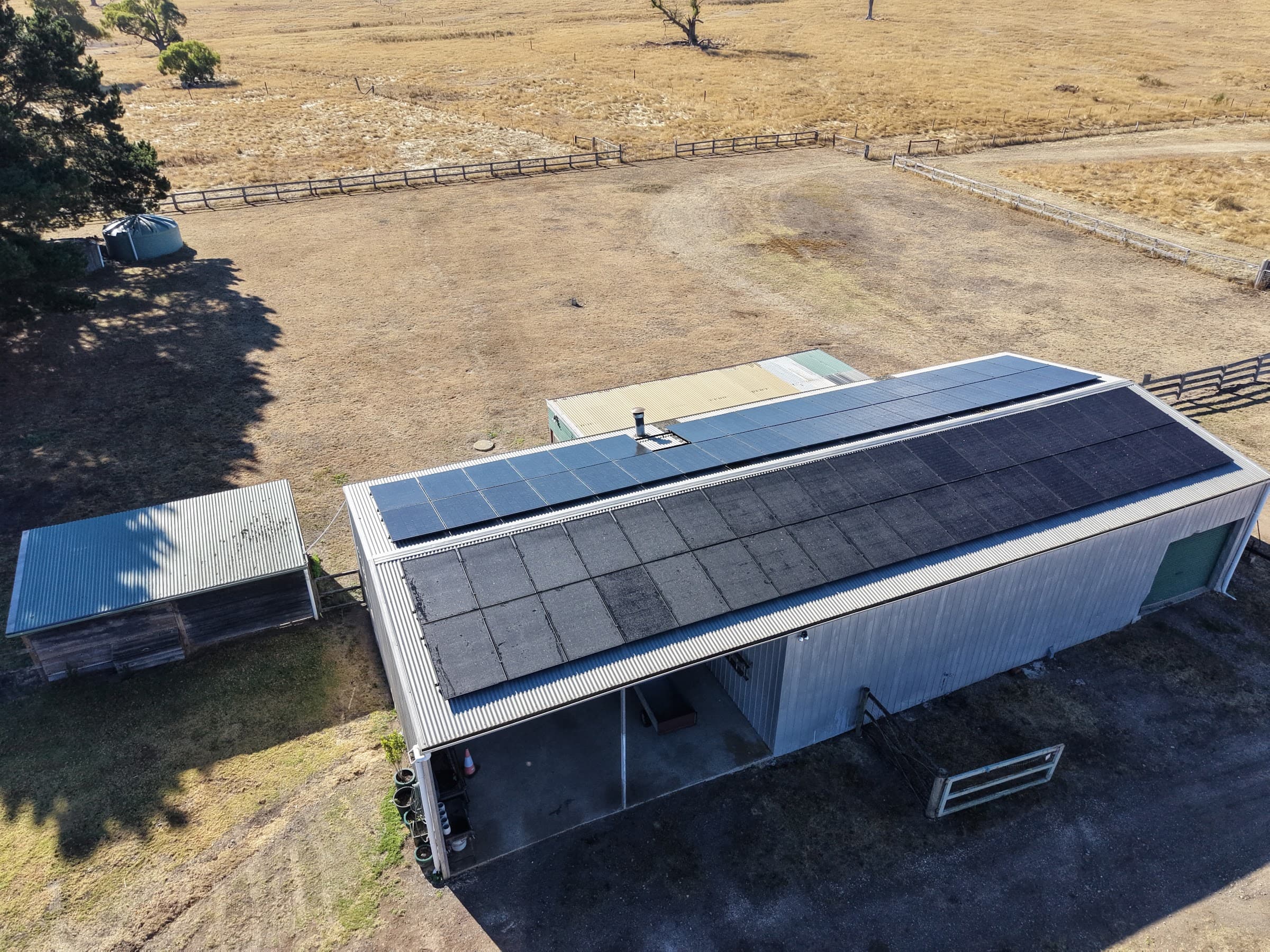
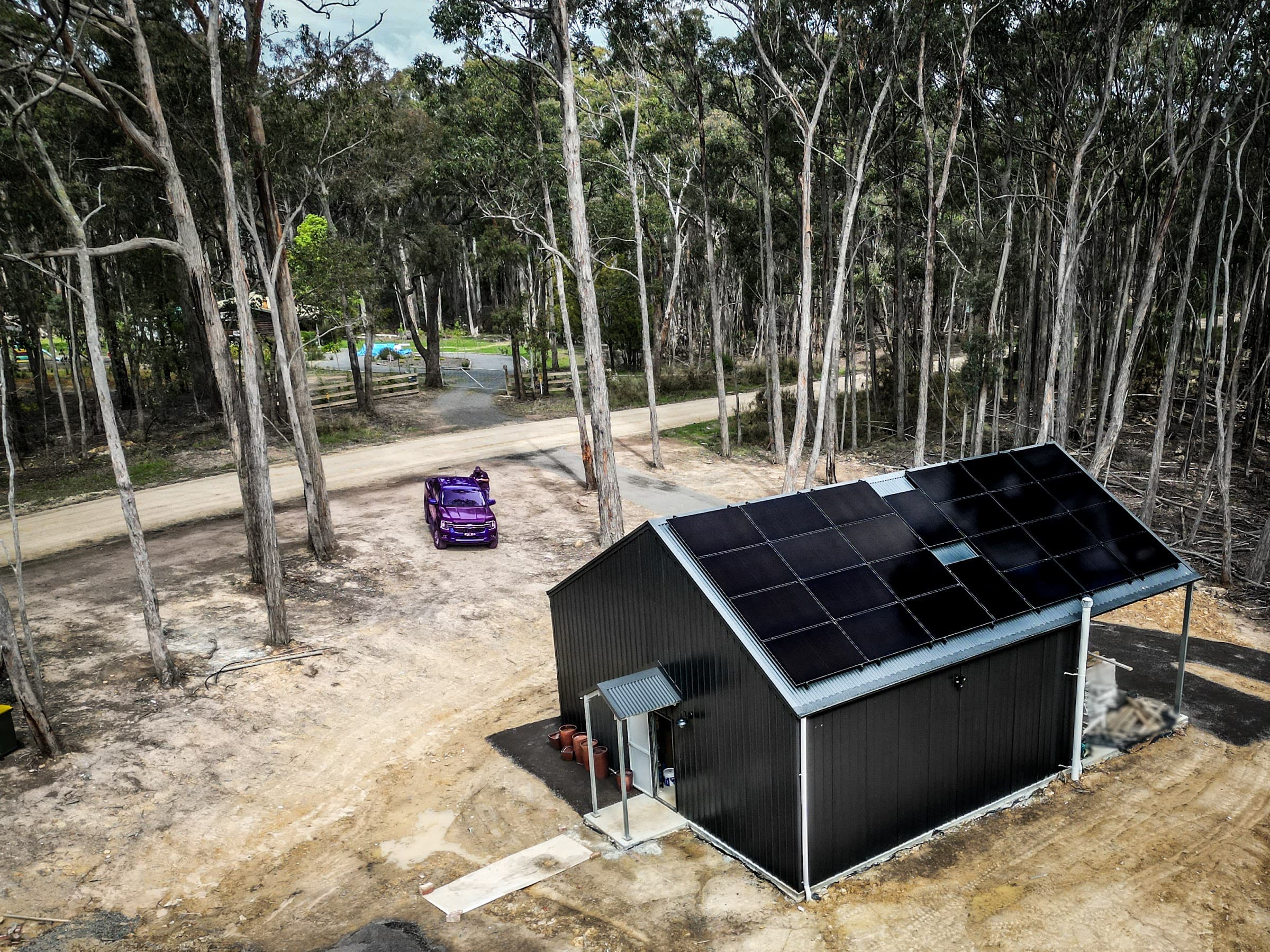
The all black model has black cells, a black backsheet and a black anodised frame with no silver lines on the front, so from the street the array reads as one dark sheet. On a dark Colorbond roof or a heritage home in Daylesford or Trentham that is the reason many customers pick it. The black frame white backsheet model (the 3P54) gives a little more power, 475 to 500 W, at the cost of the white lines between cells showing.
What changed in 2026
Three things worth knowing if you read about AIKO a year ago.
- The patent cloud lifted. On 6 February 2026 Maxeon, SunPower's successor, and AIKO announced a licensing agreement covering all of Maxeon's back contact cell and module patents outside the United States, with all enforcement actions withdrawn. Supply into Australia is no longer a question.
- The panels got bigger and tougher. In March 2026 AIKO launched its Gen 3 60 cell modules in Australia at 535 to 545 W and above 25% efficiency in a 1954 by 1134 mm frame, with the dual glass variants carrying IEC Fire Class A. In June 2026 at SNEC it announced the 54 cell Neostar range had added cyclone certification for Australian wind regions C and D to its existing TÜV Rheinland 40 mm hail test and IEC 61701 severity 6 salt mist rating, and the Neostar 3P54 reached 500 W at 25% module efficiency in the standard residential footprint.
- Installers kept voting for it. AIKO won the SolarQuotes Installers' Choice award for panels in 2026 for the second year running, and in June 2026 EUPD Research named it a Top Brand PV for Australia.
What they cost and when a cheaper panel is the right call
SolarQuotes' database in October 2026 puts Neostar panels at about $0.32 to $0.44 per watt, roughly $149 to $220 a panel including GST, which is more than a good value panel but not the premium it was in 2024. AIKO's warranty also does not exclude shaded locations, which some panel warranties do.
Where we would still quote a cheaper panel: a big, plain, unshaded north facing roof with room to spare. There the extra efficiency buys you nothing you could not get by adding one more panel, and the money is better spent on battery capacity. Where AIKO earns its price: a tight roof, a roof with chimneys and vents, a home where the look matters, or a customer who wants the longest performance warranty on the market. We put both options in the quote side by side so you can see the difference in dollars and in kilowatt hours for your roof.
Send us a recent bill and your address and we will come back with a right sized design, with the shade on your roof measured rather than guessed.
Questions
Are AIKO panels shade proof?
No panel is. AIKO handles a shadow on one cell or a few cells much better than a conventional panel, which the TÜV tests and the Brisbane roof test both show. Once a whole row of cells is covered the bypass diode takes over and the panel loses output like any other. Heavy shade still needs a careful layout or optimisers.
Is the hail rating good enough for the Macedon Ranges?
The standard mono glass Neostar is certified to the IEC 25 mm hail test, and AIKO has had the 54 cell range tested by TÜV Rheinland to 40 mm. Our region sees damaging hail every few years, so we treat 40 mm certification as the figure that matters and we fit the panels with that in mind.
Do AIKO panels work with my inverter or battery?
Yes. Electrically they are a standard panel and they pair with Sigenergy, Fronius, GoodWe and the other inverters we install. The only design difference is that their higher current per panel is checked against the inverter's MPPT limits, which we do on every string anyway.
Will AIKO still be here in 25 years to honour the warranty?
Nobody can promise that about any manufacturer. What we can say is that AIKO has had a Melbourne office since its Australian launch on 6 March 2024, it has settled its patent dispute with Maxeon, and it is a listed BloombergNEF Tier 1 manufacturer. The 30 year performance warranty is also backed by a warranty partner, Munich RE, named on the datasheet.
Sources
- AIKO Neostar 3S54 datasheet, V2.1, February 2025 (PDF)
- SolarQuotes, Aiko Solar review (read October 2026)
- MC Electrical, AIKO vs Canadian Solar shade test on a Brisbane roof (March 2025, updated July 2025)
- AIKO Australia, Partial Shading Q&A: how not to test shade tolerance (June 2025)
- Maxeon and AIKO announce patent licensing agreement (6 February 2026)
- AIKO launches Gen 3 ABC 60 cell module in Australia (AAP, 11 March 2026)
- AIKO reinforces Australian growth with SNEC 2026 announcements (Energy Matters, 11 June 2026)
- TW Solar introduces full black module for the Australian rooftop market (pv magazine Australia, 15 October 2025)
Written by the Trentham Energy team.