An installer's Sigenergy review: what the SigenStor stack is, the battery and inverter sizes sold in Australia, the warranty terms, and the trade offs.
The Sigenergy SigenStor is a well built, tidy stacking system that puts the solar inverter, the battery and an optional EV DC charger in one column and it suits most grid connected homes well. Its trade offs are real, though: it is a closed ecosystem where every piece has to be Sigenergy, and its full warranty depends on the system staying connected to the internet. This Sigenergy review sets out what the SigenStor is, the sizes sold in Australia as at November 2026, what the warranty actually says, and who it suits.
We install SigenStor, so read this as an installer's view rather than an independent test. The figures come from Sigenergy's own Australian pages and warranty document.
What is the Sigenergy SigenStor?
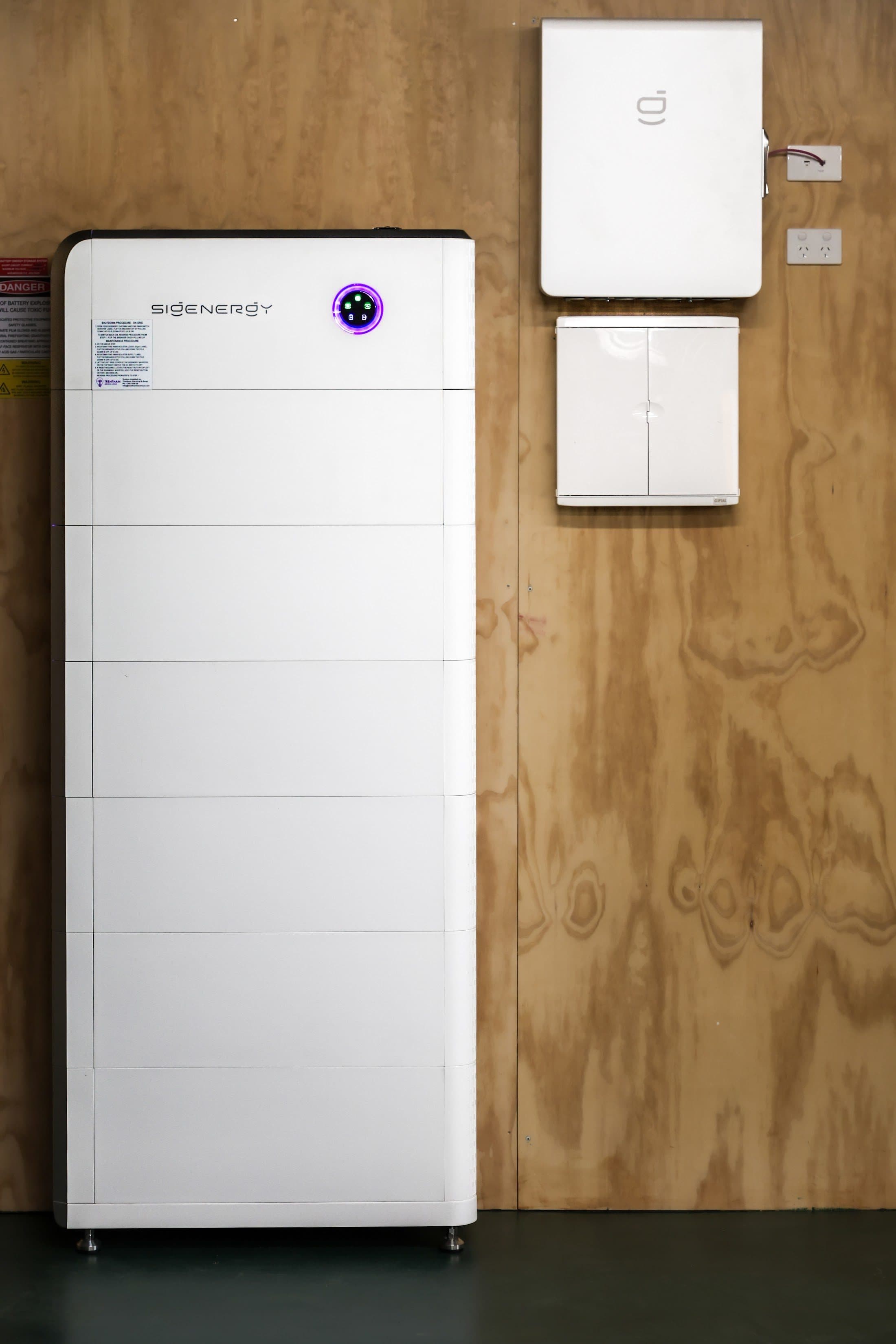
SigenStor is a stack: an energy controller (the hybrid inverter) at the top, battery modules underneath, and an optional EV DC charging module that slots in. Sigenergy describes it as five in one: solar inverter, EV DC charger, battery power conversion, battery pack and energy management.
In practice that means one maker, one app (mySigen) and very little wiring between the parts, because the modules plug into each other. Sigenergy rates the components IP66 and says a stack installs in about 15 minutes, with commissioning in about five. The result usually takes up less wall and floor space than a separate inverter and battery.
What sizes do the Sigenergy inverter and battery come in?
The Sigenergy inverter, which Sigenergy calls the energy controller, comes in single phase models up to 12 kW and three phase models from 5 to 30 kW. Sigenergy's Australian warranty lists single phase controllers at 3, 5, 6, 10 and 12 kW and three phase controllers at 5, 8, 10, 15, 20, 25 and 30 kW. Its specification page lists two to four solar inputs (MPPTs), with a working range of 50 to 550 V on single phase and 160 to 1,000 V on three phase.
The Sigenergy battery modules are lithium iron phosphate (LFP). The warranty lists four modules and their usable energy:
- SigenStor BAT 5.0: 5.2 kWh usable
- SigenStor BAT 6.0: 6.0 kWh usable
- SigenStor BAT 8.0: 7.8 kWh usable
- SigenStor BAT 10.0: 9.0 kWh usable
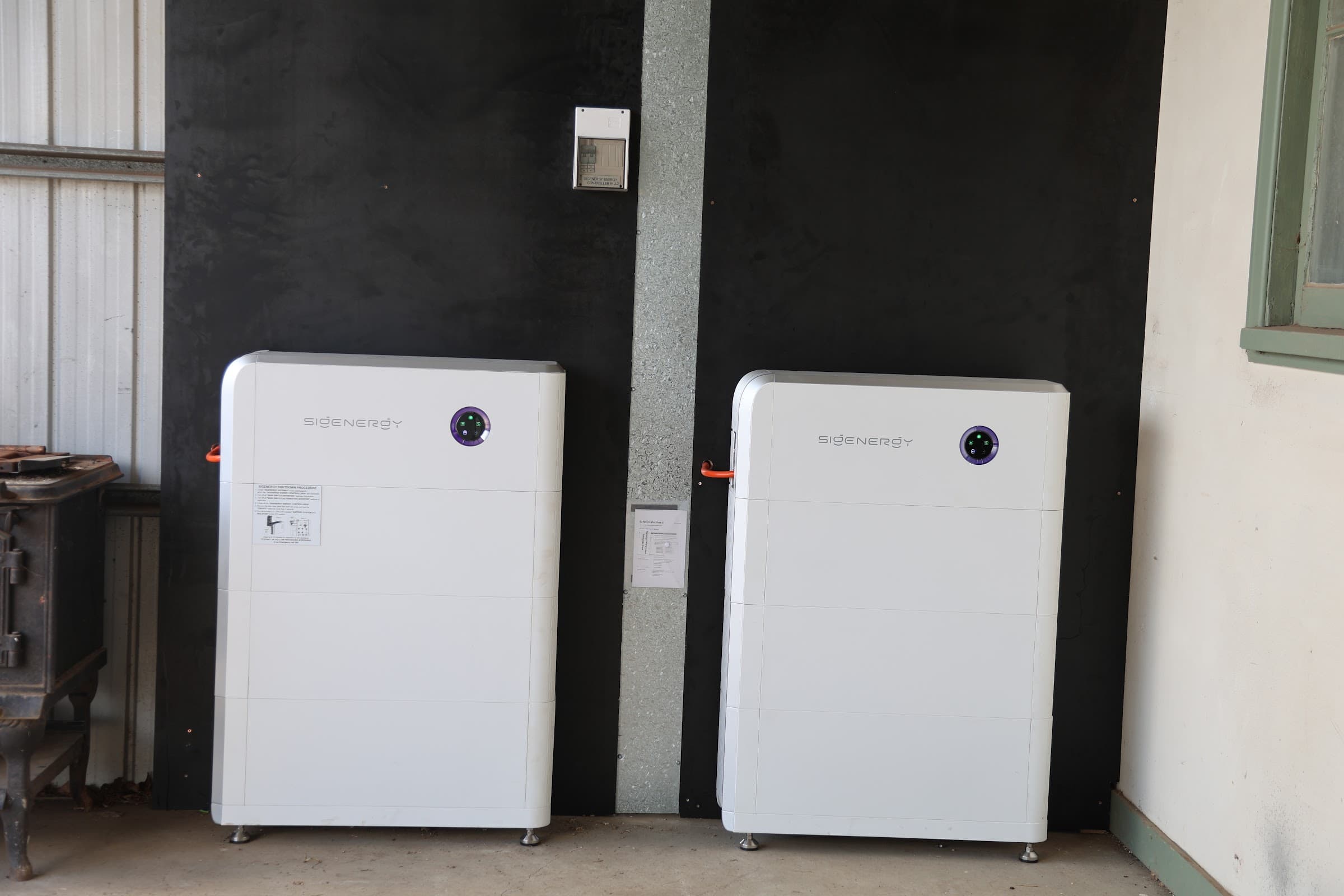
Each controller takes one to six modules, so a single stack can be as small as about 5 kWh or as large as about 54 kWh of usable storage. Bigger homes, or properties with more than one phase, can run more than one stack; we wrote about one such farm in two phases, two batteries, one brain.
What about the gateway, backup and the EV charger?
Blackout backup on the SigenStor needs Sigenergy's separate energy gateway between the system, your switchboard and the grid. Sigenergy's page lists a 0 ms switchover on the backed up side and a grid port that can take a generator through an automatic transfer switch. Without the gateway, a SigenStor still shifts solar into the evening but stops when the grid goes down, like most hybrid systems. If you want to know whether it can run a house with no grid at all, we covered that in can Sigenergy run off grid.
The EV DC charging module is the unusual part. Sigenergy lists 12.5 kW and 25 kW versions with a CCS2 plug, charging the car on DC straight from the solar and battery. Sigenergy says it is ready for vehicle to home and vehicle to grid, but that depends on the vehicle and on standards still to be published, so we would not buy it on that promise alone. It is also a dearer path than a wall mounted AC charger, and many households are well served by the AC option.
Sigenergy has also announced the SigenStor Neo, with the gateway built in. What is confirmed about it in Australia is in our SigenStor Neo article.
What does the Sigenergy warranty actually cover?
Sigenergy's warranty for SigenStor in Australia and New Zealand (the version we read is dated 26 May 2026) gives:
- 10 years on the battery modules and on the energy controller
- 3 years on the EV DC charging module
- a battery performance promise of at least 70% of usable energy at 10 years, or a set amount of energy through the battery, whichever comes first (for example 29.64 MWh for a BAT 8.0 and 33.29 MWh for a BAT 10.0)
Two conditions deserve to be read twice. First, the system must stay connected to the internet for firmware updates. If it is offline for more than 90 days it drops into a Safe Operation Mode, and if it is offline for more than a year, the warranty is cut to 5 years from activation. On a rural block with patchy internet, that is something to plan for at install time, not after. Second, claims go through the mySigen app and Sigenergy asks for them within 30 days of a failure.
What decides the Sigenergy price?
We do not publish a price here, because the honest answer depends on the job. The things that move a Sigenergy price the most are:
- the size of the controller and how many battery modules you choose
- whether you want blackout backup, which adds the gateway and switchboard work
- whether the EV DC charger module is included
- single phase or three phase, and the state of your switchboard
- how much new solar is going in alongside it
The federal Cheaper Home Batteries discount applies to eligible batteries and is set by the installation date, not the date you sign. From 1 May 2026, the Clean Energy Regulator applies the full discount to the first 14 kWh of capacity, 60% of it for each kWh from 14 to 28 kWh, and 15% from 28 to 50 kWh, so a very large stack earns proportionally less. Our guide to home battery rebates in Victoria has the rest.
What are the trade offs of Sigenergy?
The main ones, as we see them:
- A closed system. The battery modules only work with a Sigenergy controller. If Sigenergy ever stopped supporting the range, you could not slot in another brand's battery.
- Internet dependence. Monitoring, updates and the full 10 year warranty all lean on a working connection.
- A newer name. Sigenergy has a shorter track record than some long standing inverter makers. The warranty is only as good as the company behind it, a lesson Australian battery owners have learnt this year.
- Backup costs extra. On the current SigenStor, whole home backup needs the gateway.
On the other side: a compact install, a large range of sizes from one family of parts, LFP chemistry, a good app, and one maker to deal with for the inverter and the battery.
Mick McDonald
Technical Director, Trentham Energy
Questions about your own system? Call 1300 3458 00 or send us a message.
Sources