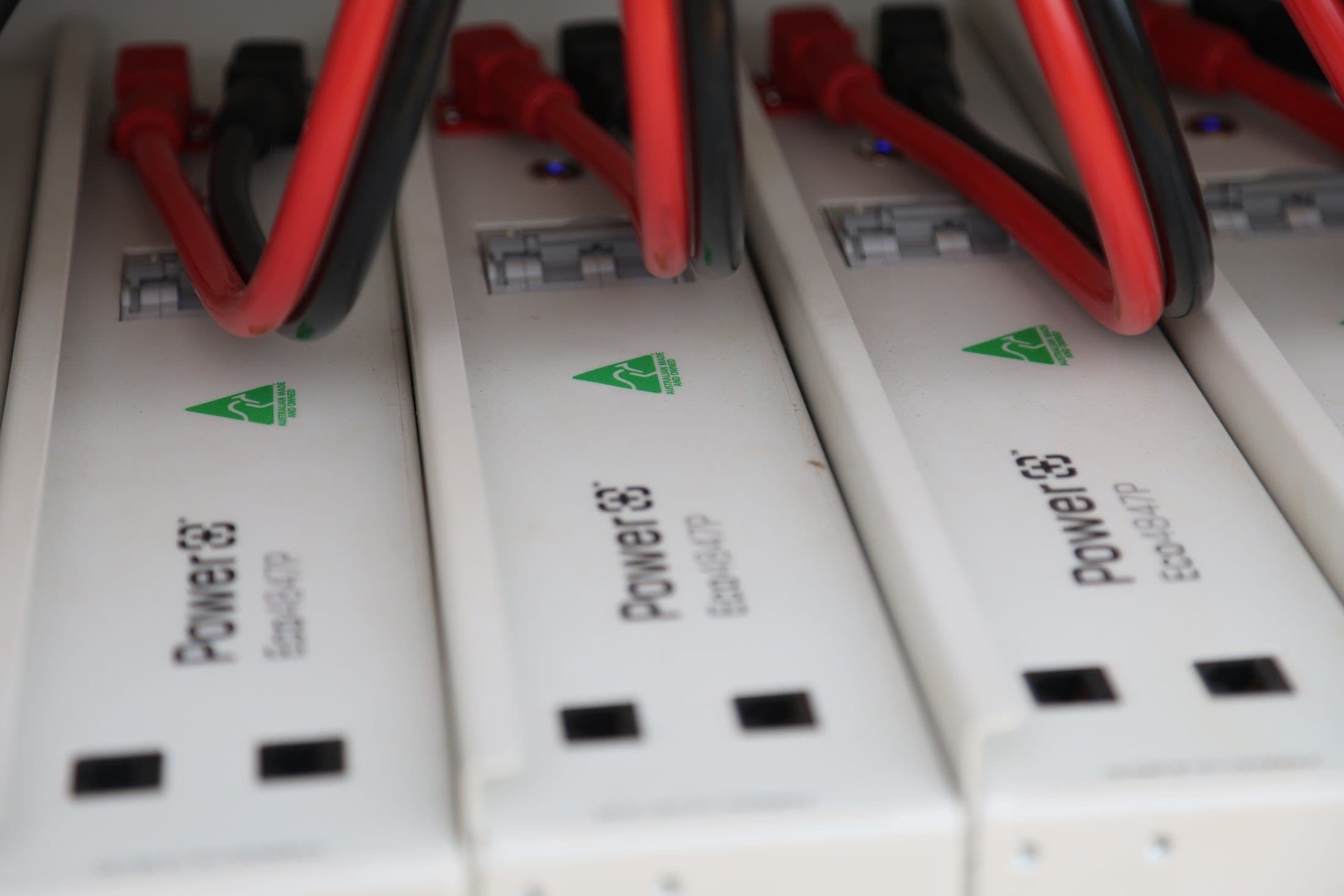
What the numbers in a PowerPlus battery name mean, the three current models, the legacy 4840P, cabinets, stacking and Victron or Selectronic pairing.
PowerPlus Energy sells three current home and farm batteries as at November 2026: the LiFe4838P (3.8 kWh), the Eco4847P (4.7 kWh) and the LiFe4851 (5.12 kWh). All three are 51.2 volt lithium iron phosphate modules that stack in parallel to build a bigger bank, and the name tells you most of what you need: the "48" is the 48 volt class and the last two digits are the capacity of one module. If you have an older PowerPlus battery such as an Eco4840P or a LiFe4833P, it is now a legacy model, and that matters when you want to add to the bank.
Our earlier piece on what the PowerPlus warranty asks of an off grid owner covers the seven day full charge rule and the pro rata terms. This one is a plain guide to the range itself.
How do you read a PowerPlus battery model number?
Read it as family, voltage class, then capacity. "LiFe" and "Eco" are the two product families, "48" is the 48 volt class, and the next two digits are the energy in one module to one decimal place.
Checked against the current datasheets:
- LiFe4838P: 48 volt class, 3.8 kWh, 51.2 V nominal, 74.2 Ah
- Eco4847P: 48 volt class, 4.7 kWh, 51.2 V nominal, 92 Ah
- LiFe4851: 48 volt class, 5.12 kWh, 51.2 V nominal
The legacy names follow the same pattern. PowerPlus says the Eco4847P has 17.5% more storage than the Eco4840P it replaced, which puts the old Eco4840P at about 4.0 kWh. PowerPlus also lists a LiFe2433P and a LiFe12033P as legacy models, which by the same reading were 24 volt and 120 volt class batteries. PowerPlus doesn't explain the "P" on its product pages, so we won't guess at it.
What are the current PowerPlus batteries?
The three current models suit different jobs, and the differences are in charge rate, size and where they are made.
LiFe4838P
A 2RU rack module, 3.8 kWh, made in Australia according to its datasheet (version 10.0, 9 September 2026). It can discharge continuously at 63 A, about 3.2 kW, but the warrantable charge current is 39 A, about 2 kW per module. PowerPlus recommends using 80% or less of it, which is 3.04 kWh. It weighs 43 kg and needs no communication cable: the battery manages itself and offers a volt free alarm contact.
Eco4847P
Also a 2RU module, 4.7 kWh, with 85% Australian made content according to PowerPlus. It discharges and charges at up to 63 A, with a nominal charge current of 46 A. Recommended usable capacity is 3.76 kWh at 80% depth of discharge. Like the LiFe4838P it runs without communication cables. PowerPlus warns on its product page that the Eco4847P and the older Eco4840P must not be mixed in one bank because their battery management systems use different voltage setpoints.
LiFe4851
The newest of the three, and different in kind. It is a 3RU module, 5.12 kWh, rated at 120 A continuous charge and discharge, with a recommended depth of discharge of 90% (4.6 kWh). It talks to an inverter over CAN or RS485, or can run self managed. Its datasheet (version 2.0, 24 June 2026) says plainly that it is manufactured in China and engineered, tested and assured in Australia, and lists up to 20 modules in parallel.
Searching for the PowerPlus 4840P?
The Eco4840P is no longer supplied for new projects. PowerPlus names the Eco4847P as its replacement, and as above, the two must not share a bank.
That leaves an owner with a 4840P bank three honest choices when it needs to grow or a module fails:
- keep the existing bank as it is and add capacity as a separate bank, which needs its own design and protection
- replace the whole bank with current modules
- ask PowerPlus about its trade in offer, which its home page advertises for some legacy models including the Eco4840P and LiFe4833P
Which is right depends on the age and health of the bank.
How many PowerPlus modules can you stack?
The 2RU LiFe and Eco modules are rated "unlimited, refer to manufacturer" in parallel on their datasheets, and the LiFe4851 lists up to 20. None of them may be connected in series.
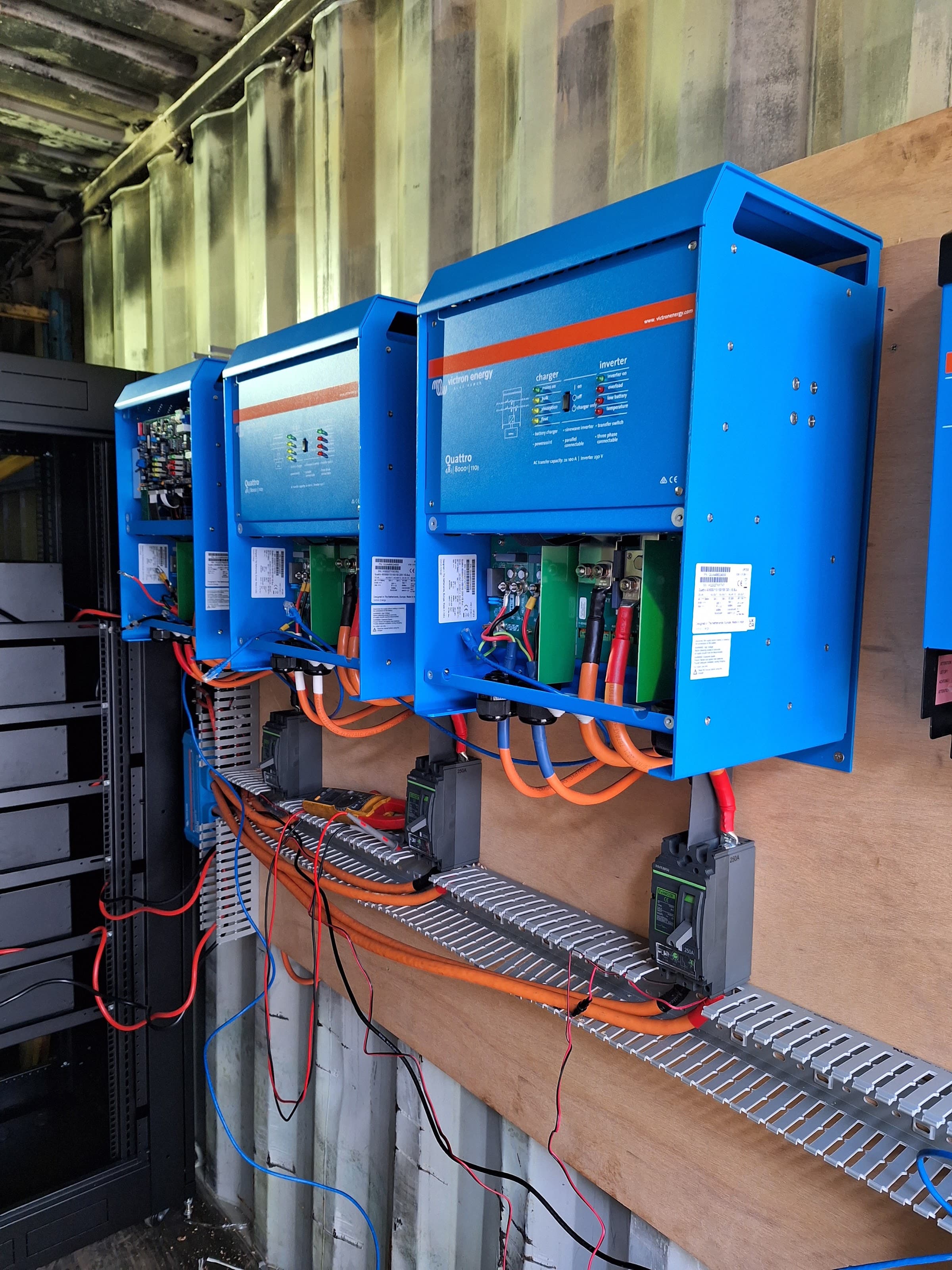
In practice the limit is the inverter and the cabling, not the batteries. The charge rate matters more than people expect. A LiFe4838P is warranted to charge at 39 A, so a bank of four will take about 156 A in total. A Victron MultiPlus-II 48/5000 charges at up to 70 A from a generator, and the solar charge controllers add their own current on top on a sunny day. The bank has to be big enough to accept everything the system can push into it, which is one reason PowerPlus banks for an off grid house usually end up larger than the raw kWh figure suggests. Our guide to how much battery an off grid house needs runs through the sums.
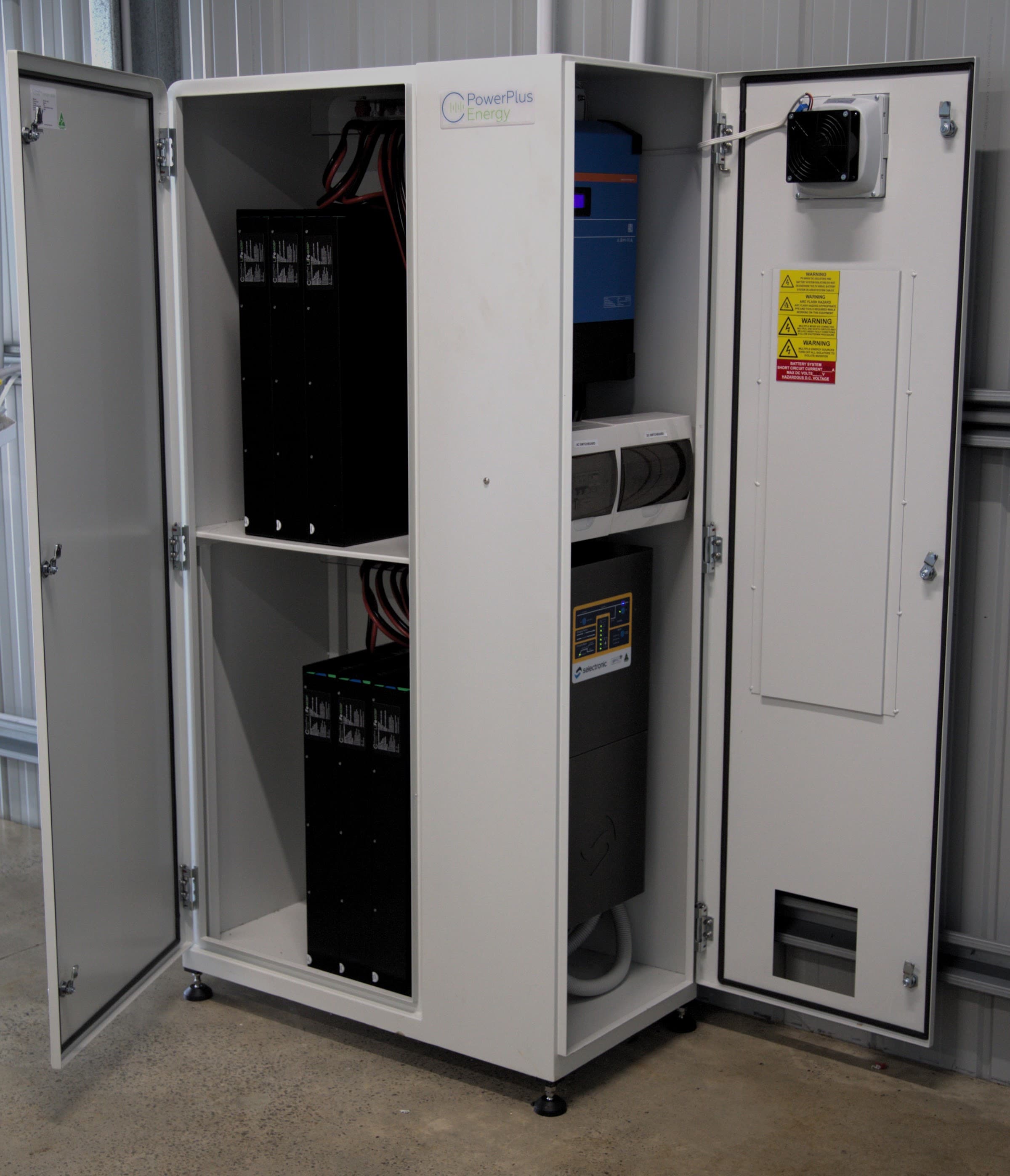
PowerPlus also sells pre wired cabinets to hold the rack modules: the Slimline, the 'T' Rack and the 'P' Rack series.
Do PowerPlus batteries work with Victron and Selectronic?
Yes. PowerPlus publishes charger settings for Victron and Selectronic, among others including SMA, Schneider, Outback, Deye and AERL, and a declaration of compatible inverters on each product page.
The way they connect differs by model:
- LiFe4838P and Eco4847P: no data link. The inverter charger is programmed with PowerPlus's charge voltage (55.7 V), shutdown voltage and restart voltage, and a separate battery monitor does the state of charge counting. That is why the seven day full charge matters: it resets the monitor and balances the cells.
- LiFe4851: can be managed over CAN, so the battery tells the inverter how to charge it.
PowerPlus is not on Victron's own list of batteries tested for closed loop communication, last updated 23 September 2026 when we checked. That doesn't stop a PowerPlus bank working well on Victron. It means the installer sets the limits from PowerPlus's guide rather than relying on a tested data link. We install PowerPlus Energy batteries and look after and service existing PowerPlus and Selectronic systems; our Selectronic and PowerPlus page covers that side.
What about the Whispr and the bigger PowerPlus systems?
The Whispr series is PowerPlus's all in one product for grid connected homes, an inverter and battery in one unit, and PowerPlus lists it as rebate eligible.
On rebates: the federal discount is paid through the Small scale Renewable Energy Scheme and the battery must be on the Clean Energy Council approved list. The Clean Energy Regulator says an off grid battery must be installed on a dwelling that is lived in, so a shed or a bore pump doesn't qualify. PowerPlus marks the LiFe4838P and Eco4847P as rebate eligible on its site; check the exact model on the approved list before you count on it.
What can an owner safely check on a PowerPlus bank?
From outside the cabinet, an owner can safely look at each module's status light, read the state of charge on the inverter screen or app, and keep the area around the cabinet clear, dry and ventilated. PowerPlus's recommended ambient range for the Eco4847P is minus 10 to 50°C.
Anything that involves opening the cabinet, the module breakers, the DC cabling or the inverter's battery settings is work for a licensed electrician. A battery bank can deliver hundreds of amps into a fault even with every load switched off.
Mick McDonald
Technical Director, Trentham Energy
Questions about your own system? Call 1300 3458 00 or send us a message.
Sources
- Eco4847P specifications, V2.3, 25 September 2025, PowerPlus Energy
- LiFe4838P specifications, V10.0, 9 September 2026, PowerPlus Energy
- LiFe4851 specifications, V2.0, 24 June 2026, PowerPlus Energy
- Eco4847P product page, PowerPlus Energy
- PowerPlus Energy home page and product list
- Battery compatibility, Victron Energy
- Solar batteries, Clean Energy Regulator