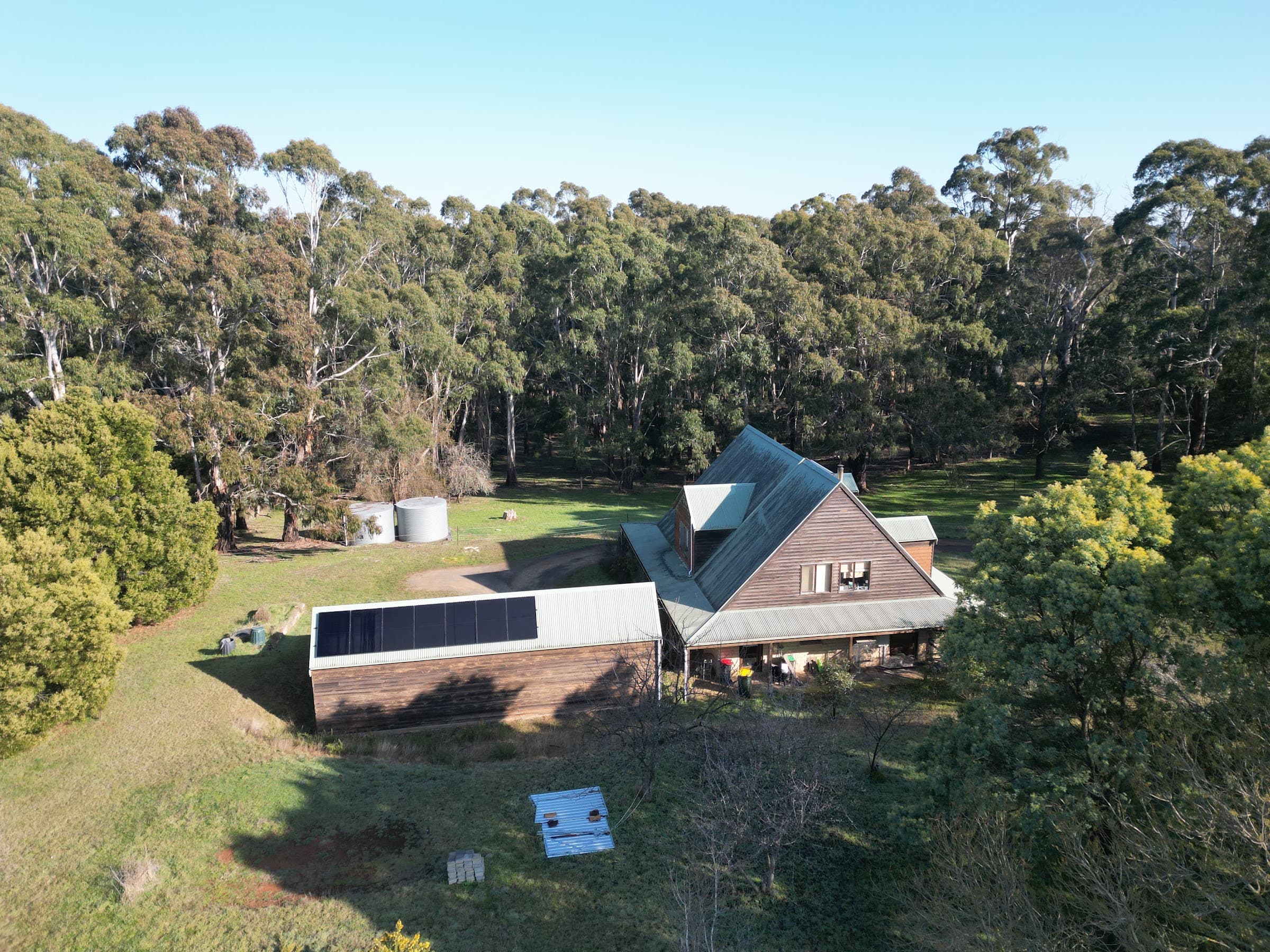
Most off grid cabins and tiny houses using 2 to 4 kWh a day need about 2 to 3 kW of solar in Central Victoria, sized for June, plus a battery and backup.
For a cabin or tiny house using 2 to 4 kWh a day, a fixed system in Central Victoria usually needs around 2 to 3 kW of solar panels, a lithium battery holding about two days of use, and a generator or other backup for long grey spells in winter. The panel number is driven by June, not January. A weekender used mostly in summer can get by on much less, and a portable kit is fine for camping, but a home lived in all year needs a properly designed, fixed system.
How much power does a cabin or tiny house actually use?
Most small off grid dwellings use somewhere between 1.5 and 4 kWh a day once heating, cooking and hot water are kept off the electricity. Add electric heating or an electric oven and the figure jumps quickly, so the first job is to write down what you will run.
A typical small load list looks like this. The wattages are our working assumptions; use the labels on your own gear.
- Fridge: allow around 1 kWh a day for a small fridge, and check yours. The energy rating label gives kWh per year, so divide it by 365.
- Lights: six LED lights of 8 W each for five hours is about 0.24 kWh.
- Water pump: around 0.2 kWh for a household pressure pump on modest use.
- Phones, laptop, internet and a small TV: about 0.5 to 0.7 kWh.
- The inverter itself: an inverter draws a little power just being switched on, all day and all night. Check the idle figure on its datasheet and allow for it, often a few tenths of a kWh a day.
That adds up to roughly 2.5 kWh a day. Once you have your own figure, our off grid cost guide shows what drives the price of a system that size.
How many solar panels do you need for 2 to 4 kWh a day?
Sizing for an average June day, a cabin using 2.5 kWh a day needs about 1.6 kW of panels on paper, and we would usually fit 2 to 3 kW, which is roughly four to seven modern house sized panels.
Here is the working, with every input shown:
- Daily use: 2.5 kWh.
- Winter yield: our design assumption is about 2 kWh per kW of panels on an average June day in Central Victoria, for a north facing array tilted steeply. Heavily overcast days give a fraction of that.
- Losses: battery charging and discharging, wiring, dust and temperature take a share, so we add around 20 to 25 percent.
- Result: 2.5 kWh divided by 2, plus 25 percent, is about 1.6 kW of panels to cover an average June day.
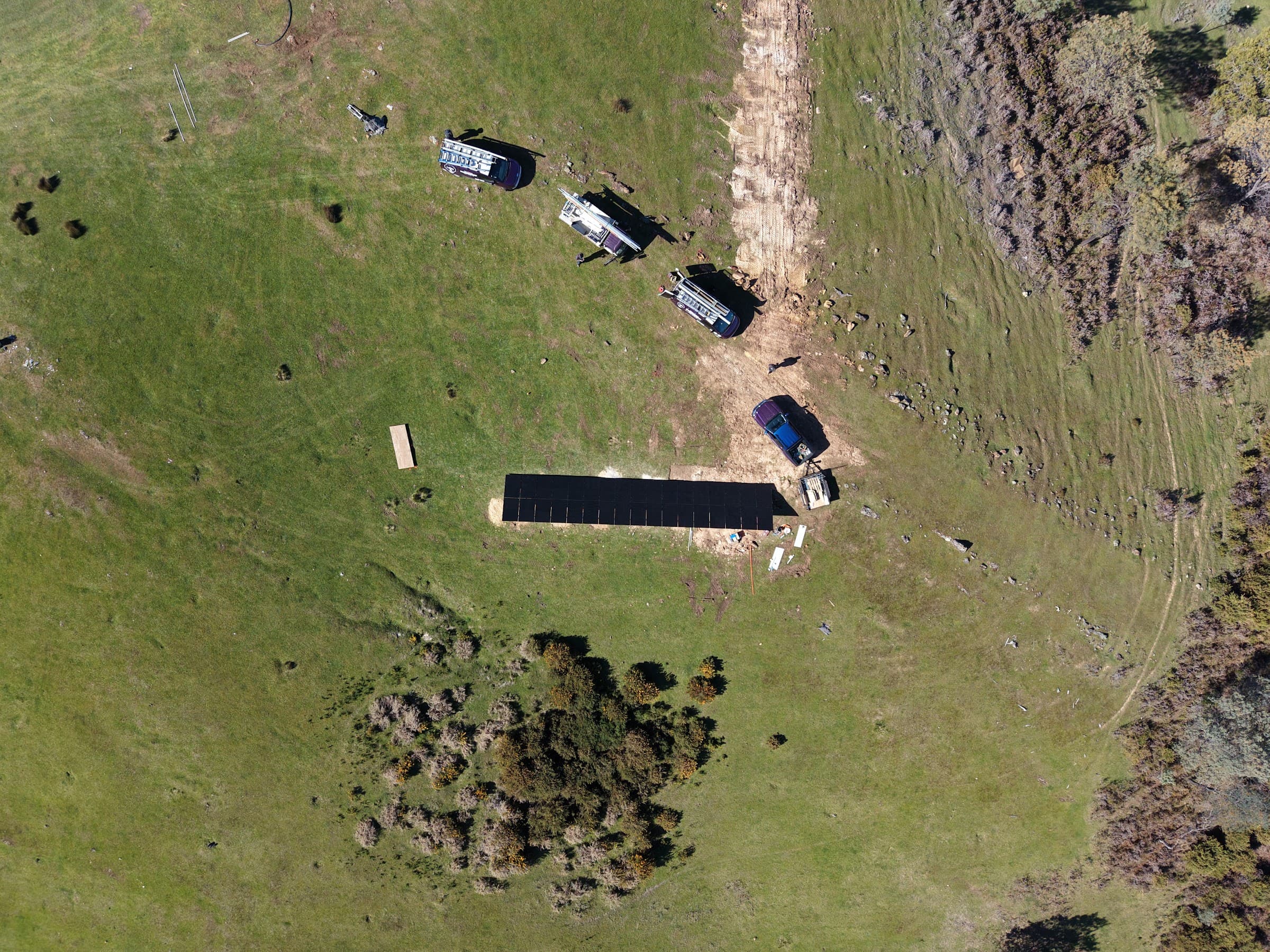
We would usually go to 2 to 3 kW rather than stop at 1.6, because a string of cloudy days is what actually empties a battery. Panels are the cheapest part of the system per kWh of winter energy, so a bigger array usually costs far less than a bigger battery or more generator hours. Tilt matters too: a steep tilt of around 50 to 60 degrees favours the low winter sun, which is one reason ground mounts suit off grid so well.
If you want to run your own numbers, our off grid sizing tool does this calculation for your location with no login.
How big a battery does a small off grid cabin need?
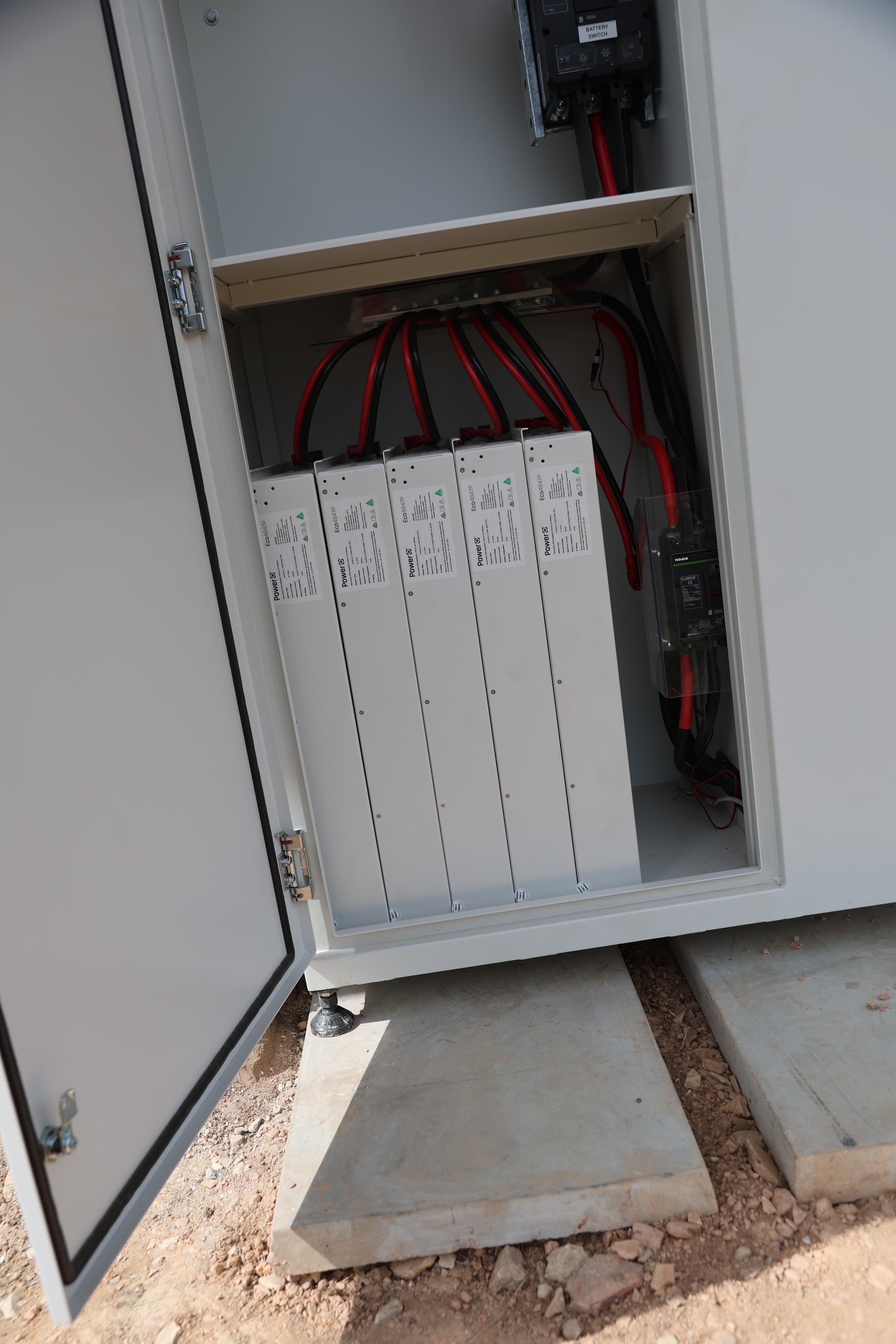
Plan for about two days of your daily use as usable storage, so a cabin using 2.5 kWh a day wants roughly 5 kWh usable. In practice that means a 5 to 10 kWh lithium battery, depending on how much reserve you want and how often you are willing to start a generator.
A bigger battery rarely fixes a winter shortfall: if the panels cannot refill it, it just takes longer to empty. Our off grid FAQ covers more on storage and backup.
Portable kit or a fixed system?
A portable power station with folding panels is fine for weekends and camping, but it is not a home power system. A fixed system, wired into the building with a proper inverter charger, is what you want if anyone will live there or leave a fridge running all winter.
Portable units typically store 1 to 2 kWh and come with a few hundred watts of panels. On a sunny weekend that runs lights, phones and a 12 V fridge. In a week of June cloud it will not keep up, and you cannot safely plug a portable unit into a building's fixed wiring without the right changeover gear installed by an electrician.
Voltage matters as the system grows. A 12 V system suits a caravan or a very small hut, and chargers such as the Victron SmartSolar MPPT 100/30 work at 12 or 24 V with up to 30 A of charge current. But a 2,000 W load at 12 V draws roughly 170 A before inverter losses, which needs very heavy cable and careful fusing. At 48 V the same load draws about 42 A. That is why for a lived in cabin we design at 48 V with a Victron inverter charger such as a MultiPlus-II, a SmartSolar charge controller and GX monitoring so we can see the system from Trentham.
What should you spend on first?
Spend first on cutting the load, then on a good inverter charger and battery, then on panels, and plan the backup from day one.
- The load: an efficient fridge, LED lighting, and heating and hot water that do not lean on the battery. A wood heater, or gas for cooking and hot water, takes the biggest winter loads off the system.
- Inverter charger and battery: these do the hard work every hour of every day. A cheap inverter with a high idle draw or a battery without a reliable management system costs you every night.
- Panels and mounting: cheap to add, so do not skimp on array size or a mount that gets the tilt right.
- Backup: a small generator, ideally auto start, covers the grey weeks. See our guide to off grid generators.
What compliance applies if the cabin is a permanent dwelling?
If the cabin or tiny house has 230 V fixed wiring, the electrical work must be done by a licensed electrician, who must issue a Certificate of Electrical Safety when the work is finished. Whether the building itself needs a planning or building permit is a question for your council and building surveyor, so ask before you build.
On the electrical side, a few rules apply in Victoria:
- Licensed work and inspection: under the Electricity Safety (General) Regulations 2019, the electrician must engage a Licensed Electrical Inspector to inspect a solar installation within eight business days, and the inspector then has four business days to lodge the certificate with Energy Safe Victoria. Solar Victoria explains this on its update on electrical safety certificates. Energy Safe Victoria says the registered electrical contractor arranges that inspection, not you.
- Standards: stand alone power systems are covered by AS/NZS 4509.1, which sets safety and installation requirements for systems supplying a single home or building, or a group of them. In Victoria, battery systems as defined in AS/NZS 5139 must be installed to comply with that standard, as Energy Safe Victoria's guide to the regulations sets out.
- Accreditation: solar installer accreditation moved from the Clean Energy Council to Solar Accreditation Australia on 29 May 2024. Before you take a quote, ask for the installer's Solar Accreditation Australia number and check it is current; the Australian Government's installer guide explains how.
What can an owner safely check?
You can safely read the monitoring app, watch the battery state of charge, look at the panels from the ground for shading or dirt, and check that the battery area is clear, dry and ventilated. Anything behind a cover, inside the switchboard or battery enclosure, or on the DC cabling needs a licensed electrician. A 48 V lithium battery can deliver enormous current into a short circuit, and generator fuel should be stored away from the battery and inverter.
Mick McDonald
Technical Director, Trentham Energy
Questions about your own system? Call 1300 3458 00 or send us a message.
Sources
- Update on electrical safety certificates post installation, Solar Victoria
- Community support, Energy Safe Victoria
- Electricity safety general regulations, Energy Safe Victoria
- AS/NZS 4509.1:2009 (R2016) Stand-alone power systems, Part 1: Safety and installation, Building CodeHub
- Choose your solar retailer and installer, energy.gov.au
- SmartSolar MPPT 100/30 and 100/50, Victron Energy